Hair moisture balance depends on the optimal ratio of water and protein within the hair shaft to maintain elasticity and strength.
The stretch test helps identify whether hair is overloaded with protein or moisture, guiding tailored treatments for balanced curls.
If you’ve ever piled on conditioner to fix dry, frizzy curls and ended up with limp, lifeless strands, you’ve experienced what happens when hair moisture balance explained as a concept gets ignored in practice. Most people with curly or wavy hair focus entirely on adding more moisture when the real issue is often the relationship between protein and water inside the hair shaft. Getting that relationship right is what separates defined, bouncy curls from hair that constantly fights you. This guide breaks down the science, the symptoms, and the exact steps to fix it.
Table of Contents
Key Takeaways
| Point | Details |
|---|---|
| Protein and moisture work together | Hair needs both keratin strength and water flexibility. Too much of one without the other causes damage. |
| The stretch test tells you everything | Testing a wet strand tells you whether your hair needs protein, moisture, or is already balanced. |
| Curly hair needs sealing, not just hydrating | Adding water without sealing it in with oil or cream leads to rapid moisture loss and frizz. |
| Mineral buildup fakes protein overload | Hard water deposits can mimic protein overload symptoms. Always clarify before diagnosing your hair. |
| Routines must shift with the seasons | Climate, humidity, and heat styling change what your hair needs every few weeks. |
Hair moisture balance explained: what’s actually happening
Your hair is made of keratin, a protein that forms the structural core of each strand. Water works alongside that protein to keep the fiber flexible and resilient. Healthy hair holds 10 to 13% water by weight, roughly one part water for every seven to eight parts protein. When that ratio shifts, the problems start.
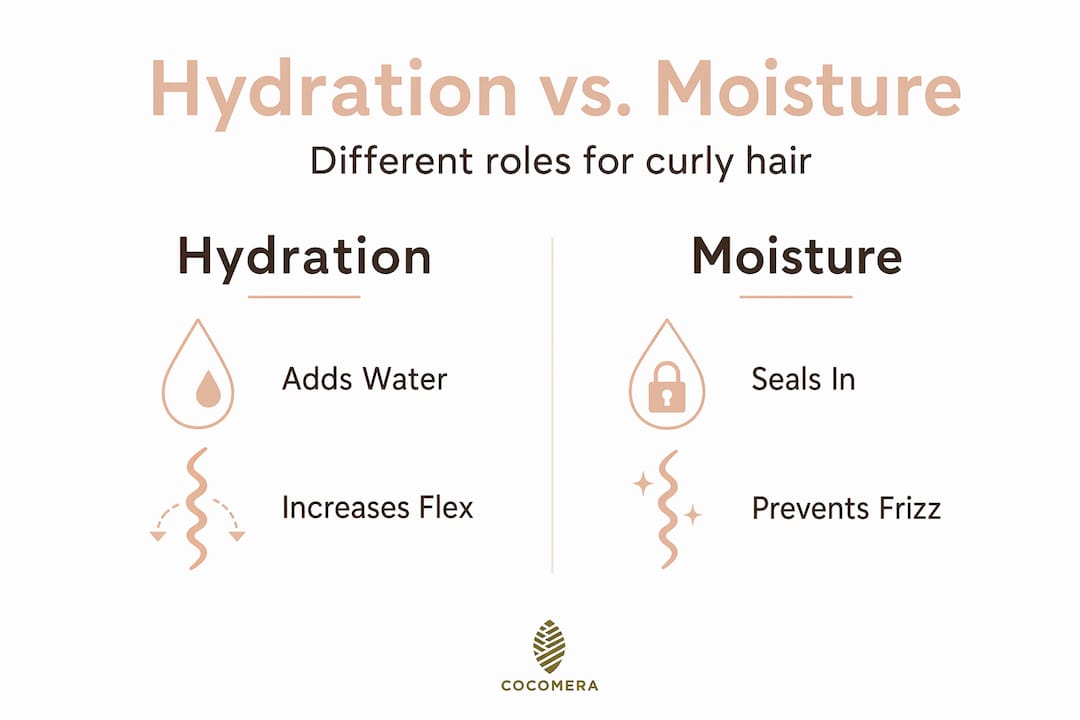
Here’s the part most people miss: there’s a difference between hydrating hair and moisturizing it. Hydration adds water into the cortex, the innermost layer of the strand. Moisturizing seals the cuticle to stop that water from escaping. You need both. Skipping the sealant step after a deep conditioning treatment is like filling a leaky bucket without patching the hole.
Protein bonds play an equally specific role. They reinforce keratin chains internally, improving tensile strength and curl definition. But protein without adequate hydration creates rigidity. The strand becomes stiff, snaps under tension, and loses its ability to stretch and recover.
When the balance tips toward too much protein, the hair hardens and resists moisture no matter how much conditioner you apply. When it tips toward too much moisture and not enough protein, the hair becomes overly soft, stretches like taffy, and loses its shape. Neither extreme gives you the curls you want.
Pro Tip: Think of your hair like a rubber band. A healthy rubber band stretches and snaps back. A dry, overworked one breaks. A waterlogged one just goes limp. Your goal is always that elastic, snappy middle ground.
Here’s what the two imbalance states look like side by side:
-
Protein overload: Hair feels hard, straw-like, or crunchy even after conditioning. Curls lose definition and strands snap when pulled gently.
-
Moisture overload: Hair feels mushy or overly soft when wet. Curls look limp and undefined. The strand stretches a long way before breaking.
-
Balanced hair: Soft when dry, resilient when wet, with visible curl shape and no excessive breakage.
Signs your curls are out of balance
Curly hair’s spiral structure makes it harder for natural oils to travel from the scalp down the length of the strand. That makes curly and wavy hair naturally prone to moisture loss, higher porosity, and faster imbalance. You’re not doing anything wrong. The structure itself creates the challenge.
Knowing which imbalance you’re dealing with matters because the fixes are completely opposite. Treating moisture overload with more conditioner makes things worse. Treating protein overload with a protein mask is equally damaging.
Signs of protein overload:
-
Curls feel hard or crunchy even after moisturizing
-
Strands snap quickly when you pull them
-
Hair looks dull and feels rough to the touch
-
Overuse of protein-enriched products has been the only recent change in your routine
-
Deep conditioning doesn’t seem to help
Signs of moisture overload:
-
Curls have no shape or definition even with styling products
-
Hair feels spongy or mushy when wet
-
Strands stretch far without any bounce back
-
You’ve been heavy on leave-ins and oils without any protein in weeks
One tricky point: mineral buildup from hard water mimics protein overload almost perfectly. Calcium and magnesium deposits coat the strand, block moisture from penetrating, and lift the cuticle. Before you cut out all protein products, use a chelating shampoo to strip those minerals. You might find the problem wasn’t protein at all.
Seasonal changes and heat styling also shift the balance. High humidity in summer causes the cuticle to swell and frizz to spike. Regular heat use depletes moisture reserves over time. Your hair’s needs in January are genuinely different from its needs in July.
How to do the stretch test
The stretch test is the fastest, most reliable way to figure out where your hair stands. Here’s how to do it correctly:
-
Wash your hair and leave it soaking wet. Do not add any products yet.
-
Take a single strand from your head. Try to get one that shed naturally rather than pulling hard from the root.
-
Hold each end between your thumb and forefinger. Leave about two inches of strand exposed between your fingers.
-
Pull gently and watch what happens.
Reading your results:
-
The strand snaps immediately with little stretch: your hair is protein overloaded or severely dry. It needs deep hydration and a break from protein products.
-
The strand stretches a long way and does not spring back: your hair has moisture overload. It needs protein to restore structure.
-
The strand stretches slightly and bounces back: your hair is balanced. Keep doing what you’re doing.
Pro Tip: Test three or four strands from different parts of your head. The crown and ends often have different needs, especially if you color or heat style.
A common mistake is testing already-styled hair or hair with product buildup on it. Always test on freshly washed, completely product-free hair. The test reads the condition of the hair itself, not the products coating it. Also, wet hair is 25 to 70% weaker than dry hair, so be genuinely gentle when pulling. A strand that breaks under rough handling doesn’t give you accurate data.
Restoring and maintaining balance
Once you know what your hair needs, fixing it is straightforward. The key is being patient. Overcorrecting by adding a ton of protein or conditioning every day back to back can swing the pendulum in the wrong direction just as fast.
If you have protein overload:
-
Stop all protein-containing products immediately for at least two weeks
-
Do a clarifying wash to reset the cuticle
-
Use a hydrating mask weekly with no protein in the ingredients list
-
Look for products containing aloe vera, glycerin, hyaluronic acid, or panthenol
-
Avoid ingredients like hydrolyzed protein, keratin, silk amino acids, or wheat protein until your hair feels soft again
If you have moisture overload:
-
Reduce your conditioning frequency and skip the heavy leave-ins for a week
-
Introduce a light protein treatment, such as a rice water rinse or a product with hydrolyzed protein
-
Avoid layering multiple heavy creams or butters
-
Give your hair time to respond before adding more protein
Once you’re balanced, layering your products in LOC or LCO order keeps moisture locked in without buildup. LOC means Liquid (water or leave-in), then Oil, then Cream. LCO flips the oil and cream. Fine or low porosity curls usually respond better to LCO because the oil seals better as the last step. High porosity curls tend to prefer LOC.
Here’s a quick reference for choosing your method:
| Hair type | Recommended method | Why it works |
|---|---|---|
| Fine or low porosity | LCO | Cream over oil prevents greasiness and weighing curls down |
| Medium or normal porosity | Either works | Experiment to find what gives better definition |
| High porosity or coily | LOC | Oil between liquid and cream improves moisture retention |
| Coarse or dry curls | LOC with heavier cream | Thicker sealants close the cuticle more effectively |
Check your best hair moisturizers options to find products that fit each layer of this method without overloading your hair.
Heat is one of the most overlooked disruptors. Hair exposed to heat above 140°C suffers damage that cannot be undone. Blow drying at around 60°C with a diffuser protects the moisture content. Always use a heat protectant before any direct heat, and avoid styling wet hair with irons or wands.
Environmental factors that shift your balance
Your indoor and outdoor environment is constantly working on your hair, even when you’re doing nothing. Understanding what’s happening makes it much easier to respond before the damage piles up.
Moisture balance is dynamic and needs to be reassessed every few weeks based on climate, water quality, and styling habits. Trichologists are clear on this point: there is no single routine that works year-round for every head of curls.
Summer brings humidity, UV exposure, sweat, and salt water. All of them lift the cuticle and pull moisture out. In high humidity, porous curls absorb moisture from the air unevenly, which causes swelling and frizz rather than hydration. The fix is sealing well before you go out. Stylist Ricky Walters recommends lightweight protective sealants over heavy oils in humid conditions specifically because heavy products accelerate buildup without adding control.
Practical adjustments for each season and environment:
-
Summer: Use lightweight gels or serums to seal. Clarify more often to prevent sweat and product buildup. Protect from UV with a leave-in that contains UV filters.
-
Winter: The air is drier, so increase your deep conditioning frequency. Add an extra oil step to your routine and reduce wash frequency slightly.
-
Hard water areas: Use a chelating shampoo monthly to strip mineral buildup before it affects your diagnosis.
-
High heat styling periods: Reduce protein use slightly and increase hydration to compensate for the moisture heat pulls out.
“Curly hair doesn’t fail you. It responds to its environment. When you understand those responses, you stop fighting your hair and start working with it.”
Scalp health also ties into this more than most people realize. A buildup-covered scalp restricts healthy hair growth and throws off how well products absorb along the length of the strand. Gentle, low-sulfate cleansing every one to two weeks prevents this without stripping moisture. You can find deeper guidance on the curly hair care tips page for building a scalp-to-tip routine.
My honest take on the moisture obsession
I’ve noticed a consistent pattern: most people with curly hair arrive at moisture discussions already convinced that more is always better. The curly hair community has done an incredible job raising awareness about hydration, but it’s created a blind spot. Moisture obsession leads to moisture overload, and I’ve seen it ruin routines that were otherwise solid.
What I’ve learned is that protein gets unfairly villainized. Someone uses a protein treatment once, their hair feels hard the next day, and they swear off protein forever. But what actually happened is they used too much, too soon, on hair that wasn’t clean enough to absorb it properly. That’s not a protein problem. That’s a sequencing problem.
My honest advice: do the stretch test before you buy anything. Know what your hair actually needs before you spend money on products. Most imbalance issues I’ve seen traced back to following a generic routine rather than reading the hair’s real signals. Seasonal adjustments are not optional. Your January routine will likely dry your hair out in August.
Patience is the part nobody talks about. It takes two to three weeks of consistent correction before you can accurately assess whether something is working. Give your hair time to respond before you change course again.
— Cocomera
Find the right products to balance your curls
Getting your moisture balance right depends a lot on having the right products for each step. At Cocomera, every product in the catalog has been selected specifically for wavy, curly, coily, and afro hair types. That means nothing generic and nothing that works for straight hair but clogs your curls.

Whether you need a protein-free deep conditioning mask to recover from overload, a curl styling product that seals your LOC method without buildup, or a lightweight hair oil to lock in moisture after wash day, Cocomera has options curated for your specific curl type. You can also browse the best ingredients guide to know exactly what to look for on the label before you buy.
FAQ
What is hair moisture balance?
Hair moisture balance is the ratio between water content and protein in your hair strand. Healthy hair holds roughly 10 to 13% water by weight, and disrupting that ratio causes brittleness, limpness, or frizz.
How do I know if my hair needs protein or moisture?
Do the stretch test on a clean, wet strand. If it snaps with little stretch, it needs moisture. If it stretches without bouncing back, it needs protein. If it stretches slightly and returns to shape, it’s balanced.
Why does my hair feel dry even after deep conditioning?
Mineral buildup from hard water or protein overload can block moisture from penetrating the strand. Clarify with a chelating shampoo first, then deep condition. If the dryness persists, check whether your conditioner contains protein.
How often should I reassess my hair’s moisture balance?
Every two to four weeks is a good baseline, especially when seasons change, your water source changes, or your styling habits shift. Moisture balance is not static and needs regular adjustment.
What does the LOC method do for curly hair?
The LOC method layers a liquid, then oil, then cream to seal water inside the hair shaft after washing. This approach significantly improves moisture retention for curly hair types, especially high porosity strands.