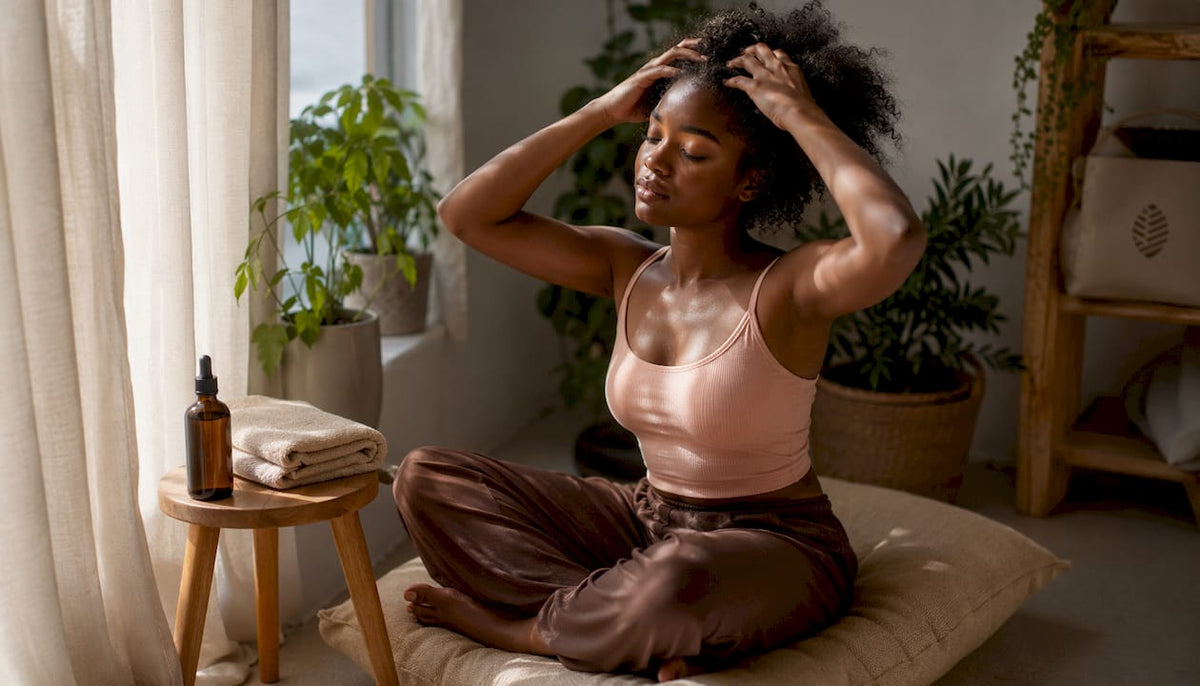
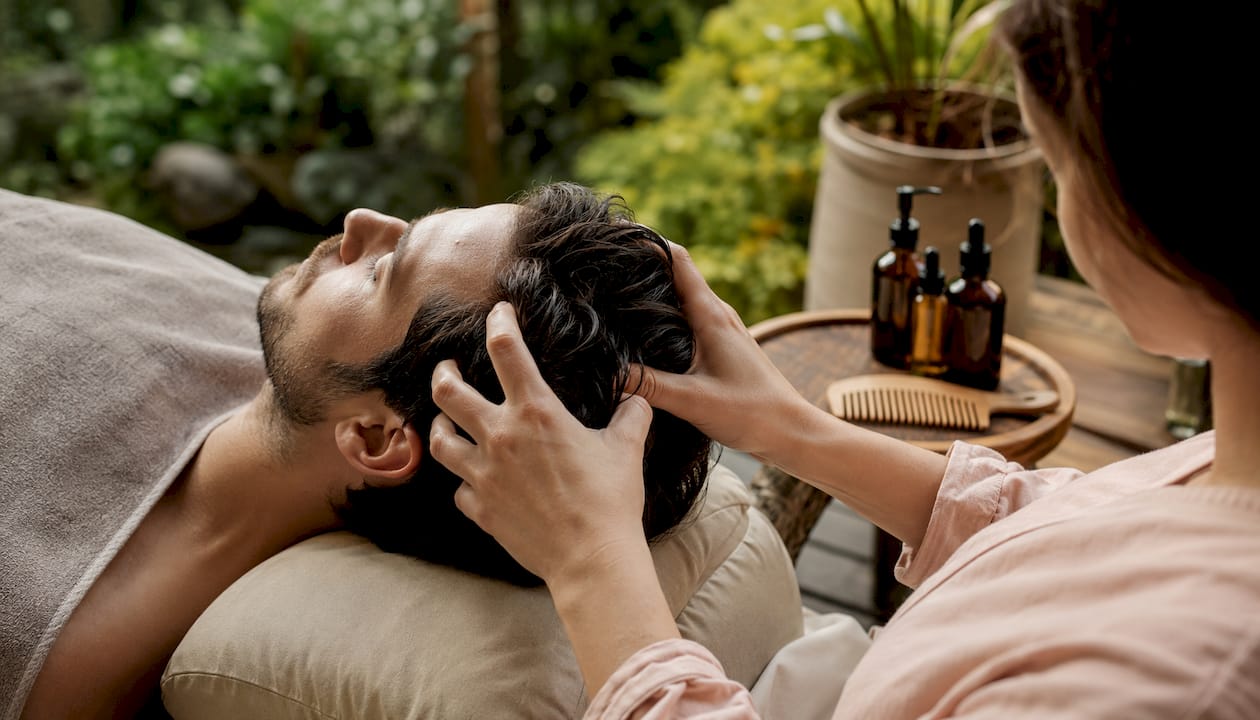
A 4–10 minute daily scalp massage using firm, deliberate pressure across defined scalp zones can support hair growth and improve scalp health. The key word is deliberate: light stroking feels nice but likely won’t move the needle on growth. You need pressure that actually shifts scalp tissue over the skull, triggering a process called mechanotransduction, where mechanical stress signals dermal papilla cells to favor the anagen (growth) phase.
A 2016 clinical study measured a meaningful increase in hair thickness after just 4 minutes of standardized daily massage over 24 weeks, with hair thickness rising from 0.085 mm to 0.092 mm alongside upregulation of growth-related genes including NOGGIN, BMP4, and SMAD4. That’s the science behind the routine below.
Start here — your minimum effective routine:
- Prep (30 seconds): Sit upright, warm a few drops of oil in your palms if using one, and position fingertips (not nails) flat against your scalp.
- Front to crown (90 seconds): Press and slowly drag scalp tissue backward from the hairline to the crown using firm circles.
- Temples and sides (60 seconds): Anchor thumbs behind ears, use fingertips to press and release in small circles moving upward.
- Nape and occiput (60 seconds): Cup the base of your skull, press upward, and hold for 3–5 seconds before releasing.
- Finish (30 seconds): Light effleurage strokes from front to nape to close.
Total: 4 minutes. Do this daily. Expect scalp changes (reduced tightness, less shedding) within weeks; measurable thickness improvements take at least 24 weeks of consistency.
Table of Contents
- What are the scalp massage steps for growth, exactly?
- Dry, in-shower, and professional-style variations
- Which oils and serums actually help with scalp massage?
- Tools that make scalp massage easier (and safer)
- How long and how often should you massage for real results?
- Pressure guidance and the mistakes that cost you results
- What does the evidence actually say about scalp massage and hair growth?
- When should you stop massaging and see a dermatologist?
- A 3-step daily plan for busy people
- What should you realistically expect from scalp massage?
- Key Takeaways
- Why this routine works especially well for textured hair
- Pair your routine with the right products from Cocomera
- Useful sources and further reading
What are the scalp massage steps for growth, exactly?
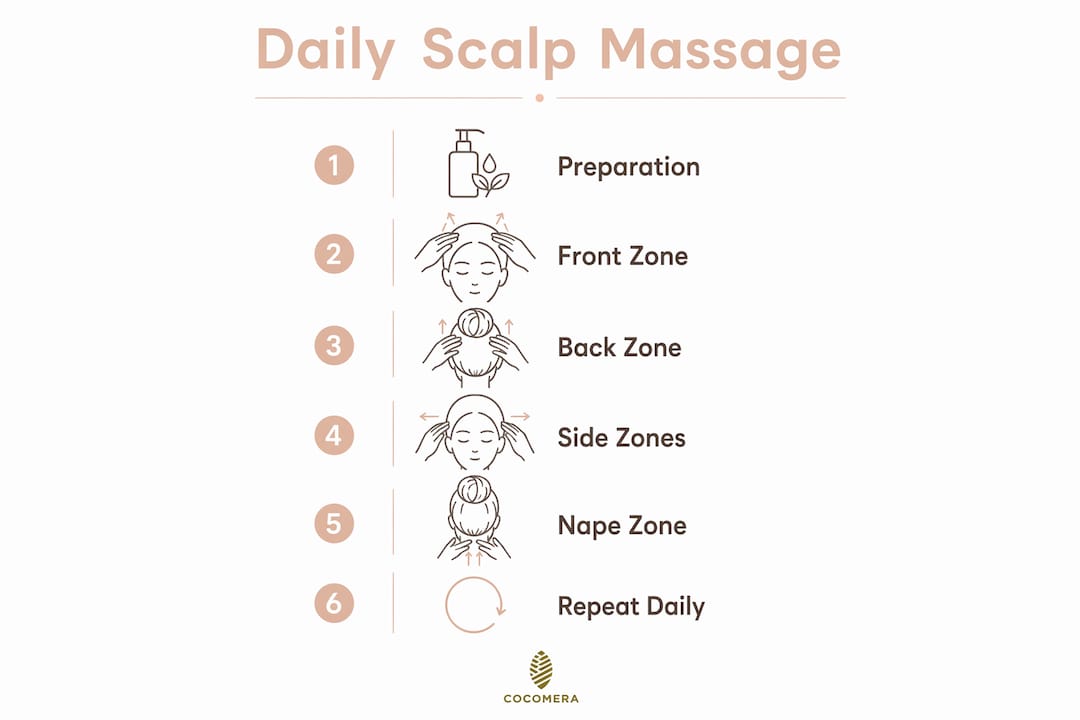
A reproducible routine means knowing exactly which zone you’re working, in what order, and for how long. Random rubbing misses tension points at the temples and nape that restrict overall scalp mobility. A zone-based approach covering front, crown, sides, and nape ensures full coverage and addresses the areas most likely to be tight.
Preparation
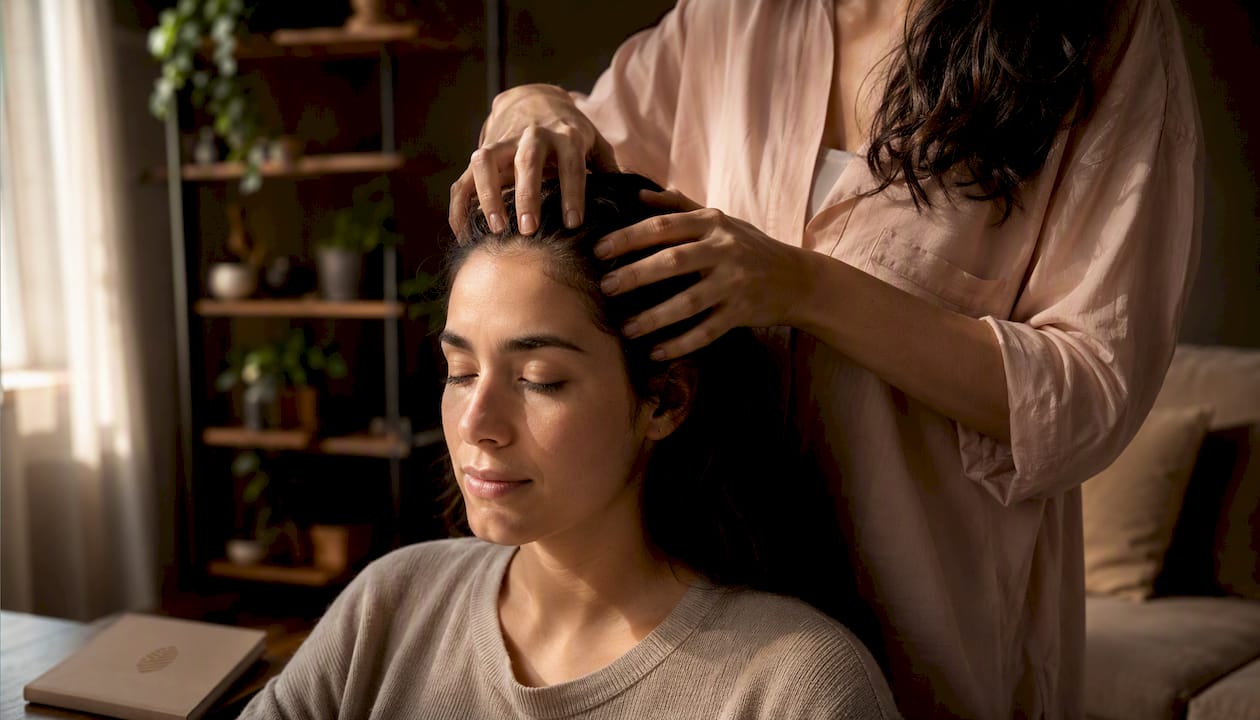
Sit with your back straight so your neck isn’t strained. Your scalp can be dry or slightly damp — avoid massaging soaking-wet hair aggressively, since wet strands are more fragile. If you’re using oil, warm it between your palms first. Place all ten fingertips flat on your scalp; your nails should never touch skin.
The three core moves
Every effective technique comes down to three actions:
- Presses: Place fingertips firmly on the scalp and hold for 3–5 seconds without sliding. This compresses tissue and begins the mechanical signal.
- Pinches: Grasp a small section of scalp between thumb and fingers, lift slightly, and release. Pinching moves tissue away from the skull, which is exactly the stretching motion that influences dermal papilla cells.
- Skin stretches: With fingertips anchored, push scalp tissue in one direction (forward, backward, or sideways) without sliding fingers across the surface. You should feel the skin move, not just your fingers gliding over hair.
Pro Tip: Here’s how to tell if you’re actually moving scalp tissue versus just rubbing hair: place a fingertip on your scalp and push sideways. If you see the skin dimple and shift, you’re doing it right. If your finger slides across the hair shaft without moving the skin underneath, add more pressure and slow down.
Zone sequence and timing
Work front to back, then sides, then nape. This order follows natural lymphatic drainage and ensures you don’t skip any zone.
| Zone | Short routine (4 min) | Extended routine (15–25 min) |
|---|---|---|
| Front / hairline | 45 sec | 3–4 min |
| Crown / top | 60 sec | 5–6 min |
| Temples / sides | 60 sec | 4–5 min |
| Nape / occiput | 45 sec | 3–4 min |
| Closing strokes | 30 sec | 1–2 min |
Numbered step sequence
- Hairline press (0:00–0:45): Start at the front hairline. Press fingertips firmly, hold 3 seconds, release, shift back half an inch, repeat.
- Crown spirals (0:45–1:45): Move to the crown. Use all ten fingers in slow outward spirals, applying firm pressure. Work from center outward.
- Temple glides (1:45–2:45): Anchor thumbs just above the ears. Press fingertips into the temple area and make deliberate upward circles.
- Side sweeps (2:45–3:15): Sweep from the sides toward the crown using skin-stretch technique, pressing firmly.
- Nape release (3:15–4:00): Cup the base of the skull with both hands. Press upward and slightly forward, hold 5 seconds, release slowly. Repeat 3–4 times.
Dry, in-shower, and professional-style variations
Not every session looks the same, and it shouldn’t. The best variation depends on whether you’re on a wash day, applying a serum, or just fitting in a quick daily session.
Dry massage (daily maintenance):
- Best for your everyday 4-minute routine.
- No product needed; works on any hair type.
- For textured hair (types 2–4), keep fingers spread wide to avoid tangling coils or curls.
- Use the press-and-hold technique rather than circular rubbing to minimize friction on dry strands.
Pre-wash massage:
- Apply a light oil to the scalp before shampooing to loosen buildup and dead skin cells.
- Massaging before shampooing helps dislodge buildup for better cleansing, making your wash day routine more effective.
- This is the right time for deeper pinching and stretching since the oil reduces friction.
- Follow with a strengthening shampoo to clear residue without stripping.
Post-serum massage:
- Apply your growth serum or treatment first, then massage immediately after.
- Massaging after serum application increases local circulation and drives actives deeper into the scalp.
- Use lighter pressure here — you want absorption, not aggressive movement.
- Ideal for anyone using a topical treatment alongside their massage habit.
Professional-style moves to add once you’re comfortable:
- Anchor-thumb technique: Thumbs planted at the occiput, fingers fanned across the crown. Press thumbs upward while fingers press down — creates opposing tension that stretches the full scalp.
- Crown spirals: Start at the center of the crown with all fingertips touching, then spiral outward with firm pressure. A trichologist-recommended sequence suggests spending 2–3 minutes here.
- Occipital release: Both hands cupped at the base of the skull, pressing upward in a sustained hold. This addresses one of the most commonly skipped tension zones.
If you wear extensions, adapt your technique to access the scalp directly without disturbing the attachment points. Caring for natural hair under extensions requires lighter pressure and more targeted zone work to avoid loosening bonds.
Which oils and serums actually help with scalp massage?
Oil choice matters more than most guides admit, especially for textured hair. The wrong oil can clog follicles, weigh down curls, or require three shampoo passes to remove.
Carrier oils by hair texture:
- Fine or wavy hair (types 2A–2C): Lighter oils like jojoba, grapeseed, or argan absorb quickly and won’t leave residue. Use just 3–5 drops.
- Curly to coily hair (types 3A–4C): Thicker oils like castor, avocado, or sweet almond provide slip and moisture. These work best as a pre-wash treatment rather than a leave-in.
Essential oils with evidence for scalp benefits:
Peppermint, rosemary, and lavender are the three most commonly cited for circulation and follicle support. None should be applied undiluted. A safe starting dilution is 2–3 drops of essential oil per tablespoon of carrier oil. Rosemary oil in particular has attracted attention for its potential to support hair density, though it works best as a consistent adjunct rather than a standalone fix.
Timing guidance:
- Massage after applying a serum or treatment to push actives deeper via increased blood flow.
- Massage before shampooing when your goal is exfoliation and scalp cleansing.
Dos and don’ts:
- Do warm oil between your palms before applying — cold oil on the scalp can cause discomfort and reduces absorption.
- Do use a scalp-specific treatment formulated for your hair type.
- Don’t apply oil directly to the scalp in large amounts if you’re prone to buildup; a few drops go a long way.
- Don’t use nails at any point, even when applying oil.
- Don’t skip rinsing thoroughly on wash day — residual oil on textured hair can attract lint and cause scalp irritation over time.
For more on pairing treatments with your routine, the herbs for hair growth guide covers botanical options that complement massage well.
Tools that make scalp massage easier (and safer)
Your hands are the most precise tool you have. But they’re not always the most practical one, especially for people with arthritis, hand fatigue, or difficulty reaching the back of the scalp.
Manual silicone brushes:
- Provide consistent pressure across a wider surface area.
- Good for exfoliation during pre-wash massage.
- Safe for most textured hair when used with a pre-wash oil; the silicone bristles glide without catching on coils.
- Avoid aggressive scrubbing — slow, deliberate circles only.
Handheld electric massagers:
- Useful for replicating the consistent pressure used in clinical protocols; the Koyama study used a standardized device to control pressure across sessions.
- Best for people who struggle to maintain firm, even pressure manually.
- Keep the device moving — holding it stationary in one spot for too long can cause irritation.
When hands are better:
- Precision work around the hairline and temples.
- Any time you need tactile feedback to gauge pressure on a sensitive or tender area.
- For textured hair, fingers are less likely to cause tangling than a brush with closely spaced tines.
Safety notes for tools:
- Clean silicone brushes after every use; bacteria accumulate quickly on scalp tools.
- Never use a brush on an irritated, flaking, or broken scalp.
- For type 4 hair especially, section hair before using any tool to prevent mechanical tangling.
How long and how often should you massage for real results?
The honest answer: daily short sessions beat occasional long ones, every time. Consistency drives better adherence and likely better outcomes than sporadic long sessions. Four minutes a day is the clinically studied minimum; you can build from there.
The minimum effective dose is 4 minutes daily. The Koyama study used exactly this protocol for 24 weeks and recorded measurable increases in hair thickness. Survey data also suggests that participants who reported stronger improvements were those spending longer daily sessions over several months — but 4 minutes is where you start, not where you stop.
A realistic progression plan:
- Weeks 1–4: Stick to 4 minutes daily. Focus on learning the zone sequence and correct pressure. Your scalp may feel tender initially as circulation increases.
- Months 1–3: You may notice reduced shedding and a less tight, more mobile scalp. These are early positive signs.
- Months 3–6: This is when measurable thickness changes become possible. Don’t judge the routine before the 24-week mark.
- After 6 months: If you want to intensify, build toward 10–20 minutes by adding time to each zone rather than rushing through more zones.
The habit itself is the variable most people underestimate. Pick a fixed time — morning shower, evening wind-down — and attach the massage to something you already do.
Pressure guidance and the mistakes that cost you results
Most people either press too lightly (relaxation, not growth) or use their nails (damage, not stimulation). Neither extreme works.
Pressure scale:
- Light pressure: Feels pleasant, improves surface circulation, good for stress relief. Won’t trigger the deeper mechanotransduction response linked to gene-level changes.
- Moderate/therapeutic pressure: Firm enough that you feel the scalp tissue moving under your fingers. This is the target zone for growth-focused massage.
- Too firm: Causes pain, micro-tears, or post-massage soreness. Back off immediately if you feel sharp discomfort.
A practical cue: press until you feel slight resistance from the scalp, then add just a little more. If your fingertips go white at the tips, you’re pressing too hard.
Common mistakes:
- Using nails: Causes micro-abrasions that open the door to infection. Flat fingertip pads only.
- Rubbing hair instead of moving scalp: The most common error. Your fingers should feel the scalp shift, not slide across the hair.
- Aggressive massage on a wet, fragile scalp: Wet hair stretches more easily and breaks. Keep pressure lighter on wash day, especially on textured hair.
- Skipping the nape and occiput: This area holds significant tension and is consistently overlooked. Missing it means incomplete coverage.
- Massaging over active inflammation or open sores: Stop immediately and let the scalp heal before resuming.
If your scalp is itchy or flaky, that translates to inflammation, which turns off hair growth. Addressing scalp health — through gentle cleansing and appropriate products — is a prerequisite, not an afterthought.
What does the evidence actually say about scalp massage and hair growth?
The mechanism is mechanotransduction: when you apply firm, stretching pressure to the scalp, that mechanical force travels through the skin layers to the dermal papilla cells sitting at the base of each hair follicle. Those cells respond by altering gene expression in ways that favor the anagen (active growth) phase.
The Koyama clinical study is the most cited evidence. Nine healthy men received 4 minutes of standardized daily scalp massage for 24 weeks. Hair thickness increased from 0.085 mm to 0.092 mm, and gene expression analysis showed upregulation of NOGGIN, BMP4, SMAD4, and IL6ST alongside a decrease in the hair-loss-associated gene IL6.
| Study / Source | Protocol | Key Finding |
|---|---|---|
| Koyama et al. (PMC4740347) | 4 min/day, 24 weeks | Hair thickness: 0.085 mm → 0.092 mm; growth-gene upregulation |
| PMC stress study (PMC5088109) | 15–25 min, 2x/week, 10 weeks | Significant reductions in cortisol, norepinephrine, and blood pressure |
| InStyle survey data | 11–20 min/day, 5+ months | Stronger self-reported improvements with longer daily sessions |
Scalp massage is a supportive therapy, not a cure. For androgenetic alopecia specifically, dermatologists recommend combining massage with proven medical treatments like minoxidil rather than using massage as a standalone intervention. Massage can complement a medical protocol; it is unlikely to replace one.
The stress-reduction data is also worth noting. A 10-week study found that 15-minute and 25-minute scalp massage sessions twice weekly produced significant reductions in cortisol and blood pressure in female office workers. Since chronic stress is itself a driver of hair shedding, the indirect benefit of regular massage may be as meaningful as the direct mechanical one.
When should you stop massaging and see a dermatologist?
Scalp massage is safe for most people, but there are clear situations where it can make things worse.
Stop massaging and consult a clinician if you notice:
- Open sores, infected lesions, or pustules anywhere on the scalp.
- Sudden patchy hair loss (could indicate alopecia areata, which requires medical evaluation).
- Pain when you press on specific areas of the scalp.
- Severe redness, swelling, or warmth that persists after massage.
- Rapid or dramatic shedding that doesn’t slow after 4–6 weeks of consistent, gentle massage.
Contraindications:
- Active scalp infections (fungal, bacterial, or viral) — massage spreads pathogens.
- Recent scalp surgery or procedures — wait for full clearance from your provider.
- Inflammatory scalp conditions like severe seborrheic dermatitis or psoriasis — massage without medical guidance can worsen inflammation.
When to seek a dermatologist regardless:
Persistent shedding despite a consistent routine, any signs of scarring alopecia (smooth, shiny patches with no follicular openings), or symptoms that feel systemic (fatigue, weight changes alongside hair loss) all warrant professional evaluation. Harvard Health notes that the key to treating thinning hair is starting intervention early — once follicles stop functioning, options narrow significantly.
A 3-step daily plan for busy people
No time for a full routine? This stripped-down version covers the essentials in about 4 minutes and still follows the evidence-based protocol.
- Prep (30 seconds): Sit upright. Warm a few drops of oil or serum in your palms if using one. Place all ten fingertips flat on your scalp at the hairline.
- Zone passes (3 minutes): Move from front to crown (60 sec), then temples and sides (60 sec), then nape (60 sec). Use firm press-and-hold moves in each zone, not sliding circles. Feel the scalp shift under your fingers.
- Close (30 seconds): Light effleurage strokes from front to nape, then nape to crown. This signals the end of the session and helps with lymphatic drainage.
That’s it. Four minutes, every day, same time. Once this feels automatic — usually after 3–4 weeks — add time to the zone passes rather than adding new steps. The goal is a habit that sticks, not a perfect technique that gets skipped.
Who should use this plan: Anyone starting out, anyone with a packed schedule, and anyone with textured hair who wants to minimize manipulation time. Upgrade to the full 10–20 minute routine once the 4-minute version is genuinely automatic.
What should you realistically expect from scalp massage?
Honest answer: modest, gradual improvements over months, not weeks. Reduced shedding tends to show up first, often within the first 4–8 weeks of daily practice. Measurable thickness changes take at least 24 weeks.
Best practice summary:
- Start with 4 minutes daily and stay consistent for at least 24 weeks before drawing conclusions.
- Combine massage with a scalp-healthy routine: regular cleansing, gentle detangling, and minimal heat.
- If you have diagnosed hair loss (androgenetic alopecia, telogen effluvium), treat massage as a complement to medical care, not a replacement.
- Pick a daily time and attach it to an existing habit — morning routine, pre-bed wind-down, or wash day prep.
Suggested next steps:
- Choose your starting variation (dry daily massage or pre-wash oil massage).
- Select a tool or oil that suits your hair type.
- Schedule a dermatologist consult if you’re experiencing significant shedding or have a diagnosed scalp condition.
This article is general information, not medical advice. For persistent hair loss or scalp conditions, consult a board-certified dermatologist.
Key Takeaways
Daily scalp massage using firm, tissue-moving pressure across defined zones can increase hair thickness and support growth when practiced consistently for at least 24 weeks.
| Point | Details |
|---|---|
| Start with 4 minutes daily | The clinically studied minimum; hair thickness rose from 0.085 mm to 0.092 mm after 24 weeks at this dose. |
| Move scalp tissue, not just hair | Firm press-and-hold and pinching techniques trigger mechanotransduction; light stroking does not. |
| Cover all four zones | Front, crown, temples, and nape — skipping the nape and temples leaves key tension points unaddressed. |
| Consistency beats session length | Daily short sessions outperform sporadic long ones; build to 10–20 minutes only after the 4-minute habit is automatic. |
| Cocomera for product pairing | Cocomera’s curated hair treatments and scalp-care products are formulated for textured hair types 2–4 and pair directly with the routine above. |
Why this routine works especially well for textured hair
Most scalp massage guides are written for straight hair and ignore the specific challenges of types 2–4: fragility when wet, the risk of tangling during manipulation, and the need for heavier oils that require proper rinsing. This guide was built around those realities.
The technique choices here — press-and-hold over circular rubbing, wide-spread fingers, pre-wash oil application, and the emphasis on dry massage for daily sessions — all reflect trichology guidance adapted for curly, coily, and wavy hair. The clinical studies referenced (Koyama et al., the PMC stress study) provide the biological foundation; the practical adjustments come from understanding how textured hair actually behaves under manipulation.
One thing worth saying plainly: scalp massage is not a cure for hair loss, and this guide doesn’t pretend otherwise. For anyone dealing with androgenetic alopecia or significant shedding, massage is most valuable as part of a broader protocol that includes medical evaluation. What it does offer is a low-cost, zero-side-effect daily habit that supports scalp health, reduces stress hormones, and may contribute to measurable thickness over time. For textured hair specifically, the added benefit of improved scalp mobility and circulation makes it a genuinely worthwhile addition to any wash-day or daily routine.
For readers who want to go deeper on reducing breakage alongside their massage habit, the guide to stopping hair breakage covers the mechanical damage side of the equation.
Pair your routine with the right products from Cocomera
The routine above works best when the products you use are actually formulated for your hair type. Cocomera curates hair care specifically for wavy, curly, coily, and afro-textured hair — so you’re not adapting products designed for straight hair and hoping for the best.
For scalp massage, the most relevant starting points are the hair treatments collection, which includes serums and oils suited for use directly before or after massage, and the brushes and combs collection for tools that work safely on textured strands. If you’re building a full wash-day routine around your massage habit, the anti-dandruff shampoos for dry and itchy scalp are worth exploring for scalp maintenance between sessions.
Apply your chosen oil or serum, then massage immediately after for maximum absorption, then rinse thoroughly on wash day. Browse the full range at Cocomera and filter by your curl type to find the right fit.
Useful sources and further reading
- Koyama et al., ePlasty / PMC4740347 — The primary clinical study on standardized scalp massage and hair thickness; the source for the 4-minute protocol and gene expression findings cited throughout this guide.
- PMC5088109 — Scalp massage and stress hormones — A 10-week controlled study on the effects of 15- and 25-minute scalp massage sessions on cortisol, norepinephrine, and blood pressure in female office workers.
- Hairlove — Scalp Massage for Hair Growth — Accessible synthesis of the Koyama findings, mechanotransduction mechanism, and consistency-based habit advice.
- Klarity Health Library — How to Do a Scalp Massage for Hair Growth — Trichology-based technique guidance covering pressure, zone mapping, and the distinction between therapeutic and relaxation massage.
- Verywell Health — Scalp Massage Pros and Cons — Balanced clinical perspective including essential oil guidance and the recommendation to combine massage with medical treatments for androgenetic alopecia.
- Dianelee — The Scalp Massage Sequence That Stimulates Hair Growth — Trichologist-sourced step sequence with per-zone timing used as a blueprint for the extended routine in this guide.
- InStyle — 3-Step Scalp Massage for Longer, Stronger Hair — Survey data on self-reported outcomes from longer daily massage sessions (11–20 minutes over five months).
- Harvard Health — It’s Not Too Late to Save Thinning Hair — Authoritative overview of hair loss treatments and the importance of early intervention.
- Cocomera Hair Treatments Collection — Curated scalp and hair treatment products for textured hair types 2–4, suitable for use with the massage routine above.