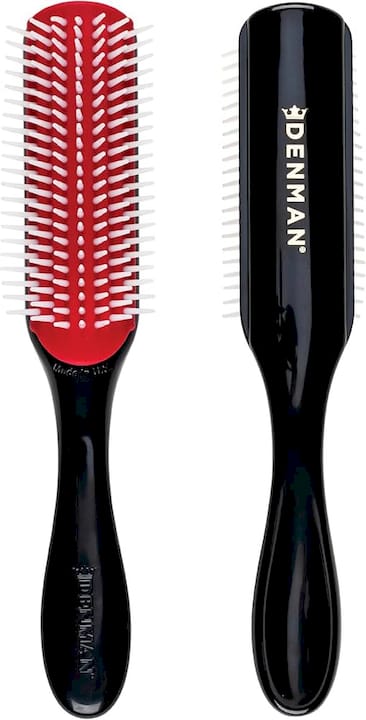
A Denman brush is one of the most effective tools for defining curls, and if you have wavy to curly hair, it belongs in your routine. The brush uses nylon bristles set in a rubber pad to create controlled tension as it moves through wet, product-coated hair. That tension is what groups individual strands into clean, uniform curl clumps instead of a frizzy cloud. Suitable for hair types 2C through 4A, it distributes styling products evenly, smooths the cuticle, and reduces the need for multiple tools.
Key features at a glance:
-
Widely spaced nylon bristles on a flexible rubber pad
-
Removable rows for customized tension
-
Disassembles for thorough cleaning
-
Heat-resistant nylon pins, safe for blow-dry styling
-
Works on wavy (2C) through coily (4A) textures
Table of Contents
What makes the Denman brush different from other brushes?
Most brushes are built to glide through hair with as little resistance as possible. The Denman does the opposite on purpose. Its nylon pins are spaced far enough apart to grab sections of hair and pull them into a defined shape, rather than separating every strand into frizz. The rubber cushion pad flexes slightly under pressure, which prevents the kind of snapping breakage you get from a stiff paddle brush.
The disassembled rubber pad is another feature that sets it apart. The pin rows pop out completely, so you can rinse every surface instead of just rinsing around bristles. You can also remove rows to reduce tension for finer or more fragile curls.
Pro Tip: Remove one or two rows from your Denman if you notice the brush snagging or pulling. Fewer rows mean less tension, which is gentler on fine or high-porosity strands.
## 1. Better curl definition and clumping
The Denman’s core advantage is curl clumping. A pro stylist who tested the brush across 2C to 4A curls found that 80% of clients saw better curl definition and less frizz compared to standard detangling brushes. The tension the brush creates encourages each section to form into ribbon-like spirals, something a wide-tooth comb simply cannot replicate.
## 2. Even product distribution
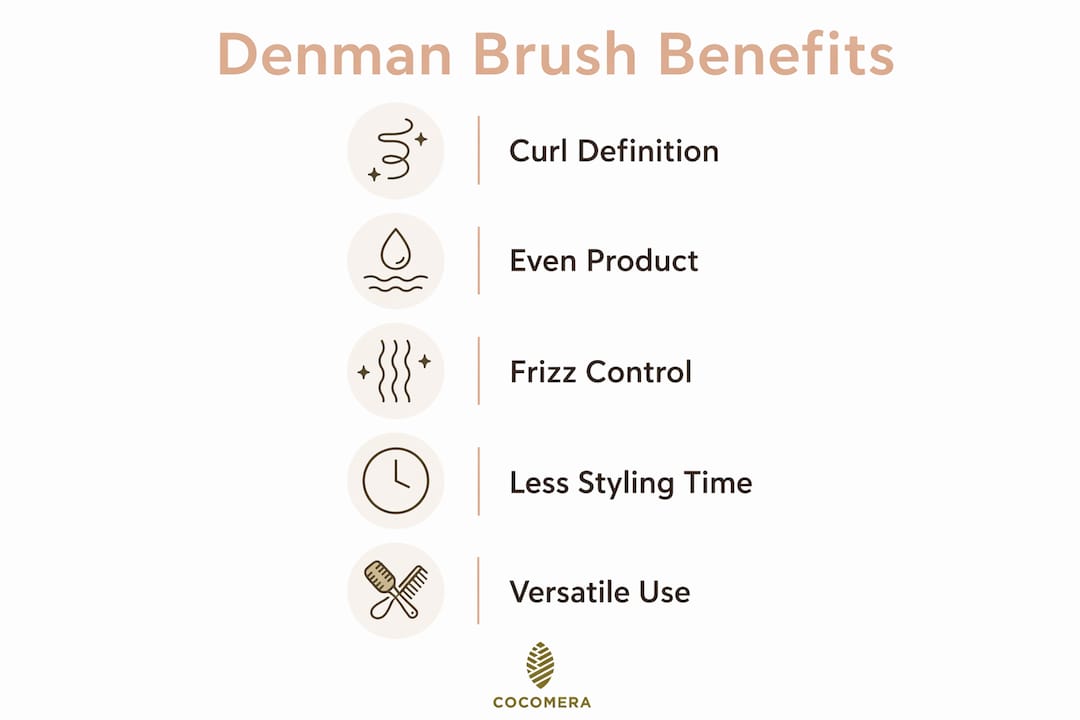
Applying a leave-in conditioner or curl cream by hand often means some sections get more product than others. The Denman’s bristles push product through every layer of a section as you brush, so damp, product-loaded hair gets consistent coverage from root to end. That consistency translates directly into more uniform curl formation.
## 3. Frizz reduction
Frizz usually starts at the cuticle. Brushing downward with the Denman smooths the cuticle layer, which reduces the rough surface that catches humidity and puffs up. The rounded rubber pad also helps neutralize static, a common culprit behind flyaways in dry climates.
## 4. Reduced styling time
For type 4 hair, traditional brushes can take 30–45 minutes to work through coils. The Denman’s design cuts that down considerably. Users with type 4 hair report styling times dropping to around 20 minutes with clearly defined curls and no tangles. For some people, it replaces both a detangling comb and a diffuser in the same session.
## 5. Versatility across curl types
The brush works on wavy 2C hair just as well as on tight 4A coils, though the technique and model vary. It also handles blow-dry styling, so you are not buying a single-use tool. The heat-resistant nylon pins won’t melt under a dryer, which makes it genuinely useful for multiple styling methods.
How to use a Denman brush for defined curls
Start with fully saturated hair. Dry hair and the Denman brush are a bad combination. Avoid brushing dry hair entirely, as it causes breakage and increases frizz rather than reducing it.
-
Wash and condition your hair, leaving it very wet.
-
Apply a leave-in conditioner or curl cream while hair is still dripping. You need slip so the brush glides without friction.
-
Divide hair into 3–4 horizontal sections. More sections give you better control and more defined results.
-
Hold a section taut with one hand. Angle the brush downward and glide from roots to ends slowly. You will see curls begin to clump and spiral as you move through.
-
Scrunch the section upward after brushing to encourage the curl to spring back into shape.
-
Air-dry or diffuse without touching the curls while they set.
Pro Tip: For tighter curl patterns, use smaller sections and slow down near the ends. Rushing through coils is the fastest way to create frizz instead of definition.
Choosing the right Denman brush for your curl type
The two most common models are the D3 and D4. The D3 has 7 rows and suits 2B–3C curls that need shape and clumping without too much tension. The D4 has 9 rows with a firmer pad, designed for 3C–4A curls that need more control and grip. Celebrity hairstylist Deaundra Metzger recommends the D3 or D4 for curl type 2, noting that closer pins promote more definition for finer strands.
-
D3: Best for medium to fine curls (2C–3B), more forgiving for beginners
-
D4: Better for dense, springy curls and coils (3C–4A), firmer hold
-
D31: Wider pin spacing, recommended for type 4 hair or anyone prone to tangling
If you are unsure of your pattern, Cocomera’s curl type guide can help you identify where you fall before choosing a model.
How to clean and maintain your Denman brush
Pop the rubber pad out of the handle and remove accumulated hair strands first. Then rinse the pad and pin rows under warm water. A toothbrush works well for scrubbing product buildup from around the base of the pins. Weekly cleaning keeps the brush performing like new and prevents residue from transferring back onto freshly washed hair. Avoid harsh chemical cleaners, which can degrade the rubber pad over time.
Pro Tip: Clean your Denman on wash day, right after you finish styling. The product is still fresh and rinses off more easily than dried buildup.
What experts say about brush maintenance and hair health
Hairstylists consistently point to brush hygiene as an overlooked part of a healthy curl routine. A dirty brush redeposits old product and shed hair back onto clean strands, which undermines everything you just did in the shower. Regular maintenance also extends the life of the brush significantly, since product buildup can stiffen the rubber pad and reduce its flexibility.
-
Clean brushes distribute product more evenly and reduce scalp irritation
-
Proper use on wet, conditioned hair minimizes mechanical breakage
-
Pairing the Denman with moisturizing products protects curl integrity over time
-
A well-maintained brush can last years, making it a cost-effective long-term tool
How the Denman compares to other curl-defining tools
Wide-tooth combs detangle effectively but do not clump curls. Finger coiling gives definition but takes much longer and produces inconsistent results across a full head of hair. Paddle brushes have too many tightly packed bristles, which create static and frizz in textured hair. The Denman sits in a specific middle ground: it detangles gently while simultaneously shaping each section into a defined curl, something most other tools handle separately. For wet styling in particular, no single tool matches its combination of tension control and product distribution.
How the Denman brush affects different curl patterns
The brush behaves differently depending on your texture. For 2C waves, it adds definition and reduces the flat, stringy look that wavy hair often gets without the right tool. For 3A–3C curls, it creates the ribbon-like clumps that give curls their bounce and shape. For 4A coils, the D31 or a modified D3 with rows removed provides enough grip to define without snagging. The key variable across all patterns is section size: tighter curls need smaller sections and slower passes to get clean definition without disruption.
Best products to use with your Denman brush
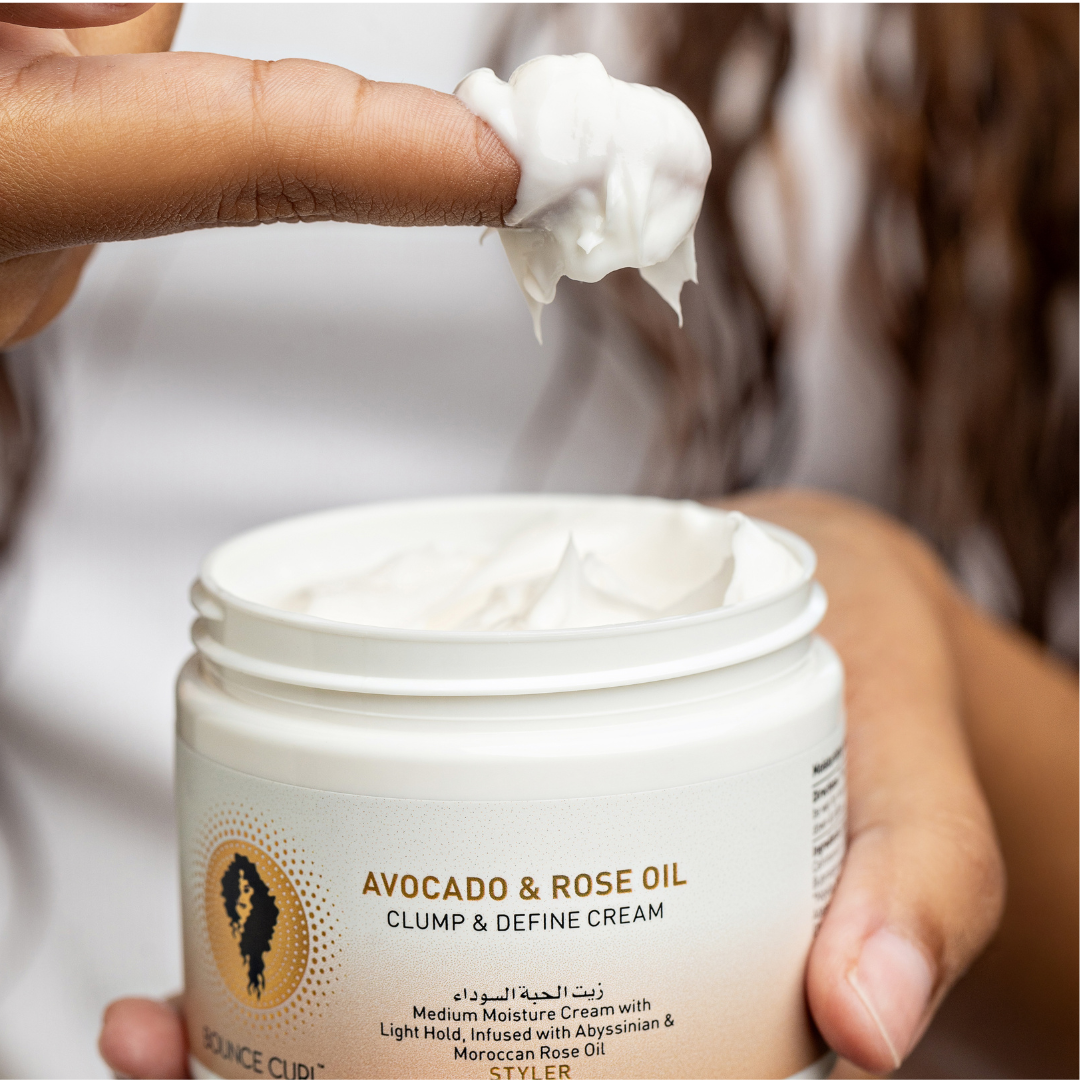
The brush needs slip to work correctly. Without enough product, friction builds and breakage follows. Leave-in conditioners are the foundation, providing moisture and enough coating for the bristles to glide. Curl creams add hold and help the clumps stay intact through drying. Lightweight gels or custards applied on top of the cream lock in the shape the brush created. For a full range of curl-compatible styling products, Cocomera carries options suited to every texture from 2C to 4A.
Cocomera has the tools and products your curls need
Cocomera curates hair care specifically for textured hair, types 2 through 4, so you are not sorting through products built for straight hair to find what actually works for your curls. The shop carries brushes and combs suited to wavy, curly, and coily textures, alongside the styling creams and leave-ins that make the Denman brush perform at its best.

Whether you are building your first curl routine or refining one that is almost there, Cocomera makes it straightforward to find the right combination in one place. Browse the full styling product collection and pick up everything your Denman brush needs to deliver its best results.
Key Takeaways
The Denman brush defines curls better than most other tools because its controlled tension clumps strands into clean spirals on wet, product-coated hair.
| Point | Details |
|---|---|
| Use only on wet hair | Brushing dry hair causes breakage; always saturate and apply product first. |
| — | A pro stylist found 80% of clients saw better definition and less frizz versus standard brushes. |
| D3 vs. D4 | D3 (7 rows) suits 2B–3C curls; D4 (9 rows) suits 3C–4A curls needing more tension. |
| Clean weekly | Pop out the rubber pad and rinse with warm water every wash day to prevent buildup. |
| Cocomera | Carries brushes, curl creams, and leave-ins curated for hair types 2–4 in one place. |