Curly hair can lose up to 50% more moisture than straight hair, yet most mainstream hair care advice still treats all hair types the same. That disconnect is exactly why so many curly-haired women in Europe struggle with persistent frizz, limp spirals, and endless product hopping. The truth is that hydration for textured hair is a science, and once you understand it, everything changes. This article breaks down the biology behind moisture loss, explains how your hair’s individual porosity shapes the entire strategy, and gives you practical routines you can start using this week.
Table of Contents
-
The science of moisture balance: Protein, hydration, and hygral fatigue
-
Daily and weekly hydration routines: Products and habits that deliver results
-
The real reason curls thrive: It’s consistency, not miracle products
Key Takeaways
| Point | Details |
|---|---|
| Curly hair loses moisture fast | Because of its structure, curly hair can lose up to 50% more moisture than straight hair. |
| Know your porosity | Your curl’s porosity should guide the products and routines you use for hydration. |
| Balance is crucial | Mixing hydration with the right protein prevents damage and keeps curls strong. |
| Routine wins over trends | Consistent hydration habits matter more than any single trendy product. |
| Choose the right products | Select lightweight or sealing products based on your curl type and porosity for best results. |
Why curls need more hydration than straight hair
To understand how best to care for curls, it’s important to know what makes them lose moisture so quickly.
The coiled structure of curly hair is genuinely beautiful, but it creates a real challenge for moisture retention. Because the hair strand bends and spirals rather than lying flat, the outer cuticle layer (the scale-like surface of each strand) lifts more easily at every curve and twist. This increases the total surface area exposed to air and environmental elements, meaning water evaporates faster than it would from a straight strand. It’s the same reason a crumpled sheet of paper dries faster than a flat one: more surface, more exposure.
Keratin, the protein that makes up hair, relies on water to stay flexible and elastic. When it’s well-hydrated, it stretches without breaking and springs back into shape. When it’s dehydrated, keratin becomes brittle and rigid. For curly hair, this is especially visible because the curl pattern depends on the strand’s ability to coil evenly. Dehydrated curls lose their definition, look frizzy, and feel rough to the touch. They also snap more easily under tension, which explains why many women with textured hair deal with chronic breakage that has nothing to do with manipulation or styling.
| Hair type | Moisture retention | Frizz risk | Breakage risk |
|---|---|---|---|
| Straight (type 1) | High | Low | Low |
| Wavy (type 2) | Moderate | Moderate | Moderate |
| Curly (type 3) | Lower | High | Moderate to high |
| Coily/Afro (type 4) | Lowest | Very high | High |
“Well-hydrated hair flexes and bends without snapping. For curly and coily textures, maintaining that water content isn’t a luxury — it’s the foundation of every healthy hair habit.”
The consequences of dehydration compound quickly:
-
Frizz forms when the hair shaft reaches out to grab humidity from the air to compensate for internal dryness.
-
Reduced curl definition happens because dry, stiff strands can’t clump together into clean spirals.
-
Breakage and split ends increase as brittle keratin snaps under the weight of daily styling or even gentle detangling.
-
Dull appearance is a sign that the cuticle is lifted and scattering light unevenly instead of reflecting it.
Understanding why moisture matters for curls at this level makes it easier to stop blaming the wrong things (your styling technique, the product brand) and start addressing the real root cause: your hair needs water, retained and sealed properly.
Hair porosity: The key to your hydration strategy
Understanding why curls lose moisture is just the beginning; next, let’s get personal — discover how your own hair’s porosity changes your hydration strategy.
Porosity refers to how easily your hair’s cuticle layer allows water to enter and exit the strand. Two women with identical curl patterns can respond completely differently to the same deep conditioner, and porosity is usually the reason. Get your porosity wrong, and even expensive, high-quality products will underperform. Get it right, and suddenly your routine clicks into place.
How to do the float test at home:
-
Wash a few strands of clean hair (no product buildup) and let them dry naturally.
-
Drop the strands into a glass of room temperature water.
-
Wait 2 to 4 minutes without stirring.
-
If the hair floats near the top, you likely have low porosity. If it sinks to the middle, you have normal porosity. If it sinks quickly to the bottom, you have high porosity.
This test isn’t perfect, but combined with how your hair behaves (does it take forever to get wet? does it dry out within an hour of styling?), it gives you a solid working picture.
| Feature | Low porosity | High porosity |
|---|---|---|
| Cuticle layer | Tightly closed | Open or damaged |
| Gets wet | Slowly (water beads up) | Quickly |
| Dries | Slowly | Fast |
| Absorbs products | Hard, builds up easily | Easily, but loses moisture fast |
| Best products | Lightweight, water-based | Heavy butters, oils, sealants |
| Key technique | Heat or steam to open cuticle | Layer and seal immediately |
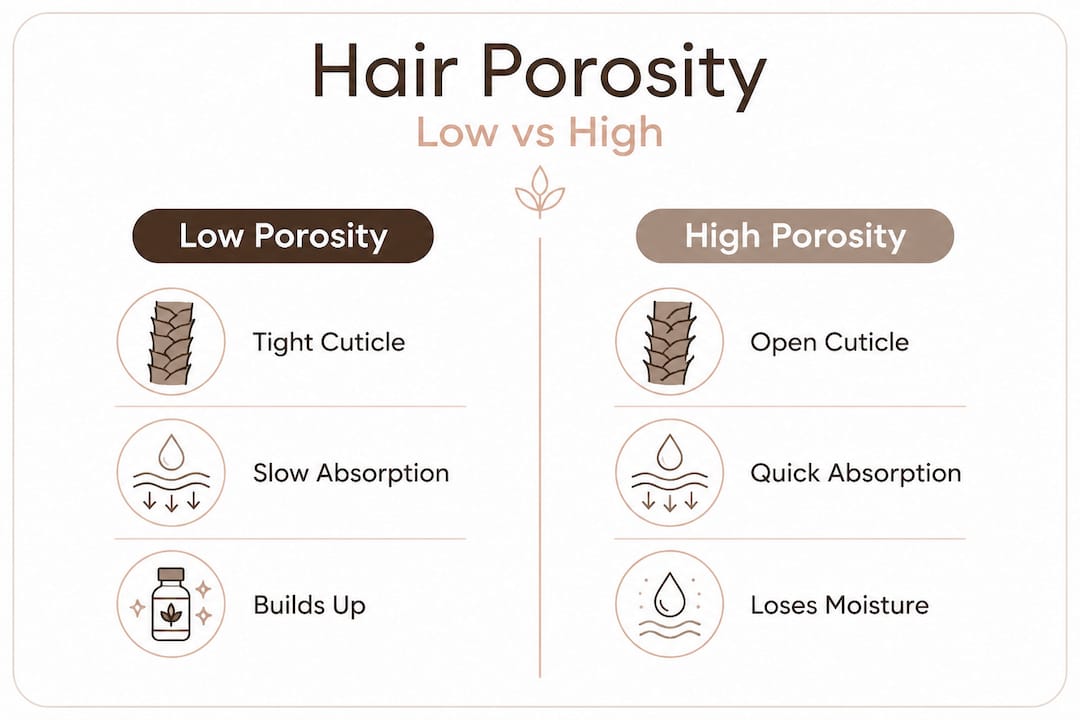
Low porosity hair has a tightly sealed cuticle that resists product absorption. The biggest mistake with hair moisturizers for different porosity types is applying rich, heavy creams to low porosity hair. They sit on top, cause buildup, and make curls look greasy without ever penetrating. Instead, use lightweight water-based gels and creams, and apply them to soaking wet hair so the moisture is already inside the strand before you add anything else. Steam or a heat cap opens the cuticle temporarily, allowing conditioners to actually absorb rather than coat.
High porosity hair is the opposite problem. The cuticle is too open, often because of heat damage, chemical processing, or just genetics. Moisture gets in fast, but it also escapes fast. This is where the best oils by porosity really make a difference. Heavier oils like castor, shea butter, and mango butter help seal the cuticle and slow down moisture evaporation. Layering is key: apply a water-based leave-in first, then a cream, then seal with an oil or butter.

Pro Tip: If your low porosity curls constantly feel coated and weighed down, the culprit is almost always product buildup. Use a clarifying shampoo for buildup once or twice a month to reset your scalp and strands, then follow immediately with a lightweight moisture treatment.
The distinction between these two porosity types also explains why low porosity needs lightweight products, heat and steam for penetration, while high porosity requires heavy sealants like butters and oils to prevent rapid moisture loss. Applying the wrong approach doesn’t just fail, it can actively make your hair worse.
The science of moisture balance: Protein, hydration, and hygral fatigue
Once you know your porosity, fine-tuning how much hydration your hair needs becomes easier, especially when you understand the importance of moisture and protein balance.
Most conversations about curly hair focus on moisture, and rightfully so. But protein is the other half of the equation, and ignoring it causes just as many problems. Hair is made of keratin protein, and while water keeps it flexible, protein keeps it strong. Too much moisture without enough protein leads to limp, mushy curls that stretch without snapping back. Too much protein without moisture creates brittle, stiff strands that break easily.
Signs of moisture and protein imbalance:
-
Too much moisture (hygral fatigue): curls feel soft but gummy or elastic when wet, they stretch further than normal, and they lack any bounce or definition
-
Too much protein: curls feel stiff, rough, or wiry even after conditioning; breakage increases; hair snaps rather than stretches
-
Balanced hair: curls are soft but springy, they have definition and hold, and they feel strong when detangled
Hygral fatigue is a real but often overlooked condition. It happens when hair repeatedly absorbs and releases large amounts of water, causing the cuticle to swell and contract repeatedly. Over time, this weakens the hair structure. Highly porous hair is most at risk because it absorbs and loses water so rapidly.
Balancing moisture and protein doesn’t require a chemistry degree. A practical approach is to do a protein treatment every 4 to 6 weeks, or whenever your curls start feeling overly stretchy or limp, and to follow any protein treatment immediately with deep conditioning to restore softness.
The most effective tool in your routine for genuine deep conditioning treatments is heat. Heat opens the cuticle and allows the conditioning molecules to penetrate beyond the surface of the strand. A hooded dryer, a heat cap, or even wrapping your conditioned hair in a warm towel for 20 to 30 minutes will produce noticeably better results than leaving conditioner on at room temperature.
Pro Tip: If you’re not sure whether you need moisture or protein, do a quick stretch test on a wet strand. If it stretches and slowly snaps, you need protein. If it snaps immediately with very little stretch, you need moisture. This simple check takes five seconds and saves you from weeks of frustration.
According to hair care research, weekly deep conditioning with heat delivers the best moisture absorption for textured curls, and this is especially true for low porosity types where penetration is the primary challenge.
Daily and weekly hydration routines: Products and habits that deliver results
Understanding balance is one thing; putting routines into practice is how you see real results. Here’s how to get started for every curl type.
Daily habits for hydrated curls:
-
Start with damp or wet hair before applying any leave-in or styler.
-
Apply products from thinnest to thickest: water-based leave-in first, then cream or styler, then oil or butter to seal.
-
Use a microfiber towel or an old cotton t-shirt to blot excess water without disrupting curl clumps.
-
Protect curls at night with a satin or silk bonnet, pillowcase, or loose pineapple updo to prevent friction and moisture loss.
-
Refresh second-day curls with a small amount of water mixed with leave-in in a spray bottle, then scrunch gently to reactivate the curl pattern.
For everyday curl care tips, consistency matters far more than perfection. You don’t need to fully re-wash and restyle every day. A good refresh keeps curls looking alive between wash days and reduces the manipulation that causes breakage.
Weekly wash day routine:
-
Use a moisturizing shampoo that cleanses without stripping. Sulfate-free formulas are generally gentler for type 3 and 4 hair.
-
Follow with a rinse-out conditioner, focusing on mid-lengths and ends.
-
Once a week, swap the rinse-out conditioner for a deep conditioning mask and apply heat for 20 to 30 minutes.
-
Apply your leave-in conditioners while hair is still soaking wet for maximum absorption.
-
Seal with an oil appropriate for your porosity level.
The low porosity routine leans on lightweight products and steam, while high porosity hair benefits from heavier creams layered with rich butters and oils. Both types, however, benefit from the same foundational discipline: wash day, deep conditioning, sealing, and overnight protection every single week.
The real reason curls thrive: It’s consistency, not miracle products
Here’s the uncomfortable truth about curly hair care that the beauty industry would rather you didn’t hear: no single product will transform your curls. Not the expensive styler with the impressive ingredient list. Not the viral treatment everyone on social media swears by. What actually transforms curls is showing up for them consistently, week after week.
Most curl “failures” happen not because of the wrong product, but because of irregular deep conditioning, skipped nighttime protection, and inconsistent wash day timing. Curls thrive on routine. When you deep condition every week, your hair’s moisture levels stabilize. When you protect your hair at night without fail, you dramatically reduce friction-related breakage. When you clarify monthly and refresh daily, your curls never have a chance to fall into the dehydration spiral.
We’ve seen this pattern repeatedly: someone switches products every few weeks because their curls don’t seem to respond, when in reality they’ve never stayed consistent long enough to give their hair time to improve. Textured hair responds slowly. Real change happens over months, not days.
Paying attention to the best curly hair ingredients matters, but only after you’ve nailed the routine. Ingredients are important, yes. But they’re multipliers on a foundation you’ve already built. Small, repeated habits like sleeping with a satin bonnet, refreshing curls mid-week, clarifying once a month, and deep conditioning weekly will outperform any single product purchase every time.
Stop chasing the perfect product. Start building the consistent practice.
Take your curls further with proven hydration solutions
Finding the right information is only half the journey. The other half is having the right products in your hands.

At Cocomera, we’ve carefully curated collections that match exactly what we’ve covered in this article: lightweight leave-ins for low porosity curls, rich butters and hair oils for curls for high porosity types, and curly hair treatments designed for weekly deep conditioning. You won’t need to spend hours researching whether a product suits your curl type, because we’ve already done that work. Browse our styling products for curly hair to build a routine that genuinely works for your texture, porosity, and lifestyle. Everything in one trusted place, shipped across Europe.
Frequently asked questions
How can I tell if my curls are dehydrated?
Dehydrated curls feel rough and coarse to the touch, look dull or frizzy, and lose their spring and definition. If your curls look limp in dry weather but puff up in humidity, dehydration is almost certainly the cause.
What’s the best way to moisturize low porosity hair?
Use lightweight water-based products on soaking wet hair and apply heat or steam to open the cuticle and allow absorption. Clarifying monthly prevents buildup that blocks moisture from penetrating the tight cuticle layer.
How does porosity impact product selection?
Low porosity hair works best with light gels, humectants, and creams that don’t sit on the surface, while high porosity curls need heavier products. The right product match by porosity is the single biggest variable in whether your routine actually works.
Can you over-hydrate curly hair?
Yes, over-moisturizing without balancing protein causes hygral fatigue, which leaves curls feeling gummy and limp with no bounce. Adding a protein treatment monthly prevents this from becoming a chronic issue.
How often should you deep condition curly hair?
Deep conditioning weekly with heat gives textured curls the best results for sustained moisture retention and overall strand health. Once you make it a non-negotiable part of wash day, the difference in your curl health becomes obvious within a few weeks.