TL;DR:
- A curl-friendly routine, also known as the Curly Girl Method, emphasizes gentle cleansing, styling on wet hair, and avoiding sulfates and silicones to enhance natural curls. Proper technique, consistency, and understanding your curl type are essential for achieving defined, frizz-free curls, regardless of hair texture. Building a routine with suitable products and patience leads to healthier, more radiant textured hair.
If you’ve ever stared at your curl products wondering what order they go in, you’re not alone. A curl friendly routine, more formally known as the Curly Girl Method or CGM, is a structured approach to caring for textured hair that prioritizes moisture, gentle handling, and curl enhancement over stripping cleansers and heat. The framework applies beautifully across hair types 2 through 4, whether you have loose waves or tight coils. This guide breaks down every step, explains what to avoid, and gives you the practical foundation to start seeing real results.
Table of Contents
Key takeaways
| Point | Details |
|---|---|
| Avoid sulfates and silicones | These ingredients strip moisture and block hydration, making frizz and dryness worse. |
| Apply products to soaking wet hair | Styling on thoroughly wet hair locks in moisture and encourages curl clumping. |
| Detangle only when wet | Use fingers or a wide-tooth comb during conditioning to prevent breakage and frizz. |
| Consistency beats product volume | A simple, repeatable routine outperforms an expensive but inconsistent one. |
| Refresh curls between wash days | Mist with a leave-in spray and scrunch to revive shape without starting over. |
What a curl friendly routine actually means
A curl friendly routine is any consistent hair care regimen designed to support your natural curl pattern rather than fight it. The formal term most often used in the industry is the Curly Girl Method, coined by stylist Lorraine Massey. Its core idea is simple: curly hair thrives when you stop stripping its natural oils and start working with the hair’s structure instead of against it.
The method rests on a few non-negotiable principles:
-
No sulfates. Sulfates are the harsh detergents in conventional shampoos that create a rich lather. They also strip every trace of natural oil from your scalp and strands, leaving curls brittle and prone to frizz.
-
No silicones. Silicones coat the hair shaft to create a false smoothness. The problem is that sulfates strip natural oils and silicones cause buildup that blocks moisture from penetrating the hair.
-
Gentle cleansing only. Co-washes (conditioner-only washing) or sulfate-free shampoos are the go-to cleansers for curl friendly hair care.
-
Styling on wet hair. Products applied to soaking wet hair seal in water, define curl clumps, and cut frizz dramatically.
-
Minimal friction. Regular towels, tight elastic bands, and rough handling all break up curl definition and add frizz.
Pro Tip: If you’re switching from conventional shampoos that contain silicones, do one clarifying wash with a sulfate shampoo first. Without this reset, product buildup blocks moisture from absorbing and your new routine will feel like it isn’t working.
What makes this approach stand out is that it treats technique and timing as seriously as product choice. Many people with curly or wavy hair spend money on quality products and still see frizz. The issue is usually application, not the product itself.
The step-by-step curl routine explained
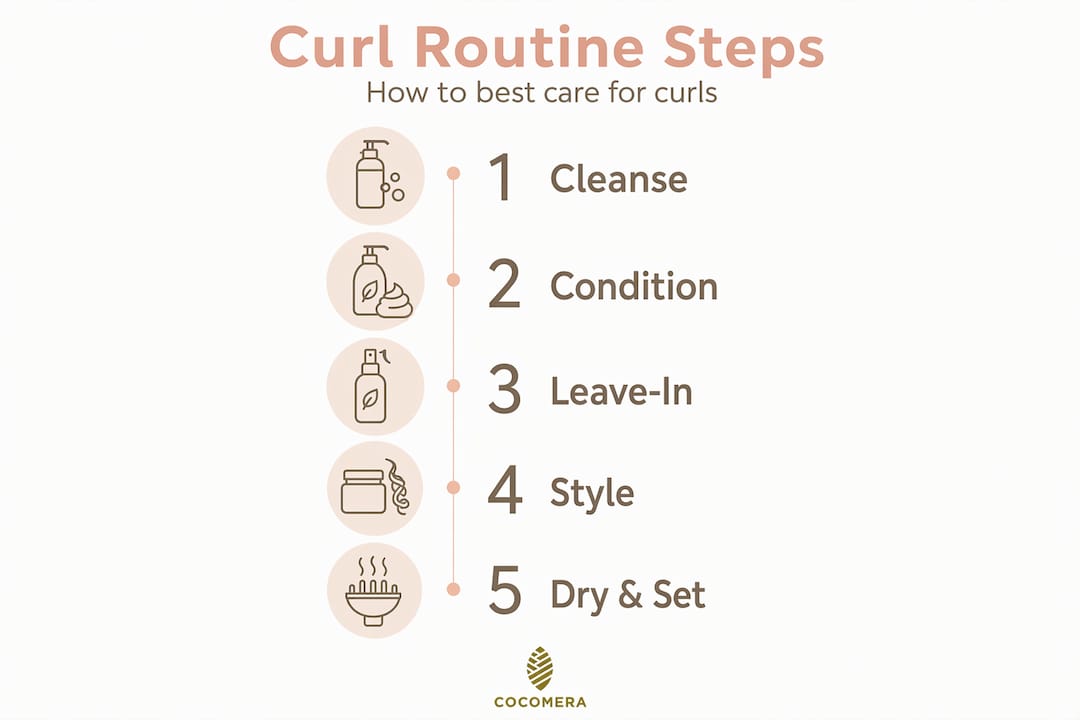
Understanding how to care for curls becomes much easier when you see each step as a link in a chain. Skip one and the whole chain weakens. Here’s how a standard wash-day routine flows:
-
Cleanse your scalp. Use a sulfate-free shampoo or co-wash. Focus the product on your scalp and massage gently with your fingertips to stimulate circulation and lift buildup. Let the rinse water carry the product down the length of your hair naturally.
-
Condition and detangle. Apply a generous amount of conditioner from mid-shaft to ends while your hair is still saturated with water. Then detangle using your fingers or a wide-tooth comb starting from the ends and working upward. Detangling only when wet and coated with conditioner prevents breakage and keeps curl definition intact. Never detangle dry.
-
Apply styling products to soaking wet hair. Don’t squeeze or shake out excess water before applying your leave-in conditioner, curl cream, or gel. The water in your hair is an ingredient. Styling on soaking wet hair encourages curl clumps to form and dramatically reduces frizz.
-
Scrunch and plop. Once your products are distributed, scrunch your hair upward toward your scalp to encourage curl formation. Then plop. Plopping means laying a microfiber towel or old cotton T-shirt flat, flipping your wet hair onto it, wrapping the ends up toward your nape, and securing it on top of your head. Plopping with a microfiber towel absorbs excess water while preserving clumps, something a regular terry cloth towel cannot do without causing frizz.
-
Dry without touching. Air dry or diffuse on low heat. The most important rule during drying: keep your hands off. Every time you touch your hair while it’s wet, you break up curl clumps and introduce frizz.
-
Scrunch out the cast. When your hair is fully dry, it will feel crunchy. That’s the gel cast doing its job by locking in the curl shape. Scrunch your hair firmly from the ends upward to break the cast and release soft, defined curls underneath.
Pro Tip: Applying gel on wet hair and waiting until hair is completely dry before scrunching out the cast is one of the most commonly skipped steps. Doing it too early collapses the curl and reintroduces frizz.
Common mistakes that wreck your curl results
Even people who follow a curl-friendly approach can run into frustrating results if a few key habits stay in place. Here’s what to watch for:
| What to avoid | Why it hurts your curls |
|---|---|
| Brushing dry curls | Separates clumps, creates a frizzy halo, and causes breakage |
| Applying products to damp hair | Diluted hold means undefined, flat curls that dry with frizz |
| Using a regular terry cloth towel | Rough texture creates friction that disrupts curl pattern |
| Skipping clarifying washes | Product buildup blocks moisture and makes hair look dull and limp |
| Touching hair while it dries | Breaks curl clumps before they fully form and set |
Beyond these common errors, one habit derails more people than any other: product overload. Adding more and more products doesn’t compensate for incorrect technique. The fix is almost always in the process, not the bottle.
A few additional pitfalls worth naming specifically:
-
Fine-tooth combs on curly hair. These separate individual strands rather than keeping curl clumps together. Always reach for your fingers or a wide-tooth comb instead.
-
Skipping the clarifying reset. If you’ve been using silicone-based products for years, a clarifying wash is needed before your sulfate-free products can actually penetrate and work. Many people try curl friendly routines and quit early because they skipped this step.
-
Applying heat carelessly. Diffusing on high heat or flat-ironing frequently overrides all the moisture work you’ve done and loosens your curl pattern over time.
The Curly Girl Method tips from Healthline reinforce that proper ingredient choices and technique timing are inseparable from real results.
Adjusting your routine for your curl type
One of the most under-discussed parts of curly hair daily routines is that the method is not one-size-fits-all. Curl types 2, 3, and 4 each have different needs, and understanding yours saves a lot of trial and error.
Wavy hair (type 2) tends to be finer and more prone to getting weighed down. Lighter products work best here. Reach for mousse or a lightweight curl cream instead of a heavy butter. Over-conditioning can cause waves to drop, so use conditioner mainly from the ears down and focus on root volume.
Curly hair (type 3) falls into the sweet spot where both creams and gels work well. Layering a leave-in with a styling gel gives hold and definition without the stiffness of gel alone. Type 3 curls benefit enormously from scrunching technique and consistent plopping.
Coily and tight curl patterns (type 4) are the most porous and most prone to moisture loss. Heavier creams, butters, and oils work better here to seal in hydration. Wash day matters a lot. For a detailed look at caring for textured hair, the coily hair wash day workflow breaks it down step by step for type 4 patterns.
Refreshing curls between wash days is its own skill. Most curls do not need a full wash every day. Between wash days:
-
Mist hair with water or a leave-in spray to rehydrate and revive curl shape
-
Scrunch in a small amount of your original styling cream to reshape any flattened sections
-
Use the pineapple method at night: gather hair loosely on top of your head with a soft scrunchie to preserve curl volume while you sleep
-
Sleep on a satin pillowcase or wear a satin bonnet to reduce friction and moisture loss overnight
Pro Tip: Your hair porosity determines how often you need deep conditioning and how heavy your products should be. Low porosity hair repels moisture and does better with lighter, heat-activated products. High porosity hair absorbs moisture fast but loses it just as quickly, so sealing with an oil on top of your styler helps lock it in.
The natural hair checklist for textured curls at Cocomera is a useful reference for identifying your specific needs before building your routine.
My honest take on finding your curl routine
I’ve seen a lot of people in the textured hair space give up on curl friendly routines within the first two wash days because their hair didn’t transform overnight. The real issue isn’t the routine. It’s the expectation.
What I’ve learned is that consistency matters more than the number of products on your shelf. One solid wash-day routine practiced every week will outperform rotating through five different product combinations. The hair needs time to adjust, and your hands need time to develop the muscle memory of scrunching, plopping, and leaving things alone.
My biggest piece of advice is to treat each wash day as an experiment with one variable. Adjusting one factor at a time helps you actually identify what’s working instead of overhauling everything and starting back at zero. Changed your gel? Keep everything else the same for three wash days before drawing conclusions.
The mindset shift that changed everything for me was accepting that textured hair is not broken hair that needs fixing. It’s hair with a specific structure that responds beautifully when you stop fighting it. Small wins, like the first time your curls dry with actual definition, are worth celebrating because they signal your hair is responding. Don’t quit before that moment arrives.
— Cocomera
Build your curl routine with Cocomera
At Cocomera, we’ve done the work of vetting what actually belongs in a curl friendly routine so you don’t have to start from scratch. Every product in our collection is carefully selected to work for wavy, curly, coily, and afro hair types, and nothing on the shelves contains the harsh sulfates or heavy silicones that sabotage results. Whether you’re looking for a gentle sulfate-free shampoo to start your wash day right, a detangling conditioner to ease through knots without breakage, or a hold-strong styling gel that creates that coveted cast, you’ll find it curated and organized by hair type. Browse our full curl styling collection to find products matched to your curl pattern and goals, all in one place.
FAQ
What is a curl friendly routine?
A curl friendly routine, also called the Curly Girl Method, is a structured hair care approach that avoids sulfates and silicones, focuses on gentle cleansing, and emphasizes styling on soaking wet hair to enhance and define natural curl patterns.
How often should I wash my curly hair?
Most people with curly or textured hair wash every one to two weeks depending on scalp needs and hair porosity. Refreshing curls between wash days with a leave-in spray is typically enough to maintain shape and moisture.
What products do I need to start a curl routine?
A sulfate-free shampoo or co-wash, a moisturizing conditioner for detangling, a leave-in conditioner, and a styling gel or curl cream are the core products. A microfiber towel or T-shirt for plopping is the one accessory that makes the biggest difference.
Can the Curly Girl Method work for type 4 coily hair?
Yes. Type 4 hair benefits from the same core principles but typically needs heavier creams, butters, and oils to retain moisture. Wash day technique and sealing in hydration with an oil are especially important for tight coil patterns.
Why do my curls look frizzy even when I follow a routine?
Frizz usually comes from applying products to damp instead of soaking wet hair, touching the hair while it dries, or skipping the clarifying wash before starting a silicone-free routine. Technique adjustments resolve most frizz issues before product changes become necessary.