TL;DR:
- Hair typing categorizes curls by pattern and texture to help guide hair care decisions. However, individual variations, treatments, and environmental factors often make these labels imperfect. Using hair type as an initial reference alongside assessments of porosity, density, and elasticity yields the most effective routine.
If you’ve spent any time in curly hair communities online, you’ve probably seen references to “3C” or “4B” hair and wondered what those labels actually mean. The hair typing system is a classification framework that organizes hair by its natural curl pattern and texture, giving people a shared language to discuss their hair and make product choices. For anyone managing wavy, curly, or coily hair, understanding hair types is one of the first steps toward building a routine that actually works. This article breaks down how the system works, where it falls short, and how to use it practically.
Table of Contents
- Key Takeaways
- What is the hair typing system and how does it work
- Critiques and limits of hair typing
- How to use hair typing as a practical starting point
- The Andre Walker types up close
- My honest take on hair typing
- Find products matched to your hair type at Cocomera
- FAQ
Key Takeaways
| Point | Details |
|---|---|
| Hair typing explained | The hair typing system classifies hair into four pattern groups with subtypes based on curl tightness. |
| Multiple systems exist | Andre Walker, LOIS, and FIA all classify hair differently, so context matters when reading type references. |
| Typing has real limits | Hair varies across your scalp and changes with treatments, so one label rarely covers everything. |
| Other traits matter too | Porosity, density, and elasticity shape your routine just as much as your curl pattern does. |
| Use typing as a starting point | Hair type classification works best as an entry point, not a rulebook, for product and routine decisions. |
What is the hair typing system and how does it work
Hair typing systems classify hair by its natural pattern and texture to create a shared framework for care and product selection. The goal is simple. Instead of describing your hair as “curly but not super curly, kind of S-shaped,” you can say “3B” and most people in the curly hair community will immediately understand what you mean.
The most widely used system today is the Andre Walker Hair Typing System, developed by Oprah Winfrey’s longtime hairstylist. It divides hair into four main pattern categories: Type 1 (straight), Type 2 (wavy), Type 3 (curly), and Type 4 (coily or kinky). Each main type is further split into subtypes A, B, and C, where A represents the loosest version and C the tightest or most compact version within that group.
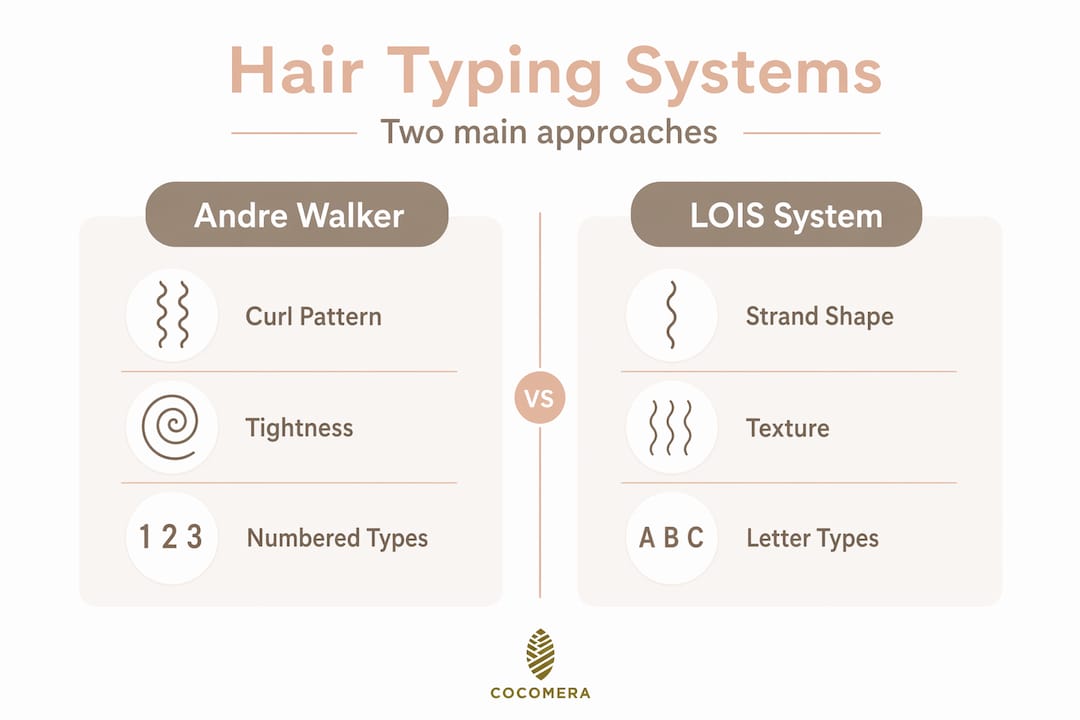
Other systems take a different approach. The LOIS system uses letter shapes (L, O, I, S) to describe strand patterns and also factors in strand texture and sheen. The FIA system combines pattern, strand size, and overall hair volume for a more layered picture. L’Oréal developed its own quantitative classification that measures curl geometry more precisely for research purposes. Multiple mainstream classification systems exist, each measuring different traits, which is why two sources might describe the same hair differently depending on which system they use.
Here is a quick comparison of the leading systems:
| System | Primary criteria | Approach | Best use |
|---|---|---|---|
| Andre Walker | Curl pattern, tightness | Qualitative | Consumer product guidance |
| LOIS | Strand shape, texture, sheen | Descriptive | Community communication |
| FIA | Pattern + strand size + volume | Multi-factor | Detailed self-assessment |
| L’Oréal | Curl geometry measurements | Quantitative | Research and formulation |
For most people navigating the hair texture chart in beauty stores or online shops, the Andre Walker system is the reference point. It’s the most popular among consumers, though it comes with notable limitations covered below.
Critiques and limits of hair typing
No system is perfect, and the hair typing system has earned genuine criticism from experts and communities alike.
The most practical limitation is that hair varies significantly across the scalp, even on the same head. Your crown might be 3C while your edges are closer to 4A. Treating your entire head as one type can lead to over-moisturizing some areas and under-treating others. This is a real, everyday problem for a lot of people with textured hair.

Beyond variation, visual systems like Andre Walker’s depend on what your hair looks like at a given moment. Chemical treatments, heat damage, and even the weather can shift how a curl pattern appears. Experts caution that visual perception-based systems don’t fully account for these lifestyle and biochemical changes, which means your “type” can look different from week to week.
There are also historical and cultural critiques worth acknowledging. Andre Walker’s original system was widely criticized in Black hair communities for initially framing looser curl patterns as more desirable and easier to manage. That framing shaped how products were marketed for years, and some of that bias still shows up in how brands position their product lines today. Understanding hair types means recognizing that no system is culturally neutral.
Additional critiques include:
- Oversimplification of the full spectrum of Black and afro-textured hair
- Marketing influence that shapes how “good” hair is defined by pattern rather than health
- Rigid labels that discourage experimentation with techniques and products outside your assigned type
Pro Tip: When you read product recommendations based on hair type, ask yourself whether the advice also accounts for your hair’s porosity and density. If it doesn’t, treat the recommendation as a starting suggestion, not a final answer.
How to use hair typing as a practical starting point
Here’s the thing about hair type classification. It works best when you treat it like a map, not a rulebook. A map shows you the general territory. Your specific journey still depends on conditions on the ground.
Porosity, density, and elasticity influence your results just as much as curl pattern does. Porosity describes how well your hair absorbs and retains moisture. High porosity hair drinks up products quickly but loses moisture just as fast. Low porosity hair is slower to absorb but holds moisture well once it’s in. Two people with the same 3C curl pattern can need completely different product strategies because of these differences.
Follow these steps to get a more accurate read on your hair before shopping for products:
- Assess in a consistent state. Wet hair better reveals your natural curl pattern than dry hair does, because styling, humidity, and shrinkage can obscure or change what you see. Wash your hair with a gentle shampoo, skip conditioner temporarily, and observe the pattern while it air-dries.
- Check for variation. Section your hair into four quadrants and look at each area separately. Note whether your curl pattern shifts from front to back or crown to nape.
- Test your porosity. Drop a clean strand into a glass of water. If it sinks quickly, your porosity is high. If it floats, it’s likely low.
- Assess strand thickness. Hold a single strand up to light. Fine strands are barely visible; thick strands are clearly defined.
- Consider elasticity. Gently stretch a wet strand. Healthy elasticity means it stretches without snapping immediately.
Once you have this fuller picture, use your hair type as the starting filter and let porosity and density guide your final product choices. For practical help building a routine for your curl pattern, the curly hair care tips at Cocomera are a solid next step.
Pro Tip: If you have multi-textured hair across your scalp, consider applying lighter products to your looser sections and richer creams or butters to your tighter coil areas within the same wash day.
The Andre Walker types up close
Understanding the specific types within the system makes it much easier to recognize where your hair fits and what it generally needs.
Types 1 and 2: straight to wavy
Type 1 hair is fully straight with no natural curl pattern. Type 2 hair forms loose S-shaped waves and is divided into 2A (fine, barely-there waves), 2B (more defined flat waves with some frizz), and 2C (thick waves that start to spiral at the ends). Wavy hair benefits from lightweight gels and mousses that enhance the wave without weighing it down.
Type 3: curly
This is where the curl community gets large and vocal. Type 3 hair forms real, springy curls from loosely wound spirals to tight corkscrews.
| Subtype | Curl description | Key care focus |
|---|---|---|
| 3A | Loose, large spirals, about the circumference of sidewalk chalk | Frizz control, lightweight moisture |
| 3B | Medium springy ringlets, about the circumference of a marker | Hydration, curl definition creams |
| 3C | Tight corkscrews, about the circumference of a pencil | Rich moisture, anti-shrinkage styling |
For styling type 3 hair, the curl creams and styling lotions curated for curly and kinky hair work well as a daily defining product.
Type 4: coily and afro-textured
Type 4 hair is the most tightly coiled category and often carries the most shrinkage. It’s also the most varied.
| Subtype | Curl description | Key care focus |
|---|---|---|
| 4A | Tightly coiled S-pattern, roughly pencil-width | Moisture retention, gentle cleansing |
| 4B | Z-shaped sharp bends, less defined coil | Deep conditioning, LOC or LCO method |
| 4C | Very tight coils or zig-zags, minimal visible pattern when dry | Maximum moisture, protective styling |
Type 4 hair tends to be the most moisture-hungry and the most susceptible to breakage from manipulation, which is why moisture retention for textured hair is especially critical for this group. For a dedicated product collection built around these needs, the Type 4 hair collection at Cocomera is organized specifically for this range.
My honest take on hair typing
I’ve watched people tie themselves in knots trying to decide if they’re “really” a 4A or closer to 3C, as if getting the label wrong means they’ll be using the wrong shampoo forever. That’s not how this works, and it’s not how it should work.
What I’ve found is that the hair typing system is genuinely useful as a communication shortcut and an education entry point. When someone new to textured hair care reads “this product works best for 3B to 4A hair,” that gives them a starting frame of reference. That’s real value. The problem starts when the label becomes the ceiling of your curiosity rather than the floor.
The harder truth is that rigid adherence to hair type categories often fails because hair is dynamic. The same head of hair can behave differently depending on water quality, season, stress, diet, and the last three products you used. I’ve seen people with technically the same curl subtype have completely opposite results with identical products, entirely because of differences in porosity.
The cultural history of hair typing also deserves more than a footnote. For communities where natural hair has been policed and graded for generations, being told your 4C hair is “difficult” because a product line wasn’t built for it carries real weight. A good hair typing system should expand access to care, not reinforce a hierarchy.
My advice: learn the system, use it loosely, and pay more attention to how your hair actually responds than to whether your curls are the “right” diameter to match a label.
— Cocomera
Find products matched to your hair type at Cocomera
Knowing your hair type is just the beginning. The real payoff comes when that knowledge connects you to products that actually perform on your specific curls and coils.
At Cocomera, every product collection is organized with textured hair in mind. Whether you’re building your first wash-day routine or refining one you’ve had for years, the styling products for curly hair cover everything from hold to definition across types 2 through 4. For hair that needs deeper repair and conditioning, the hair treatments collection includes targeted options for high and low porosity needs. You can also browse leave-in styling products built for curl types that need moisture locked in before styling. Shop by type, browse by ingredient, or start with your biggest hair concern. Cocomera makes the process easier.
FAQ
What is the hair typing system?
The hair typing system is a classification framework that organizes hair by its natural curl pattern and texture. The most widely used version, the Andre Walker system, divides hair into four main types (1 straight through 4 coily) with A, B, and C subtypes based on curl tightness.
How do I determine my hair type?
Assess your hair while wet and freshly washed without conditioner, as this reveals the truest natural curl pattern. Look at the curl shape, tightness, and whether it varies across different sections of your scalp.
Why doesn’t my hair match just one type?
Many people have mixed hair types across their scalp, with different sections showing different curl patterns. This is completely normal and means your care routine may need to account for more than one type.
Is hair type the only thing that matters for product selection?
No. Products labeled by hair type alone often don’t deliver expected results because porosity, density, and elasticity shape how your hair responds. Two people with identical curl patterns can need very different product strategies.
What is the difference between hair typing and hair texture?
Hair type refers to your curl pattern (straight, wavy, curly, coily). Hair texture describes the thickness of individual strands (fine, medium, coarse). Both matter for understanding hair types and making smarter product and routine choices.