Your curl routine’s effectiveness depends more on proper layering order than on product quantity.
Understanding your hair’s porosity guides choosing the appropriate layering method, enhancing moisture retention and curl definition.
If you’ve ever followed what felt like a solid curl routine and still ended up with frizz, crunchy clumps, or limp waves by midday, the problem probably wasn’t your products. It was the order. This guide to layering curly hair products breaks down exactly how to stack your products based on your hair’s porosity, dryness level, and curl type, so every layer actually works instead of fighting the one before it. No guesswork. No overloaded bathroom shelf. Just curls that hold.
Table of Contents
Key takeaways
| Point | Details |
|---|---|
| Porosity drives your method | Your hair’s porosity determines whether LOC, LCO, or LOB is the right layering sequence for you. |
| Order matters more than product count | Applying oil before a water-based leave-in blocks hydration and causes product failure, regardless of product quality. |
| Wet hair is your best canvas | Styling on soaking wet hair maximizes moisture absorption and reduces frizz during drying. |
| Balance hold and moisture | Too much conditioning prevents gel from holding, while too little leaves curls brittle and dry. |
| Drying technique seals the routine | Diffusing until 80 to 90% dry before air drying gives curls structure without disrupting their pattern. |
The guide to layering curly hair products starts with porosity
Before you touch a single bottle, you need to know your hair’s porosity. It’s the single biggest factor that determines how your hair absorbs and retains moisture, and it changes everything about which layering method will actually work for you.
Low-porosity hair has tightly packed cuticles. Products tend to sit on top rather than absorb, which means you need lighter, water-based formulas applied to very damp hair. The best match is the LOC method: Liquid (water or leave-in), then Oil, then Cream. The oil seals the leave-in before the cream locks everything in. It sounds counterintuitive to put oil before cream, but the thin oil layer protects the moisture while the cream provides structure on top.
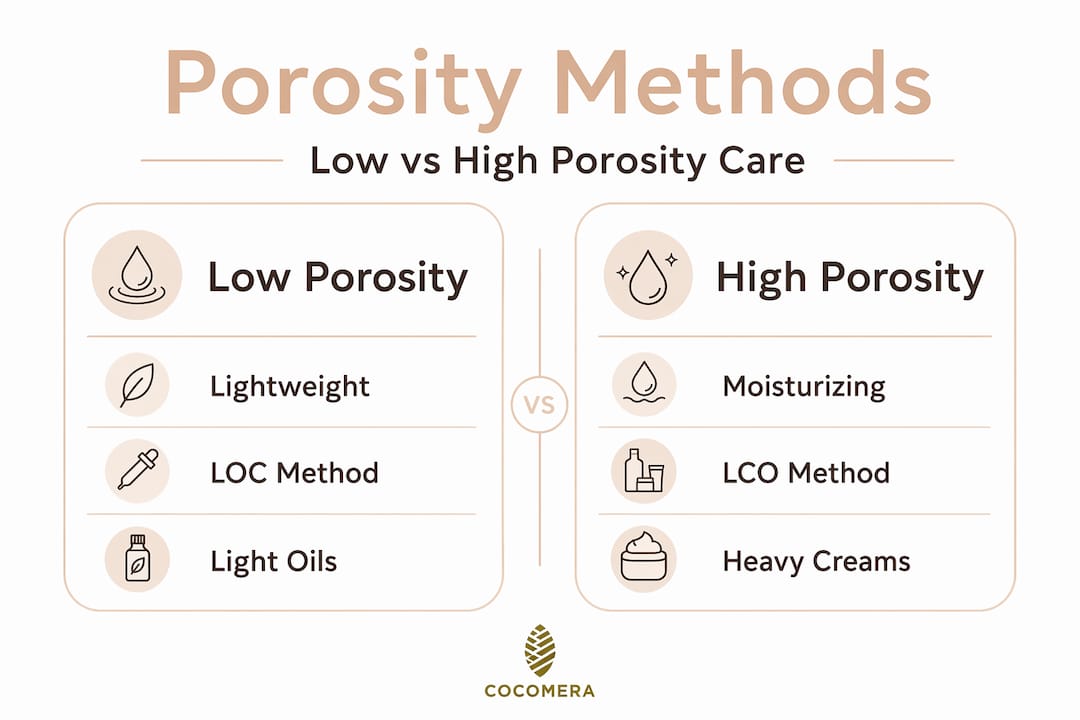
High-porosity hair has raised cuticles that absorb quickly but also lose moisture fast. The LCO method works better here: Liquid, then Cream, then Oil. The cream delivers moisture and some hold, and the oil goes on last as a sealant to slow down moisture loss throughout the day.
For very dry, high-porosity, or coily hair types (think 4a, 4b, 4c), there’s also the LOB method: Liquid, Oil, then Butter. Butters are heavier than creams and form a denser seal. This is particularly effective in dry or cold climates where moisture evaporates faster.
| Method | Hair type | Order | Why it works |
|---|---|---|---|
| LOC | Low porosity (2a to 3c) | Liquid, Oil, Cream | Oil seals moisture before heavier cream adds definition |
| LCO | High porosity (3a to 4c) | Liquid, Cream, Oil | Cream hydrates first, oil seals to slow moisture escape |
| LOB | Very dry / coily (4a to 4c) | Liquid, Oil, Butter | Butter creates the densest seal for maximum moisture retention |
Pro Tip: To test your porosity at home, drop a clean strand of hair into a glass of water. If it floats for more than two minutes, you likely have low porosity. If it sinks quickly, you’re probably high porosity.
Understanding the role of oils by porosity type helps you pick the right oil weight too. Light oils like argan or grapeseed suit low-porosity hair, while heavier oils like castor or jamaican black castor oil are better for high-porosity and coily textures.
Preparing your hair for layering
The prep work before you apply a single styling product is where most people leave moisture on the table. Layering curly hair products on hair that isn’t properly clean or conditioned is like painting over a dirty wall. The products can’t perform.
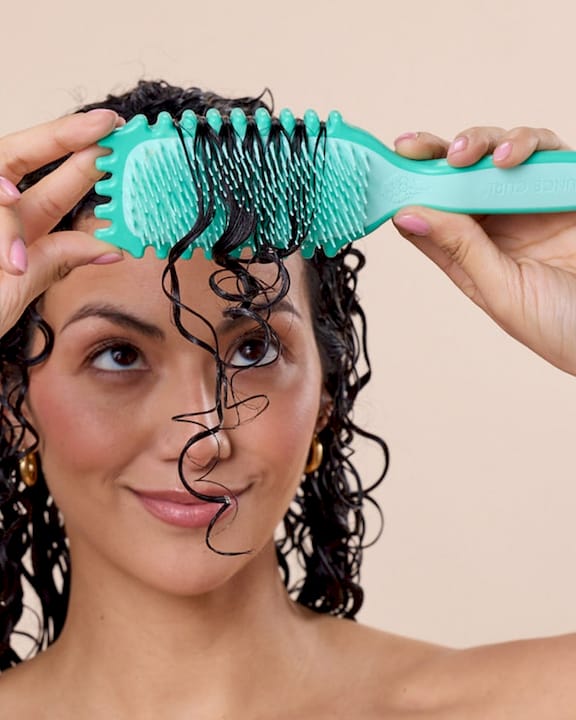
Start with a sulfate-free shampoo or a co-wash depending on your routine frequency. Rinse-out conditioner is not optional. It acts as the baseline conditioning step that brings your hair to the right level of softness and moisture before you add anything else. Work it through section by section, detangling with a wide-tooth comb while the conditioner is in. Rinse with cool water to help close the cuticle slightly before styling.
From there, the moisture sandwich technique is your best friend. The idea is simple: you apply a water-based leave-in on damp hair, wait one to two minutes, then apply your cream, wait again, and finish with an oil or butter. Those absorption pauses make a genuine difference. They give each layer time to penetrate before the next one seals over it, which prevents buildup and product balling.
Here’s a clean prep checklist to follow before you get to styling:
-
Shampoo or co-wash to remove buildup and open the slate for fresh moisture
-
Apply rinse-out conditioner generously, section by section, and detangle thoroughly
-
Rinse with cool water and gently squeeze out excess, leaving hair very damp
-
Split hair into four to six sections for controlled product application
-
Work through each section one at a time so no part dries before you get to it
Pro Tip: If your hair feels coated or products keep balling up, it’s time for a clarifying shampoo. Clarify once every two to four weeks depending on how heavily you layer, and always follow with deep conditioning.
Product buildup is one of the quieter causes of curl problems. Even great curly hair product combinations can fail if you’re layering on top of old product residue.
Step-by-step wash day and refresh routine
This is where the rubber meets the road. Once your hair is prepped, the order of application on wash day follows a clear pattern. The goal is to layer from the most water-based to the heaviest product, giving moisture the best chance to penetrate before you seal it in.
Wash day product application
-
Leave-in conditioner: Apply generously to soaking wet hair, section by section. Work it from roots to ends.
-
Curl cream: Apply over the leave-in while hair is still very wet. Rake and smooth it through each section. Soaking wet styling locks in significantly more moisture than applying to damp hair.
-
Oil or butter: Add a few drops to seal in the leave-in and cream. For the LOC method, this goes before the cream. For LCO, it goes after.
-
Gel or mousse: Apply to define and hold the curl pattern. Use a gel with a strong hold if your curls tend to drop, or a softer mousse if you want more volume. Scrunch upward toward the scalp to encourage curl formation.
-
Diffuse or air dry without touching: Once product is applied, leave the hair alone. Minimal manipulation during drying is what separates defined curls from a frizzy mess.
Midweek refresh routine
Your curls don’t need a full wash day every time they lose their shape. A quick refresh can extend definition by another two to three days.
-
Mist hair with water until it’s lightly damp, not soaking
-
Apply a small amount of leave-in conditioner or a curl refresher spray
-
Scrunch upward gently to reactivate the curl pattern
-
Add a tiny amount of gel only to areas that have lost definition
-
Air dry or diffuse briefly on low heat
Troubleshooting common layering mistakes
Even with the right products, small mistakes in technique can unravel everything. Here’s what to watch for.
The most damaging error is applying oil before your water-based leave-in. Heavier oils create a hydrophobic barrier on the cuticle that blocks water-based products from penetrating. Your hair ends up looking coated but feeling dry underneath. Always lead with liquid.
The second most common problem is over-conditioning. This one is sneaky because conditioning feels like care. But when conditioning accumulates across your shampoo, rinse-out conditioner, leave-in, and cream, your gel has nothing firm to grip. Curls go limp, especially by the end of the day.
Here are the most common signs your routine is out of balance:
-
Limp curls by afternoon: Usually too much conditioning relative to hold. Try a stronger gel or reduce the amount of cream.
-
Crunchy curls that don’t soften: Usually not enough conditioning or over-use of gel. Add more leave-in before the gel.
-
Frizz despite heavy layering: Products may not be absorbing. Check porosity and switch methods, or clarify to remove buildup.
-
Product balling: Hair is too dry when applying, or layers aren’t getting enough absorption time between them.
Pro Tip: Dense, coily hair (4b and 4c) usually needs heavier products and more of them. Fine, wavy hair (2a to 2c) often does better with fewer layers and lighter formulas. The same technique applied to two different curl types can produce completely opposite results.
The goal of curly hair layering tips is always about achieving synergy between your conditioning steps and your hold steps, not piling on more product.
Maintaining curls after styling
Getting your curls to look great at wash day is only half the job. Keeping them looking that way for the next four to six days takes deliberate choices around drying and overnight care.
Drying methods compared
| Method | Best for | Key benefit | What to avoid |
|---|---|---|---|
| Diffuser on low heat | All curl types | Speeds drying with less frizz | Holding diffuser still; scrunch into it instead of roaming |
| Air drying | Low to medium density curls | Zero heat damage | Touching hair before it’s fully dry |
| Plopping | Fine or medium curls | Encourages clumping and shape | Leaving in too long (over 30 minutes) |
| Silk bonnet overnight | All types | Retains moisture and curl shape | Cotton pillowcases that absorb product and cause friction |
Diffusing until 80 to 90% dry before finishing with air drying gives curls their best structure. The roaming diffuser technique works better than pressing curls directly into the cup. Move the diffuser slowly across sections rather than holding it in one place.
For overnight care, a satin or silk pillowcase or a bonnet is not optional if you want your curls to last. Cotton absorbs your product and creates friction that disrupts the curl pattern. Loose plaits or a pineapple (gathering curls loosely at the top of your head) keeps length and volume intact.
Pro Tip: If your curls deflate overnight even with a bonnet, your hair may be losing moisture during sleep. Try applying a tiny amount of lightweight oil to the ends before bed to slow moisture loss.
Midweek hydration also matters. Layering products for curls forms a humidity barrier that protects against dehydration, but that barrier breaks down after a few days. A simple mist of water followed by a light leave-in keeps it refreshed without a full wash.
My honest take on layering curly hair products
I’ve watched so many people spend months trying product after product, convinced their curls were “just difficult,” when the real issue was sequence and timing. The truth is, I’ve seen the exact same product line produce incredible results for one person and do almost nothing for another, purely because of how and when they applied it.
What I’ve learned from seeing dozens of curl routines succeed and fail is that patience with the process consistently beats product overload. Most people don’t need more products. They need to use fewer products in the right order with enough time between layers to let absorption happen. The moisture and hold balance framework is genuinely the most useful mental model for this. Think of your routine as a dial between conditioning and hold. Your job is to find where your specific curls need that dial to sit.
One thing that consistently surprises people is how much porosity matters compared to curl type. Two people with 3b curls can need completely opposite layering methods if one has low porosity and the other has high porosity. I’d encourage you to test your porosity before you do anything else and use that as your starting point, not your curl number.
Don’t follow a trend or copy a routine just because it worked for someone online. Their porosity, density, climate, and water type are different from yours. Observe how your hair behaves after each wash day and adjust from there. That feedback loop, not any single product, is what gets you to consistent, defined curls.
— Cocomera
Find the right products for your layering routine
If you’ve been putting in the work and still feel like something’s missing, it might come down to having the right building blocks in your routine.
At Cocomera, every product is curated specifically for wavy, curly, coily, and afro hair types. You’ll find styling products for curly hair that are organized by function, so you know exactly what role each one plays in your layering sequence. From lightweight leave-in conditioners for fine type 2 and 3 curls to richer curl creams suited for type 4 textures, the range covers every step of the LOC, LCO, and LOB methods. You’ll also find hair brushes and combs designed for textured hair to make product distribution easier without disturbing your curl pattern.
FAQ
What is the LOC method and who should use it?
The LOC method (Liquid, Oil, Cream) is best for low-porosity hair types that struggle to absorb moisture. It applies a water-based leave-in first, seals with oil, then adds cream for definition and hold.
How do you layer curly hair products without weighing curls down?
Use lighter products for fine or low-porosity hair and reduce the number of layers. Applying products to soaking wet hair also helps each layer absorb properly instead of sitting on top and creating heaviness.
What’s the difference between LOC and LCO methods?
The LOC method puts oil before cream and works for low-porosity hair, while the LCO method reverses the last two steps and suits high-porosity hair that needs oil as a final sealant.
How often should you clarify when layering products?
Clarify every two to four weeks depending on how many products you use. Signs you need to clarify include product balling, lack of definition, or a heavy, coated feeling that doesn’t go away after regular washing.
Can you use the same layering routine in summer and winter?
Not ideally. In summer, layered products form a humidity barrier that fights moisture overload, so lighter gels work well. In winter, drier air means you may need heavier butters or more layers to compensate for faster moisture loss.