TL;DR:
- Protective styles for curly and afro hair must minimize manipulation, protect ends, and avoid scalp tension to be effective. Proper preparation, tension control, and timely takedown are essential for retaining length and maintaining scalp health, while styles should be worn within recommended durations to prevent damage. Active, consistent care, including moisturizing and proper washing routines, ensures true protection and hair health during styling periods.
If you have curly or afro hair, you already know the cycle: wash day takes hours, your ends are constantly dry, and every time you try to refresh your style, you lose more hair than you should. This guide to protective styling is for you. Not the version that just lists a few braid styles and calls it done, but the one that explains what actually makes a style protective, how to prep your hair correctly, and how to keep your scalp healthy while your hair is tucked away. Follow this, and you will keep more of your length and spend less time fighting your hair.
Table of Contents
Key takeaways
| Point | Details |
|---|---|
| Definition matters | A style is only protective if it minimizes manipulation, protects ends, and avoids scalp tension. |
| Prep is non-negotiable | Deep conditioning and scalp cleansing before installation directly impacts how well your hair survives the style. |
| Duration limits are real | Braids and twists should stay in 4 to 12 weeks max; wearing them longer causes more damage than no style at all. |
| Maintenance is active work | Washing every 2 to 3 weeks and moisturizing regularly keeps your scalp healthy and your hair strong throughout the style. |
| Growth myths persist | Protective styles retain length by reducing breakage. They do not make your hair grow faster. |
What protective styling really means
The phrase “protective style” gets used loosely, and that is where a lot of damage starts. So let’s be precise.
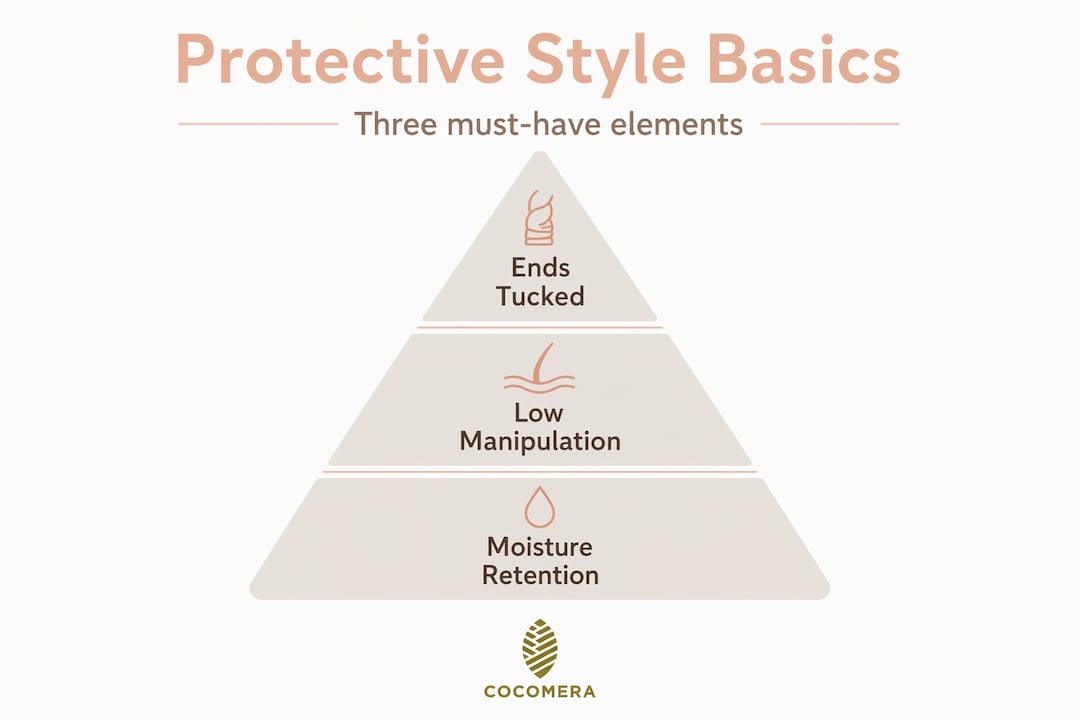
A style qualifies as protective when it does three things: minimizes daily manipulation of your hair, keeps your ends tucked away from friction and dryness, and does not place chronic tension on your scalp or follicles. Any style that creates pain during or after installation, or that you cannot access your scalp through, is not truly protective. It is just styled.
Styles that count as protective
Common protective styles for curly and afro hair include:
-
Box braids and knotless braids: Long-lasting and versatile. Knotless braids distribute weight more evenly and are gentler on the hairline.
-
Twists (two-strand or flat): Great for finer 3c to 4a hair types and less tension-intensive than braids.
-
Faux locs: Heavier than braids, so tension management at the roots is especially important.
-
Buns and updos: Excellent for low-manipulation days, especially when the ends are fully tucked.
-
Wigs and weaves: Effective when your natural hair underneath is properly moisturized and not braided too tightly.
-
Cornrows: Stylish and classic, but require careful attention to tension at the scalp.
How long should each style stay in?
| Style | Recommended duration |
|---|---|
| Box braids / twists | 4 to 12 weeks |
| Cornrows | 2 to 8 weeks |
| Bantu knots | 1 to 2 weeks |
| Buns and low-manipulation styles | Refresh weekly or as needed |
| Wigs | Rotate every 1 to 2 weeks for scalp access |
Wearing braids past 12 weeks does not give your hair more time to grow. It gives new growth more time to tangle into old braids, making takedown a nightmare and breakage almost unavoidable.
How to prep your hair before installing a style
The work you do before your braider or stylist even touches your hair determines how well your hair comes out when the style comes down. Skipping prep is the most common reason people lose length after protective styles.

Start with a clarifying wash. Product buildup and hard water deposits block moisture from penetrating your strands, and trapping that buildup under a style for weeks accelerates scalp irritation. Use a strengthening shampoo designed for textured hair so you cleanse thoroughly without stripping moisture.
Follow with a protein treatment if your hair has been feeling limp, stretchy, or prone to snapping. Protein fills in weak spots along the hair shaft. After the protein treatment, always follow up with a deep conditioner so your hair does not feel stiff or brittle going into the style. You can learn exactly how to approach this step with a hair masking guide built for textured curls.
Here are the key prep steps in order:
-
Clarify your scalp and strands with a sulfate-based or apple cider vinegar rinse
-
Apply a protein treatment, leave on for 20 to 30 minutes, then rinse
-
Follow immediately with a deep conditioning mask for 20 to 45 minutes with heat
-
Detangle gently from ends to roots while conditioner is still in your hair
-
Apply a leave-in conditioner and seal with a lightweight oil before styling
Pro Tip: Do not install your protective style on the same day as your wash. Give your hair one day to fully dry and absorb your leave-in and oil. Going into a style wet or still damp increases the risk of mildew on your scalp and mold in your braids.
Installing and maintaining your protective style
Getting the style in correctly is only half the job. What you do for the weeks your hair is in the style determines whether you come out with healthier hair or thinner edges.
Tension control during installation
This is the most critical part of the entire process. Pain during installation is not normal and it is not something to push through. It is your scalp telling you the style is causing damage. Even mild but constant tension over weeks can trigger traction alopecia, which is the gradual loosening and loss of hair follicles, particularly at the temples and nape.
Communicate clearly with your stylist. If something hurts, say so immediately and have them redo that section. Traction alopecia can be permanent. Your edges are worth the awkward conversation.
Moisturizing while in your style
-
Apply a lightweight leave-in spray to your braids or twists every two to three days to keep the hair underneath hydrated.
-
Follow with lightweight oils like jojoba or sweet almond oil to seal in that moisture. Heavy butters and thick creams cause buildup quickly in protective styles.
-
Massage your scalp gently every few days to stimulate circulation and distribute natural oils.
Washing your hair while in a style
Yes, you still need to wash your hair. Every 2 to 3 weeks is the standard recommendation to keep your scalp clean and prevent follicle-clogging buildup. Dilute your shampoo with water in an applicator bottle and apply it directly to your scalp in sections. Squeeze the product down the braids gently rather than scrubbing. Rinse thoroughly. If your scalp is prone to dryness or flaking, an anti-dandruff shampoo for curly hair formulated for textured hair keeps irritation under control without stripping your style.
Nighttime care
-
Sleep with a satin or silk bonnet every night. Cotton pillowcases pull moisture out of your braids and create friction that frizzes and weakens your hair at the roots.
-
If your braids are too long for a bonnet, use a satin-lined pillowcase or a silk scarf tied loosely around your head.
-
Avoid tight ponytail holders at night. Sleeping with your style pulled back tightly adds stress to your already-tended hair line.
Pro Tip: Rotating your styles and changing where your parts fall with each new install protects your edges from localized stress. Never braid the exact same part twice in a row.
Recognizing when something is wrong
Protective styles are meant to give your hair a break, not create new problems. Knowing the warning signs early saves you from real damage.
“A style is protective only when it is truly low-stress on your follicles and actively maintained. Without the right care routine, it is just a style.” — Celebrity hairstylist Paula Peralta, via Cosmopolitan
Watch for these red flags while you are in a protective style:
-
Pain or tightness that does not ease up within 24 to 48 hours of installation. Mild tension sometimes settles, but persistent pain is a clear signal to loosen the style or take it down.
-
Bumps or pimples on your scalp that may signal buildup or an allergic reaction to products or synthetic hair.
-
Flaking, itching, or redness concentrated around your parts. This usually means you need to wash sooner than planned.
-
Thinning or fuzzy edges when you take the style down. This is the earliest sign of traction stress.
When it is time to take down your style, do not rush. Soak the ends with a detangling product and work through sections slowly from ends to roots. After takedown, follow with a protein treatment and deep conditioner before restarting your routine. Your hair has been in a low-manipulation state for weeks. It needs a gentle reintroduction to your hands.
The real benefits of protective styling done right
When you prepare properly, stay consistent with maintenance, and take down styles at the right time, the results are real. Protective styles reduce daily mechanical stress and breakage, which is the primary reason many women with type 3 and 4 hair struggle to retain length. Less combing, less heat, and less friction add up over months.
You will also notice improved moisture retention. With your ends tucked and protected, they hold onto hydration longer between wash days. Styling time drops significantly because you are refreshing a style rather than building one from scratch every few days.
One thing worth being honest about: protective styles do not make your hair grow faster. Hair grows roughly 1 cm per month regardless of what is on your head. What protective styling does is help you keep more of what grows. That is length retention, not accelerated growth. It is a meaningful distinction, especially if you have been wearing protective styles for years expecting rapid transformation and feeling discouraged when it does not come.
What I have learned from watching protective styling go wrong
At Cocomera, I have seen so many people come to us after losing their edges or dealing with scalp damage they did not know how to address. And almost every single time, the problem was not the style itself. It was the belief that protective styling means you can stop paying attention to your hair.
The “low maintenance” idea is one of the most harmful myths in the natural hair community. Yes, protective styles reduce your daily styling load. But they require consistent, active care at the scalp level. The moment you stop moisturizing, stop washing, and stop checking in on your edges, the style stops being protective.
My honest take: choose your protective style based on your actual lifestyle. If you travel often, a wig with a proper wig cap and cornrows underneath might be more practical than box braids that need daily moisture. If you workout five days a week, cornrows and a satin headband will serve you better than a style that cannot handle sweat and frequent washing. The best style for you is the one you will actually maintain.
I also believe that stopping breakage before you start a style is more valuable than any product you use while in it. Go in with strong hair, and you come out with strong hair.
— Cocomera
Products that make protective styling work
Building a solid protective styling routine depends just as much on the products you use as the technique you follow.
At Cocomera, we have put together collections specifically for women with curly and afro hair who want to get the most out of every protective style. Whether you are looking for styling products for curly hair to keep your braids moisturized and your scalp clean, or hair treatments to restore strength before and after your style, you will find products chosen with your curl type in mind. If you need braiding hair that works with low-tension techniques, our braiding hair extensions collection covers you. Everything is curated to support your hair health at every stage of your protective styling routine, not just on install day.
FAQ
What is protective styling for natural hair?
Protective styling means wearing your hair in a way that minimizes daily manipulation and keeps your ends tucked away from friction, dryness, and breakage. Common examples include braids, twists, buns, and wigs.
How often should I wash my hair in a protective style?
Washing every 2 to 3 weeks is recommended while in a protective style. Use a diluted shampoo applied directly to your scalp to clean without disrupting your style.
Do protective styles make your hair grow faster?
No. Hair grows about 1 cm per month regardless of your style. Protective styles help you retain the length you grow by reducing breakage, not by speeding up the growth process.
How do I know if my braids are too tight?
If you feel pain, tightness, or see bumps along your hairline after installation, your braids are causing harmful tension. Pain that does not ease within 48 hours is a sign you need to loosen or remove the style to prevent traction alopecia.
How long should I leave a protective style in?
It depends on the style. Braids and twists last 4 to 12 weeks, cornrows 2 to 8 weeks, and bantu knots only 1 to 2 weeks. Wearing any style past its recommended time increases the risk of tangling and breakage at the roots.