TL;DR:
- Deep conditioners are essential for textured hair because they repair, hydrate, and strengthen the inner hair shaft. They differ from regular conditioners by penetrating the cortex and requiring longer application times for effective results. Regular use helps prevent breakage, frizz, and loss of curl definition, promoting healthier, more elastic, and vibrant hair.
Deep conditioners are intensive hair treatments that penetrate beyond the cuticle to repair, hydrate, and strengthen the hair shaft from within. For curly, coily, and textured hair, they are not optional extras. They are the foundation of a healthy hair care routine. Celebrity hairstylist TerraRose Puncerelli describes them as corrective treatments designed to improve elasticity and deep hydration, not daily maintenance products. The role of deep conditioners goes far beyond softness. They address the structural vulnerabilities that make textured hair prone to dryness, breakage, and loss of definition.
How do deep conditioners differ from regular conditioners?
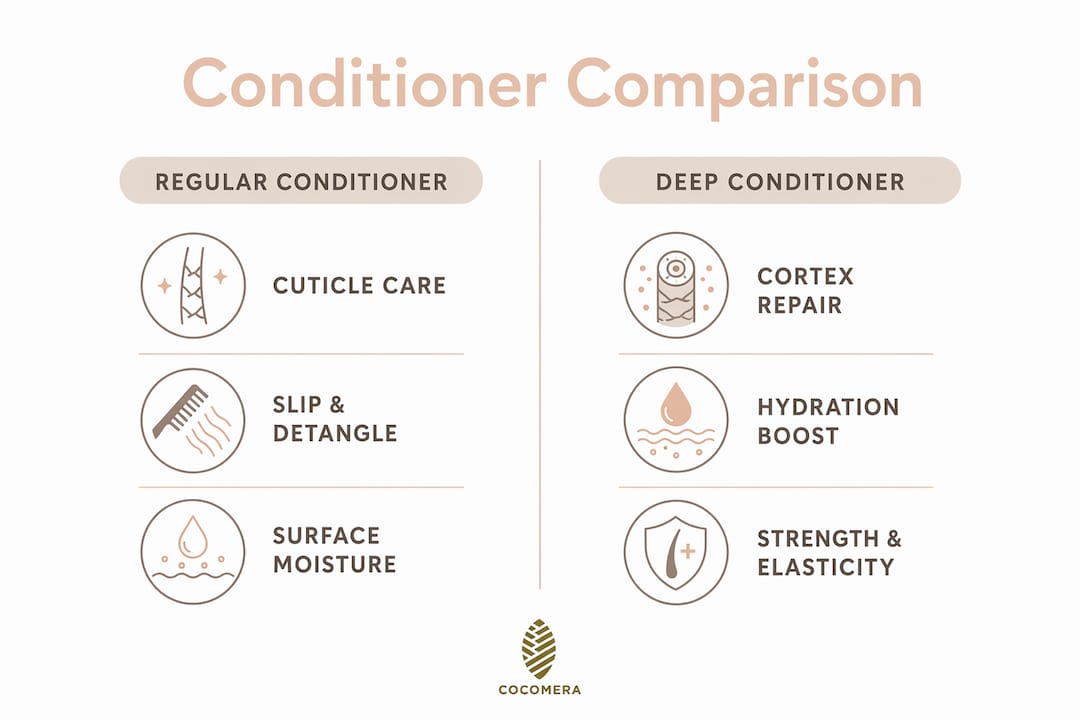
The difference between a deep conditioner and a regular conditioner is not just time. It is formulation, penetration, and purpose.
Regular conditioners primarily smooth the cuticle and add slip for detangling. They work on the surface of the hair strand and rinse out in 1–3 minutes. Deep conditioners, by contrast, contain higher concentrations of humectants, proteins, and oils specifically designed to reach the cortex, the inner layer of the hair shaft where structural damage actually occurs.
Deep conditioners require 10–30 minutes to penetrate and work effectively. That extended contact time is not arbitrary. It gives the active ingredients time to move past the cuticle and address dryness and damage at the source.
Here is a clear breakdown of the key differences:
| Feature | Regular conditioner | Deep conditioner |
|---|---|---|
| Penetration depth | Cuticle only | Cortex (inner shaft) |
| Leave-on time | 1–3 minutes | 10–30 minutes |
| Frequency | Every wash | Weekly or biweekly |
| Primary purpose | Detangling, surface smoothing | Repair, moisture restoration |
| Ingredient concentration | Moderate | High (proteins, oils, humectants) |
Both products belong in your routine. They serve completely different functions, and one does not replace the other.
Why is deep conditioning critical for curly and textured hair?
Curly and textured hair has a structural challenge that straight hair does not. Natural scalp oils struggle to travel down the twists and coils of the hair shaft, which means the ends and mid-lengths of curly strands are almost always moisture-deprived. This is not a product problem. It is biology. Understanding why your hair needs moisture at a structural level changes how you approach your entire routine.
The consequences of that chronic dryness are predictable. Hair becomes brittle, loses elasticity, and breaks before it can grow to length. Frizz increases. Curl definition fades. Deep conditioning treatments directly counter this by delivering moisture and protein to the cortex, restoring the flexibility that prevents breakage.
Key reasons deep conditioning matters specifically for textured hair:
-
Moisture deficit: Coils and kinks block natural oil distribution, so external hydration is not optional.
-
Elasticity loss: Dry hair snaps instead of stretching. Deep conditioners restore the stretch that protects strands during styling and detangling.
-
Frizz control: Well-hydrated hair responds to humidity differently. Moisture-balanced strands swell less and hold their pattern better.
-
Curl definition: Hydrated curls clump together naturally. Dry curls separate and frizz instead of forming clean coils.
-
Damage prevention: Heat styling, color, and environmental exposure all strip moisture. Deep conditioning rebuilds what those processes remove.
Pro Tip: Apply your deep conditioner to soaking wet hair after shampooing. The water already in the strand helps the product absorb faster and more evenly, especially on dense or coily textures.
What are the key benefits of a deep conditioning routine?
Deep conditioning improves elasticity, reduces breakage and split ends, restores moisture, and can support hair growth indirectly by minimizing the breakage that prevents length retention. These are not marketing claims. They are outcomes backed by dermatology and hair care professionals.
The advantages of deep conditioning stack up across multiple areas of hair health:
-
Restored moisture and softness. Deep conditioners replenish hydration at the cortex level, leaving hair noticeably softer and more pliable after a single treatment.
-
Reduced breakage. Stronger, more elastic hair withstands the mechanical stress of detangling, styling, and daily manipulation without snapping.
-
Improved manageability. Hydrated strands detangle more easily, which cuts down on the time and tension required to work through knots.
-
Protection from damage. Regular deep conditioning treatments build a buffer against heat, color, and environmental stressors that degrade the hair shaft over time.
-
Enhanced shine. When the cortex is properly hydrated, the cuticle lies flat. Flat cuticles reflect light evenly, which is what creates visible shine.
“Deep conditioners are not for daily use. They serve as corrective treatments to improve elasticity and deep hydration.” — TerraRose Puncerelli, celebrity hairstylist
One misconception worth addressing: deep conditioning does not make hair grow faster. What it does is reduce the breakage that prevents you from retaining the length your hair already grows. The result looks like faster growth because you are keeping more of what you produce.
How to use deep conditioning treatments for best results
Getting the most from your deep conditioning routine comes down to preparation, timing, and product selection. Skipping any one of these reduces the results you see.
Preparation and application
Start with a clean scalp. Shampooing before a deep conditioning treatment removes buildup that would otherwise block absorption. If you use heavy styling products regularly, a clarifying shampoo every few weeks clears the slate more thoroughly than a standard wash.
Apply the deep conditioner generously to damp hair, section by section. Work it from mid-length to ends, where dryness and damage concentrate. The scalp does not need deep conditioner. It produces its own oils.
Heat and timing
Using heat during deep conditioning slightly lifts the hair cuticle, which improves product absorption. A hooded dryer, heat cap, or even a warm towel wrapped around your head achieves this effect. Leave the treatment on for the full 10–30 minutes. Rinsing early cuts the process short before the active ingredients have finished working.
Choosing the right product
Not all deep conditioners serve the same purpose. Moisture-focused formulas work best for hair that feels dry and brittle. Protein-rich treatments suit hair that has lost elasticity or feels limp and overstretched. If your hair snaps easily, lean toward protein. If it feels rough and stiff, lean toward moisture. Many people alternate between the two based on how their hair responds week to week.
Pro Tip: Do a simple elasticity test before choosing your treatment. Take a wet strand and gently stretch it. If it stretches and returns, your moisture balance is good. If it snaps immediately, you need moisture. If it stretches but does not return, you need protein.
Overuse of deep conditioners can cause product buildup, a greasy scalp, or hair that feels limp and weighed down. Weekly or biweekly application is the standard for most textured hair types. Fine curls may need less frequency than dense coils.
What to look for in deep conditioners for textured hair
The best deep conditioners for curly and coily hair share a specific set of ingredients. Knowing what to look for on a label saves you from wasting money on products that deliver surface shine without real repair.
Effective formulas for textured hair typically contain shea butter, avocado oil, glycerin, and proteins. Each ingredient plays a distinct role. Glycerin is a humectant that draws moisture from the air into the hair shaft. Shea butter and avocado oil seal that moisture in and add softness without heaviness. Proteins, such as hydrolyzed keratin or quinoa protein, reinforce the hair shaft structure and reduce breakage.
Look for these qualities when evaluating a product:
-
Humectants listed early in the ingredient list: Glycerin, aloe vera, or honey near the top signals meaningful moisture delivery.
-
Nourishing oils without mineral oil: Avocado, jojoba, and coconut oil absorb well. Mineral oil sits on the surface and contributes to buildup.
-
Protein content matched to your hair’s needs: Hydrolyzed proteins penetrate better than larger protein molecules. Products like the Trepadora Quinoa Repair Deep Conditioner use quinoa protein specifically for this reason.
-
No heavy silicones: Dimethicone and similar silicones coat the strand and require sulfate shampoos to remove, which can disrupt moisture balance over time.
For a deeper look at which ingredients work best for your specific curl pattern, the guide on best ingredients for textured hair breaks it down by hair type and concern.
Key Takeaways
Deep conditioning is the single most effective treatment for maintaining moisture, elasticity, and structural integrity in curly and textured hair.
| Point | Details |
|---|---|
| Deep conditioners penetrate deeper | They reach the cortex, not just the cuticle, which is where real repair happens. |
| Textured hair needs external moisture | Natural oils cannot travel down coils easily, making deep conditioning treatments non-negotiable. |
| Timing and heat matter | Leave treatments on for 10–30 minutes and use heat to improve absorption. |
| Ingredient selection is key | Look for glycerin, shea butter, avocado oil, and hydrolyzed proteins for best results. |
| Overuse causes problems | Weekly or biweekly application is the right frequency for most textured hair types. |
What we have learned from years of working with textured hair
The most common mistake people make with deep conditioning is treating it like a rescue operation rather than a regular practice. They reach for a deep conditioner only when their hair is already in crisis, brittle, breaking, and unmanageable. By that point, one treatment will not undo months of neglect. Consistency is what actually transforms hair health.
We have also seen a lot of confusion around the moisture-protein balance. People hear “protein treatment” and assume it is only for chemically processed hair. That is not accurate. Natural coils and coily hair types lose protein through everyday manipulation, heat, and environmental exposure. Alternating between a moisturizing deep conditioner and a protein-rich treatment every few weeks keeps the balance right and prevents both brittleness and limpness.
The other thing worth saying plainly: not every expensive product outperforms a mid-range one. What matters is whether the formula matches your hair’s actual needs. A $12 deep conditioner with glycerin, shea butter, and hydrolyzed protein will outperform a $40 product loaded with silicones and fragrance. Read the label, not the price.
If you are new to deep conditioning, start simple. Pick one moisturizing treatment, apply it weekly for a month, and pay attention to how your hair responds. The changes in elasticity, softness, and breakage will tell you exactly what to adjust next.
— Cocomera
Find the right deep conditioning treatments at Cocomera
Cocomera curates deep conditioners and hair treatments specifically selected for wavy, curly, coily, and afro hair types. Every product in the collection is chosen for its ingredient quality and its fit with the real needs of textured hair, not just its marketing claims.
Whether you are building your first deep conditioning routine or refining one that already works, the hair treatments for curly hair collection at Cocomera gives you options matched to your curl type and hair concerns. You will also find hair masks for curly hair for targeted moisture and repair, and hair oils to seal in the hydration your deep conditioner delivers. Everything you need to build a complete routine is in one place.
FAQ
What is the role of deep conditioners in hair care?
Deep conditioners deliver intensive moisture and protein directly to the hair cortex, repairing damage and restoring elasticity that regular conditioners cannot reach. They are corrective treatments, not daily maintenance products.
How often should you deep condition curly hair?
Most textured hair types benefit from deep conditioning once a week or every two weeks. Fine curls may need less frequency, while dense coils often benefit from weekly treatments.
Can deep conditioning replace regular conditioning?
No. Regular conditioners smooth the cuticle and aid detangling after every wash. Deep conditioners provide intensive repair on a weekly or biweekly schedule. Both serve distinct functions in a complete routine.
What happens if you deep condition too often?
Overuse of deep conditioners can cause product buildup, a greasy scalp, and hair that feels limp or weighed down. Sticking to weekly or biweekly application prevents these issues.
Do you need heat to deep condition effectively?
Heat is not required, but it helps. Applying heat during treatment lifts the cuticle slightly, which allows the product to absorb more deeply. A heat cap or hooded dryer works well for this purpose.