Most people assume that skipping the blow dryer means accepting frizz as a given. That assumption is wrong, and it costs curly-haired women better hair days. Understanding why air dry curly hair practices actually work comes down to knowing what happens to your curl pattern during drying, not just choosing between heat or no heat. When you air dry with the right technique, you preserve curl clumping, protect your strands from heat stress, and let your natural texture do what it was always designed to do. This guide covers the science, the comparisons, and the practical steps that make air drying work for curly and afro hair.
Table of Contents
-
Air drying versus towel and diffusing: benefits and trade-offs for curly hair
-
Proven techniques and product tips for successful air drying of textured hair
-
How hair type, porosity, and environment shape your air drying strategy
-
Enhance your air-drying routine with Cocomera’s curated curly hair care products
Key Takeaways
| Point | Details |
|---|---|
| Frizz causes | Frizz results from lifted hair cuticles absorbing moisture unevenly, especially in humid environments. |
| Benefits of air drying | Air drying preserves natural curl formation and reduces heat damage when done gently and with the right products. |
| Technique matters | How you handle your hair—blotting, scrunching, product application—greatly affects air drying success. |
| Hair type influence | Porosity and curl tightness determine which drying strategies and products work best for your hair. |
| Combine and adapt | For healthiest curls, combine towel techniques with air drying and adjust based on climate and daily needs. |
Understanding why air drying impacts curly hair differently
Curly and coily hair responds to drying conditions in ways that straight hair simply does not. The spiral structure of each strand means the hair cuticle (the outer protective layer) is naturally more raised and irregular than on a straight strand. When that cuticle is wet, it lifts further, leaving the hair vulnerable to whatever moisture is in the surrounding air.
Frizz occurs when the cuticle lifts and absorbs moisture unevenly from the air, creating that rough, unpredictable texture most of us are trying to avoid. This is not a flaw in air drying. It is a signal that the cuticle needs support during the drying process.
The spiral shape of curly and coily hair also means the scalp’s natural oils struggle to travel down the strand. This leaves curly hair inherently drier and more thirsty than straight hair, which is why moisture retention matters so much at every step of your wash day routine.
Here is what drives frizz and texture changes specifically during air drying:
-
Cuticle lifting: Wet hair raises the cuticle layer, making strands porous and reactive to humidity
-
Uneven drying: Different sections of curly hair dry at different speeds, causing inconsistent curl formation
-
Humidity absorption: In humid climates (very common across northern and western Europe), hair can absorb up to 30% more moisture from the air, causing further swelling
-
Mechanical disruption: Touching, scrunching, or disturbing curls while wet breaks the curl clumps before they can set
-
Cold air: Slow drying in cold environments (think Swedish winters) increases the time the cuticle stays open and vulnerable
With this foundation, let’s examine the benefits and trade-offs of air drying compared to other drying methods.
Air drying versus towel and diffusing: benefits and trade-offs for curly hair
Not all drying methods are equal, but none is universally superior either. Each approach suits different hair textures, lifestyles, and climates. Knowing the trade-offs helps you choose what works for your specific curl pattern.
Air drying allows hair to dry slowly in its natural state, which preserves curl formation and reduces mechanical stress. No heat means no cuticle damage from thermal exposure, and no rushing means your curl clumps can set without interference. The downside is time. In cool, humid European climates, a full head of coily 4c hair can take four to six hours to dry completely, which carries its own risks.
The real differentiator is technique, not the method itself. A careless air dry will produce more frizz than a careful diffuse session.
| Drying method | Heat exposure | Frizz risk | Curl definition | Time required | Best for |
|---|---|---|---|---|---|
| Air drying | None | Medium (technique-dependent) | High if done correctly | Long (2 to 6 hours) | Low to medium porosity, types 2 to 4 |
| Towel drying | None | High (cotton towel) / Low (microfiber) | Can disturb curl clumps | Reduces total time | Pre-step before air drying or diffusing |
| Diffusing | Low to medium | Low to medium | High with volume | Short (20 to 45 minutes) | Thicker, tighter curl types, time-limited styling |
Key benefits of air drying for healthy textured hair:
-
Preserves natural curl elasticity over time by avoiding repeated heat exposure
-
Allows leave-in products and curl creams to fully absorb and activate without interruption
-
Reduces breakage caused by thermal and mechanical manipulation
-
Costs nothing and requires no equipment
When diffusing makes more sense:
-
Tight time constraints on weekday mornings
-
Cold weather where prolonged wetness leads to scalp dampness or hygral fatigue
-
When you want extra volume and lift at the roots
-
On coily hair wash day routines where complete drying time is impractical
Now that you know how air drying compares, let’s explore expert-backed techniques to make it work for your curls.
Proven techniques and product tips for successful air drying of textured hair
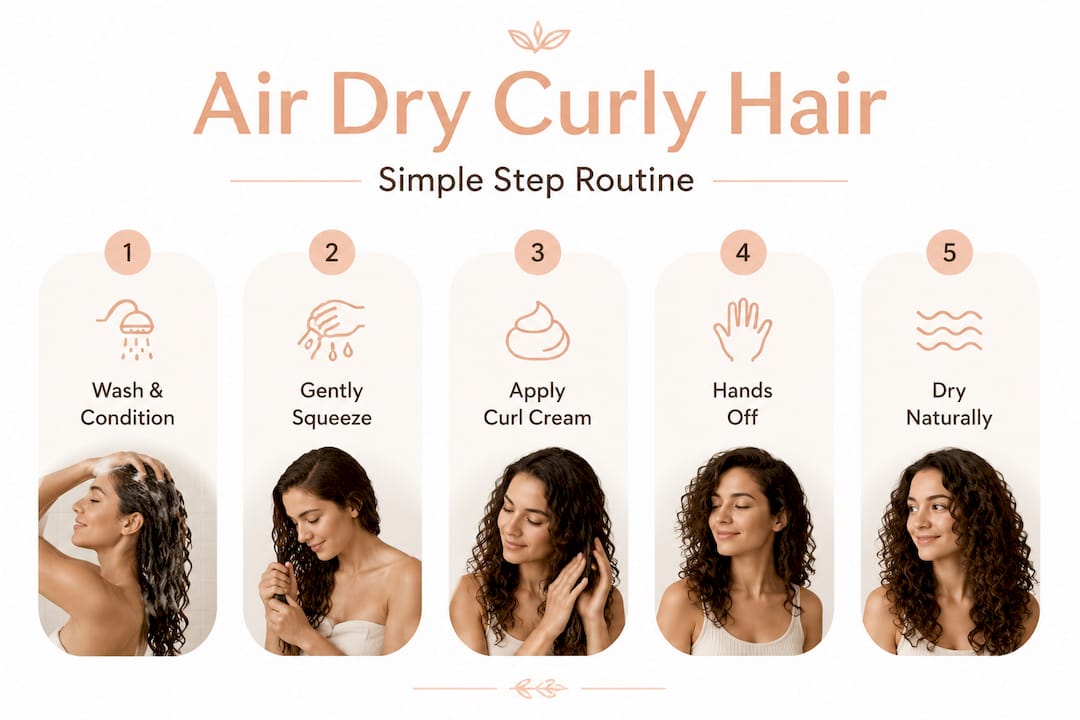
The difference between frizzy air-dried hair and beautifully defined curls is almost entirely in the first fifteen minutes after washing. What you do before the hair starts drying sets the result.
-
Remove excess water without wringing. Gently squeeze your curls from mid-length to ends using your palms pressed together. Never twist or wring. Wringing breaks curl clumps and stretches the strand while it is at its most fragile.
-
Use a microfiber towel or cotton T-shirt to blot. Regular cotton terry towels create friction that roughens the cuticle and destroys curl definition. Blotting instead of rubbing protects the curl pattern and reduces frizz. Plopping (wrapping hair in a T-shirt turban for ten to twenty minutes) is one of the most effective ways to start the drying process without disturbing curl formation.
-
Apply products to soaking wet hair. This is non-negotiable. Apply leave-in conditioner or curl cream generously to wet hair using the praying hands method (smoothing product down the strand between flat palms) followed by scrunching upward to encourage curl clumping. Wet application gives products a medium to travel through and locks moisture into the strand before drying begins.
-
Enhance definition with finger coiling or shingling where needed. For looser wave patterns (type 2 and 3), the praying hands method is often enough. For tighter coils and afro textures (type 4), finger coiling individual sections or shingling (applying gel or cream section by section from root to tip) creates uniform, defined curls that dry more evenly.
-
Leave it alone. Once products are applied and curls are set, do not touch them. Not to check. Not to rearrange. Every time you disturb drying hair you break a forming curl clump and invite frizz.
-
Finish by scrunching out crunch. If you used a styling gel, your curls may form a cast (a crunchy film) as they dry. Once fully dry, gently scrunch the cast out with a tiny amount of hair oil in your palms. This releases the curl while keeping the definition locked in.
Pro Tip: Flip your head upside down while scrunching in your curl cream or leave-in. Gravity helps the curls hang freely and clump naturally, and it builds volume at the roots that air drying alone can flatten. Using leave-in styling products formulated for textured hair makes a real difference here since these are designed to hydrate and hold without causing stiffness.
For the best results, pair these steps with leave-in conditioners suited to your porosity and a best hair moisturizer that works with your curl type, not against it.
With these techniques in hand, let’s look at how your hair’s individual characteristics should shape your air drying strategy.
How hair type, porosity, and environment shape your air drying strategy
Air drying is not one routine for all curl types. Your results depend heavily on your hair’s porosity (how well it absorbs and holds moisture), your curl pattern, and the climate you are drying in.
Porosity explained simply: Hair porosity describes how open or closed the cuticle layer is. Low porosity hair has tightly sealed cuticles that resist moisture absorption. High porosity hair has gaps or raised cuticles that absorb moisture fast but lose it just as quickly.
High porosity hair absorbs and loses moisture quickly, making it more prone to frizz during air drying, especially in humid climates. If your hair dries fast but always feels dry and looks frizzy, this is likely you.
Humidity directly impacts frizz; in humid conditions, hair can absorb up to 30% more moisture, causing swelling and further cuticle lifting. This is especially relevant in the UK, Ireland, the Netherlands, and coastal regions of Scandinavia where humidity is regularly high.
Key adjustments by porosity:
-
Low porosity hair: Use lightweight hair moisturizing products and let hair absorb products slowly. Avoid heavy butters and oils on wet hair as they can block absorption. Air drying works beautifully here since the slow process gives products time to penetrate.
-
High porosity hair: Seal moisture aggressively. Layer a leave-in conditioner, a cream, and a light oil before drying. The moisturizing shampoo you use at wash start also matters since a hydrating cleanse reduces how porous the hair behaves during drying.
| Hair type | Porosity tendency | Common air drying challenge | Best practice |
|---|---|---|---|
| Type 2 (wavy) | Low to normal | Waves drop, hair goes flat | Scrunch and plop; avoid heavy creams |
| Type 3 (curly) | Variable | Frizz in humidity, uneven definition | Layer products; use anti-humidity gel |
| Type 4a and 4b (coily) | Normal to high | Long drying time, shrinkage | Shingling or finger coiling with sealing oil |
| Type 4c (afro) | High | Extreme shrinkage and dryness | Heavy moisture layering; consider finishing with low diffuse heat |
Cold air, common throughout northern and eastern Europe from October through April, slows drying dramatically. That extended window where the cuticle stays open and wet increases frizz exposure. In these months, starting with a plopping session and finishing the last twenty percent of drying with a diffuser on low heat is a smarter approach than strictly air drying from start to finish.
The untold reality about air drying curly hair
Here is something most curly hair articles will not tell you: air drying is not always the healthiest choice, and treating it like a rule instead of a tool is where many routines go wrong.
Prolonged wetness carries a real risk called hygral fatigue. This means the hair strand repeatedly swells when wet and contracts when dry, weakening the strand’s structural integrity over time. For high porosity and coily hair types that take hours to dry, doing this daily or several times a week without any protective finishing step can lead to increased breakage, not less. The gentleness of air drying is real, but its full benefit only shows up when the drying process is actually completed in a reasonable timeframe.
Most of the content about air drying is written for temperate or warm climates. Living in Stockholm, Edinburgh, or Amsterdam changes the equation. You are not choosing between a diffuser and open air on a warm summer day. You are choosing between defined curls set by midday versus damp hair at dinner time, with a cold commute in between. A coily hair wash day routine designed for your actual climate, not someone’s Instagram ideal, will always serve you better.
The other overlooked truth is that touching your hair while it dries is the single biggest frizz trigger, and almost no one talks about it plainly enough. You can have perfect products, perfect technique, and a great curl pattern, and then absentmindedly run your fingers through your hair forty minutes into drying and undo all of it. Set your hair, step away, and do not return until it is fully dry.
The most balanced approach we have seen work consistently is this: plop for fifteen to twenty minutes after washing, air dry for the majority of the process, and finish with two to three minutes of low heat diffusing if you are in a cold or humid climate. You get the gentleness of air drying for most of the process and the reliability of a faster finish when the environment is working against you. Rigid devotion to one method is less important than genuinely listening to what your curls need that day, that season, and in your specific environment.
Enhance your air-drying routine with Cocomera’s curated curly hair care products
Getting the most out of air drying starts with having the right products on hand before your curls even leave the shower.

At Cocomera, every product in our range is selected for textured hair types 2, 3, and 4. Whether your curls need lightweight hold or serious moisture sealing before a long air dry, you will find it in our curated styling products for curly hair collection. For weekly maintenance, our hair masks for curly hair strengthen and repair strands that go through repeated wash and dry cycles. And to lock in moisture and add shine without weight, explore our hair oils for curly and afro hair, designed to seal the cuticle after product application so your curls stay defined and frizz-free from wash day to the end of the week.
Frequently asked questions
Does air drying curly hair always cause frizz?
Air drying does not always cause frizz. Frizz happens when the cuticle lifts and absorbs moisture unevenly, but with the right products and a hands-off technique, you can air dry with minimal frizz regardless of your curl type.
What is the best way to dry curly hair without causing damage?
Squeeze out water gently, blot with a microfiber towel or T-shirt, and apply curl-friendly products on soaking wet hair before leaving curls completely undisturbed to dry. Blotting instead of rubbing protects the curl pattern and significantly reduces frizz from the start.
How does humidity affect curly hair during air drying?
In humid conditions, hair absorbs up to 30% more moisture, causing curls to swell unevenly and lifting the cuticle further, which worsens frizz. Sealing products like gels and light oils applied before drying act as a barrier against excess humidity absorption.
Are there hair types that benefit more from air drying than others?
Low porosity hair types tend to benefit most from air drying since the slow process allows time for products to absorb properly. Low porosity hair benefits from slower drying and lighter products, while high porosity hair needs extra moisture sealing to avoid frizz during the longer drying window.