If you’ve ever spent forty minutes detangling your curls only to end up with a fistful of broken strands, the problem likely wasn’t your technique. It was slip, or rather the lack of it. Understanding what is slip in hair products is one of the most practical things you can do for your textured hair. Slip is not a marketing buzzword. It’s a measurable, functional property that determines whether your detangling session leaves your coils intact or costs you weeks of growth. This guide breaks down how slip works, what creates it, and how to use it correctly for curly, coily, and afro hair types.
Table of Contents
-
What slip means in hair products and why it matters for textured hair
-
The science behind slip: How it protects textured hair from friction and breakage
-
Types of slip ingredients and how to choose the best for your textured hair
-
Additional insights on slip and textured hair care for European women
Key Takeaways
| Point | Details |
|---|---|
| Slip reduces friction | Slip in hair products lowers friction between strands, minimizing tangles and hair breakage. |
| Slip is essential for textured hair | Curly, coily, and afro hair benefit greatly from slip due to their natural tangling and fragility. |
| Emollients provide slip | Ingredients like shea oil, jojoba esters, and dimethicone deliver effective slip and smooth the hair cuticle. |
| Proper use boosts hair health | Applying slip products before detangling and using silk accessories can preserve hair length and prevent damage. |
| Slip hides but doesn’t fix internal damage | Slip reduces mechanical stress but consistent gentle care is needed to avoid invisible internal breakage. |
What slip means in hair products and why it matters for textured hair
Slip is, at its core, a product’s ability to reduce friction between hair strands during combing, detangling, and styling. As one community resource puts it, “slip is that slippery, smooth feeling” that allows your fingers to glide through hair without friction, tangles, or breakage. It comes primarily from emollients, which are ingredients that coat and lubricate the hair fiber surface.
For women with textured hair, this matters enormously. Curly, coily, and afro hair types grow in a spiral or tight zigzag pattern. Each curve in the strand is a point where the hair can catch on itself or on neighboring strands. Without enough slip, those points of contact create friction. Friction creates stress. Stress creates breakage. It’s a simple chain reaction, but the consequences accumulate silently over weeks and months.
Here’s what happens at the strand level when slip is absent:
-
Hair cuticles, the overlapping scales on each strand’s surface, snag against each other like velcro
-
Tangles form at curl junctions, which are often the oldest, most fragile parts of the strand
-
Mechanical force from combing tears those tangled sections instead of releasing them
-
Breakage occurs mid-shaft, not at the root, which is why it’s so easy to miss until significant length is lost
Knowing the best ingredients for textured hair is the foundation of building a routine that actually protects your curls.
The science behind slip: How it protects textured hair from friction and breakage
Slip works by placing a lubricating layer between hair fibers and any surface they contact, whether that’s a comb, your fingers, a cotton pillowcase, or other strands. Emollients are the main drivers of this effect. They fill in the gaps between raised cuticle scales, creating a smoother surface that generates less friction under mechanical force.
The numbers here are significant. Research shows that products providing slip reduce hair-fabric friction by 34%, minimizing mechanical breakage for Type 3 and 4 curls. Meanwhile, emollients like argan oil and dimethicone reduce inter-fiber friction in curly hair by smoothing the cuticle and preventing tangles in 80 to 90 percent of grooming sessions. The effect scales dramatically: conditioners with slip can decrease detangling friction by up to 50%, reducing breakage specifically during wash days for afro hair.
Here’s a practical way to think about this progression in your wash day routine:
-
Saturate hair fully with water before applying any product. Dry tangles tear. Wet hair has more elasticity, which means it stretches before it breaks.
-
Apply a slip-rich conditioner section by section. Working in sections keeps the product concentrated where friction is highest.
-
Wait two to five minutes before touching the hair. Emollients need time to coat the cuticle properly.
-
Detangle from ends to roots using your fingers first, then a wide-tooth comb. The slip from the conditioner lets knots release rather than snap.
-
Rinse gently and follow with a leave-in to maintain some of that slip through the styling process.
“The goal of slip is not just comfort during detangling. It’s the prevention of micro-damage that accumulates over dozens of grooming sessions, eventually showing up as stunted length retention and chronic breakage.”
Perfecting your coily hair wash day workflow is where the science of slip becomes something you can actually feel and measure in your hair’s health over time.
Types of slip ingredients and how to choose the best for your textured hair
Not all slip is created equal. What gives hair products slip varies significantly depending on the ingredient category. Understanding the difference helps you read labels with confidence and match a product to your specific texture, porosity, and climate.
The three main categories of slip agents are natural oils, silicones, and fatty alcohols. Each behaves differently on the hair fiber and suits different hair needs.
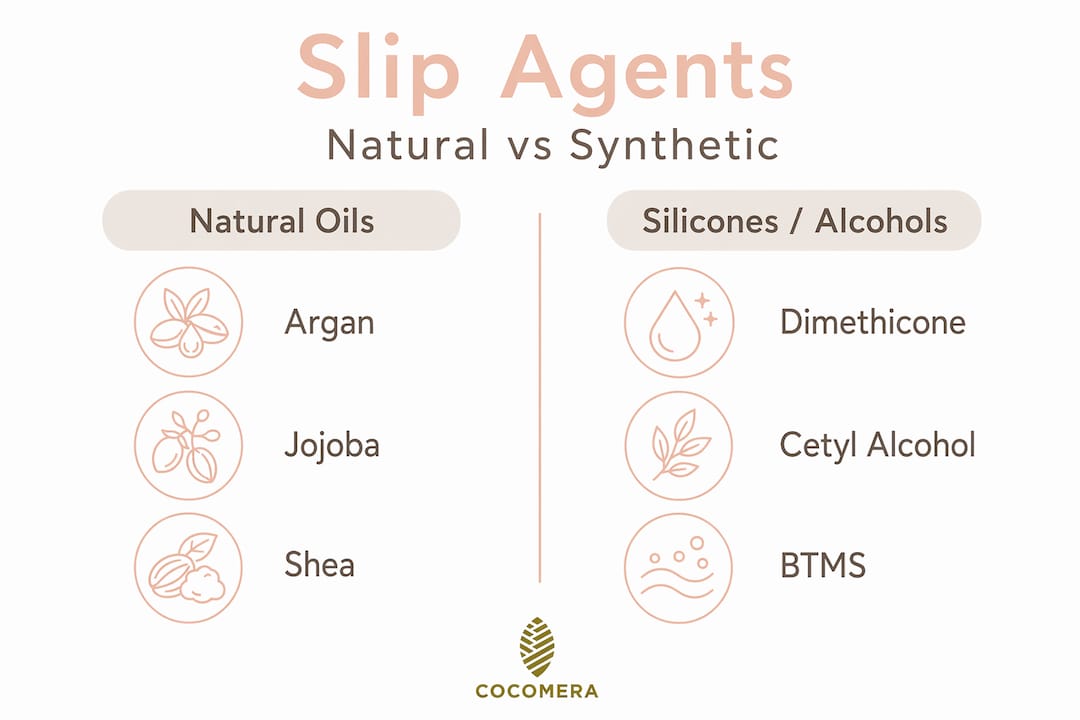
Natural oils like argan, jojoba, and shea oil penetrate or coat the hair shaft depending on their molecular size. They add nourishment alongside slip, but their performance varies. Lighter oils like jojoba and grapeseed provide manageable slip without weighing curls down. Heavier oils can build up, especially on low-porosity hair.
Silicones like dimethicone are among the most effective slip agents available. They create a consistent, smooth coating across the cuticle surface. Some women prefer to avoid them due to buildup over time if not clarified regularly, but for Type 4 hair during detangling, their performance is hard to beat.
Fatty alcohols like cetyl alcohol and behentrimonium methosulfate (often abbreviated as BTMS) are conditioning agents that also deliver strong slip. These are water-soluble, which makes them gentler on low-porosity hair and easier to rinse out. They’re a common base in many quality conditioners.
| Ingredient | Slip level | Best for | Watch out for |
|---|---|---|---|
| Dimethicone | Very high | Type 3c to 4c, dry climates | Buildup without clarifying |
| Cetyl alcohol | High | Most textured types | Rarely an issue |
| Jojoba esters | High | Low-porosity, humid climates | Little downside |
| Argan oil | Moderate | Fine to medium curls | May feel greasy if overused |
| Shea oil | Moderate to high | Coily, dense hair | Can be heavy on fine strands |
| Castor oil | Low to moderate | Sealing only | Too thick for detangling alone |
Research confirms that emollients like shea oil and cetyl alcohol reduce detangling time for kinky-coily hair by up to 50 percent. For women in northern European climates with low-porosity hair, the guidance is specific: prioritize jojoba esters over thick butters to avoid product buildup on hair that already struggles to absorb moisture.
Pro Tip: If you’re unsure about your hair porosity, drop a clean strand in a glass of water. If it floats for a long time, your porosity is low. If it sinks quickly, your porosity is high. Low-porosity hair needs lighter slip agents. High-porosity hair can handle richer emollients.
You can also explore single ingredient haircare as a way to understand exactly which ingredient is doing the work in your routine.
How to maximize slip benefits in your textured hair routine
Knowing what slip is matters far less than knowing how to use it. The benefits of slip in hair products are only realized when you apply them at the right time, in the right amount, and with the right technique.
Start with your detangling session. Apply conditioner generously before attempting to remove any tangles. Thin conditioners without enough slip can actually cause more friction than no conditioner at all because they dry out faster and leave strands rough. Research shows that slip-enabled conditioners reduce detangling time for kinky-coily sections from over 10 minutes to under 5 minutes, preserving 20 to 30 percent more length over six months.
Here’s a practical routine to integrate slip into every wash day:
-
Pre-poo with an oil that has slip properties, such as jojoba or sweet almond, before shampooing. This creates a buffer that protects strands during cleansing.
-
Condition immediately after washing while hair is still fully saturated. Slip agents spread more evenly on wet hair.
-
Detangle under water in the shower if possible, allowing water to aid the glide while the conditioner works.
-
Apply a slip-rich leave-in after rinsing conditioner. This extends the friction-reducing benefit through the rest of your styling session.
-
Seal with a lightweight oil to lock in the leave-in and reduce moisture loss overnight.
Beyond wash days, consider your daily habits. Daily emollient application in dry European winters is critical because friction-induced internal hair damage accumulates through ordinary daily activities like sleeping, wearing scarves, and even resting your head against fabric.
The slip from your overnight accessories matters as much as your products. Sleeping on a silk or satin pillowcase reduces friction by a similar margin to the slip in your conditioner. Pairing both creates a compounding protective effect most routines ignore.
Pro Tip: If your conditioner feels thin and draggy, mix in two to three tablespoons of olive oil before applying it. This immediately boosts slip and can cut your detangling time in half, especially on coily Type 4 hair.
See how to build this kind of routine from start to finish with these afro hair styling steps for Type 3 and 4 curls.
Additional insights on slip and textured hair care for European women
There are a few less-discussed aspects of slip that make a real difference for women with textured hair living in Europe, where climate, water hardness, and seasonal dryness all affect how products perform.
One underrated benefit of slip is its impact on shine. Emollients smooth the cuticle surface, allowing light to reflect more evenly off the strand. Research notes that emollients flatten raised cuticles and yield 20 to 30 percent more shine post-styling, even in the humid UK conditions common throughout autumn and winter in northern Europe.
There is also a nuanced side to slip that doesn’t get enough attention. Slip can create a false sense of security if you have high-porosity hair. High-porosity strands absorb products quickly and feel smooth on the surface, but tangles can still be hiding deeper in the curl. One salon guide highlights that high slip can mask internal tangles in high-porosity wavy hair, increasing breakage risk if you don’t back-comb or finger-detangle carefully through each section.
Key practices to combine with slip for a complete routine:
-
Use silk or satin hair accessories overnight. Pairing slip conditioners with silk pillowcases or bonnets compounds the friction-reduction effect.
-
Adjust your slip products seasonally. In damp, cool British or Scandinavian winters, you may need richer emollients. In warmer, more humid months, lighter slip agents prevent buildup.
-
Check in on your scalp. Products designed for slip on the strand can occasionally migrate to the scalp and cause buildup if you use heavy oils. Balance is key.
-
Finger-detangle before using tools. Even with excellent slip, starting with a comb on tangled sections forces mechanical stress that can snap strands.
“Slip is not a finish line. It is a foundation. The goal is to make every grooming session gentler than the last, so the damage you’re preventing never gets a chance to accumulate.”
For more ideas on supporting your hair between wash days, the best hair moisturizers for textured hair can bridge the gap between sessions.
Rethinking slip: What most textured hair guides miss
Here’s what most slip guides won’t tell you: breakage in textured hair is largely invisible, and it’s happening long before you see it. Strands don’t snap clean off in one dramatic combing session. They develop internal voids over time from repeated friction. Those voids weaken the fiber from the inside. Eventually the strand breaks at what looks like a random point on the curl, and you wonder why your hair isn’t growing.
Repeated grooming friction silently accumulates internal voids that cause breakage in textured hair despite a healthy appearance at the surface. This is the invisible damage that slip products are actually designed to prevent. Not just easier detangling. Not just a nice feeling between your fingers. Structural protection of the strand over months of consistent grooming.
The second thing most guides miss is the thick-butter myth. Many women with coily or afro hair reach for the richest, heaviest butters they can find because thicker feels like it should equal more slip. It often doesn’t. In European climates, especially in countries with lower annual temperatures and humidity variation, heavy butters can coat the hair without genuinely reducing friction. They sit on the surface and create the sensation of slip while the underlying cuticle is still raised and rough. Lightweight emollients, applied correctly to thoroughly wet hair, outperform thick products for actual friction reduction in most cases.
The third overlooked truth is that slip needs to be consistent. One great wash day with a high-slip conditioner does almost nothing for long-term length retention if the rest of the week involves dry detangling, cotton pillowcases, and heavy manipulation. Slip is a protective technique that works through repetition. Silk accessories at night, a leave-in with emollients in the morning, a quality conditioner on wash day: these combine into a friction-reduction system that your hair feels over months, not hours.
Explore slip-rich products for textured hair at Cocomera
Knowing what slip is and why it matters is only the beginning. Finding the right products for your specific curl pattern and European environment is where the real progress happens.
At Cocomera, every product in our collection is carefully chosen with textured hair in mind. Whether you need a detangling conditioner packed with emollients for your wash day, a hair oil with jojoba esters or argan oil to extend your slip between washes, or a deeply moisturizing hair mask for textured hair to restore softness and manageability, you’ll find curated options designed for Type 2, 3, and 4 hair. We make it easier to build a complete routine around real ingredients that deliver real results, wherever you are in Europe.
Frequently asked questions
What exactly is slip in hair products?
Slip is the smooth, slippery quality in a hair product that lets your fingers glide easily through wet hair without friction, tugging, or breakage. Products with good slip make detangling faster and significantly less damaging.
Why is slip particularly important for textured hair?
Textured hair curls and coils create natural points where strands catch on each other, making friction and tangling far more likely than in straight hair. Slip reduces cuticle friction during grooming, protecting those vulnerable contact points and preserving length over time.
Can slip products prevent hair breakage?
Yes. By reducing mechanical stress during detangling and styling, slip products lower the risk of mid-shaft breakage directly. Conditioners with slip cut detangling friction by up to 50%, which translates to less damage on every single wash day.
Which ingredients provide the best slip for coily or afro hair?
Emollients like shea oil, jojoba esters, cetyl alcohol, and dimethicone are among the most effective. Products with shea oil and cetyl alcohol allow faster detangling and help retain more length in afro hair over time.
How can I test if a product has good slip?
Apply the product to wet hair, then try running your fingers from root to end through a section. If there’s no resistance or tugging, the slip is working. For a quick homemade slip boost, mix two to three tablespoons of olive oil into a thin conditioner and check whether your fingers glide smoothly through saturated sections.