Proper wash day techniques focusing on hydration and gentle cleansing are essential for healthy curly hair. Balancing washing frequency, pre-wash prep, and the right products helps prevent dryness, buildup, and frizz, especially in challenging climates. Emphasizing moisture retention transforms the routine into effective maintenance for all curl types.
If your curls come out dry, frizzy, or limp after washing, the problem is almost certainly your method, not your products. Getting the hair wash steps for curls right is the single biggest change you can make for your curl health, and the good news is it is not complicated once you know what your hair actually needs. This guide walks you through every stage of wash day, from pre-wash prep to the final rinse, with techniques and product guidance tailored for type 2, 3, and 4 textures in European climates where hard water and cold air add extra challenges.
Table of Contents
Key Takeaways
| Point | Details |
|---|---|
| Tailor wash frequency | Wash based on hair type: curly every 3-7 days; coily weekly to biweekly. |
| Prep by sectioning | Section and detangle to reduce tangles and breakage. |
| Hydration first | Use gentle cleansers, co-wash, and ‘squish to condish’ for moisture. |
| Use correct water temps | Wash with lukewarm and rinse with cool water to seal cuticles. |
| Avoid mistakes | Balance co-washing with occasional clarifying shampoos and scalp massages. |
Understanding your curl type and wash frequency
Know how often your curl type needs washing. This is key in curly hair care and prevents wash day issues.
Type 3 curls: wash every 3-7 days. Coily type 4: weekly to biweekly. Tighter curls dry out faster and need more moisture.
Hairdresser Kavya Rajpowell makes this point sharply: over-washing more than once weekly is the most common frequency mistake curly-haired people make, and it strips the natural oils your curls depend on for softness and definition. Switching to a sulfate-free cleanser and spacing out wash days is not laziness. It is science.
Here is a quick reference for wash frequency by curl type:
-
Type 2 (wavy): Every 2-4 days, as the flatter wave pattern lets scalp oil spread more easily
-
Type 3 (curly): Every 3-7 days, depending on porosity and product usage
-
Type 4 (coily/afro): Every 7-14 days to protect natural oils and minimize dryness
-
All types: Use a strengthening shampoo formulated without sulfates to cleanse without stripping moisture
One more thing worth noting: your wash frequency may shift seasonally. In Scandinavian winters, the dry, heated indoor air pulls moisture out of coils fast, so you may need to extend time between washes even further and focus harder on hydration.
Preparing your hair before washing: Sectioning and detangling
Once you know how often to wash, the next critical step is preparing your curls to withstand washing without damage. Skipping this stage is one of the most damaging curly hair washing mistakes you can make, especially for type 4 hair.
The process starts with sectioning. Divide 4C afro hair into 4-8 parts before washing to minimize tangles and ensure shampoo and conditioner reach every section evenly. Use clips or loose twists to keep each section separate. This single habit cuts wash day time dramatically and reduces mid-wash knotting.
Before water touches your hair, detangle gently. Finger detangle first, then use a wide-tooth comb from ends up toward roots, always working in your pre-sectioned parts. Dry detangling before washing is actually gentler than fighting knots under running water, where wet hair is more fragile.
The third pre-wash step that most guides skip is the prepoo. Applying natural oils before shampooing reduces hygral fatigue, which is the swelling and contracting of the hair shaft during washing that weakens curls over time. Coconut oil is the most studied for this because its small molecular structure lets it penetrate the hair shaft rather than just sitting on top. Apply it 30 minutes before washing, or overnight for very dry or high-porosity hair.
For a complete guide to structuring your wash day from start to finish, the coily hair wash workflow breaks it down step by step.
Pre-wash checklist:
-
Section hair into 4-8 manageable parts
-
Finger detangle each section from ends upward
-
Apply a light oil or prepoo treatment to each section
-
Clip sections securely before stepping into the shower
Pro Tip: Do your entire pre-wash prep before you even turn on the water. Once you are in the shower, your hands are wet and your sections will start merging. Two minutes of dry prep saves ten minutes of mid-shower detangling.
Step-by-step washing for curls: Cleansing, conditioning, and rinsing right
With your hair properly prepped, you’re ready to follow these detailed wash day steps that will keep your curls healthy and defined.
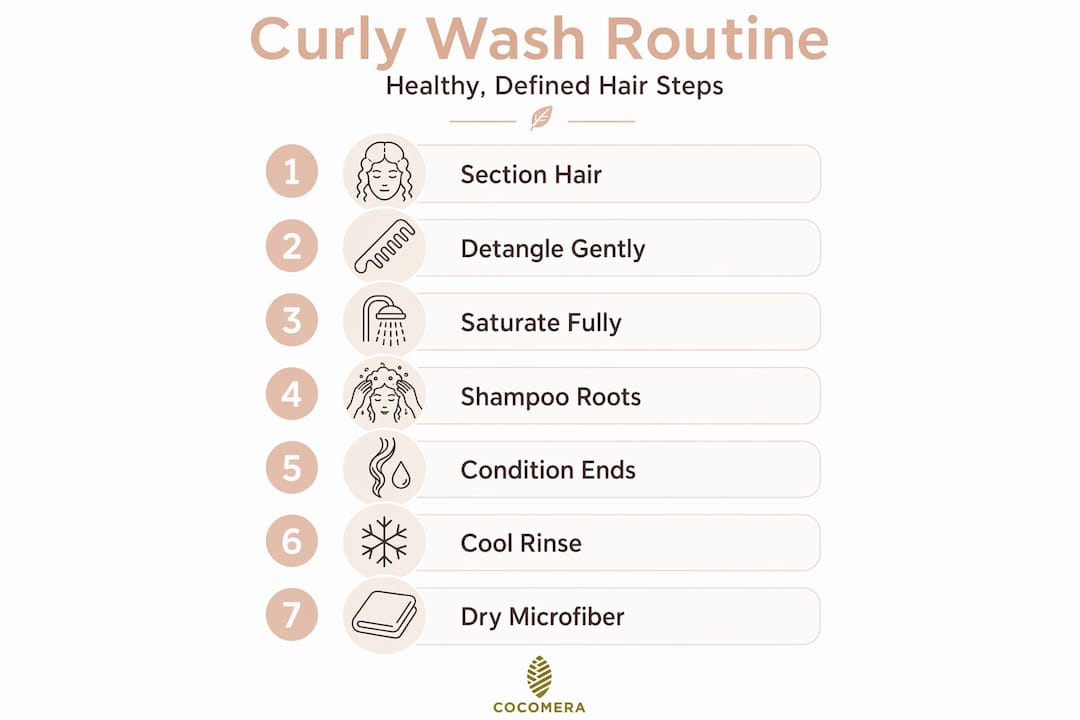
1. Saturate your hair fully with lukewarm water. Do not rush this. Spend 30-60 seconds letting water penetrate each section. Lukewarm water opens the hair cuticle for better cleansing without stripping moisture the way hot water does. Hot water is the enemy of curl definition.
2. Apply shampoo to the scalp only, not the lengths. Squeeze shampoo into your palm, emulsify it, and apply it directly to your scalp in sections. Massage in circular motions for at least 60 seconds. The lengths get cleaned when you rinse. If you are dealing with significant buildup, consider a clarifying shampoo once a month to reset your scalp.
3. For tightly coily hair, use the two-lather method. The two-lather shampoo technique involves a first lather to lift buildup, a thorough rinse, then a second lather to define and cleanse the coils more thoroughly. The second rinse is where you see the curl pattern actually emerge. This works particularly well for dense 4B and 4C textures.
4. On in-between wash days, co-wash instead of shampoo.Co-washing for at least 60 seconds on the scalp keeps textured hair fresh between full washes without stripping moisture. Browse co-wash shampoo options formulated specifically for textured hair. Co-washing works best for type 3 and type 4 hair that gets dry quickly between washes.
5. Apply conditioner from mid-lengths to ends generously. Do not be shy with conditioner. Work it through each section while the hair is still wet, and use the “squish to condish” technique: cup your hands around your curls and gently squeeze upward to push conditioner into the hair shaft. Leave it on for 3-5 minutes. Understanding why hair needs moisture makes it easier to stop underdosing conditioner.
6. Rinse with cool water to seal the cuticle. Switch to a cool rinse for the final 30 seconds. This closes the hair cuticle, locking in moisture and reducing frizz dramatically. It is uncomfortable in winter, but the difference in shine and definition is immediate and worth it.
7. Dry with a microfiber towel or cotton T-shirt. Regular terry cloth towels rough up the cuticle and cause frizz. Pat and scrunch gently. Never rub.
| Method | Best for | Frequency | Key benefit |
|---|---|---|---|
| Regular shampoo | All curl types | Weekly or bi-weekly | Deep scalp cleanse |
| Clarifying shampoo | All types with buildup | Every 2-6 weeks | Resets hair |
| Co-washing | Type 3 and 4, dry hair | Between wash days | Preserves moisture |
| Two-lather method | Type 4 coily/afro | Weekly to bi-weekly | Defines coils |
Pro Tip: Flip your head upside down while scrunching conditioner in. Gravity helps conditioner coat the full curl from root to tip, and curls tend to clump better when you work with them hanging downward.
Common mistakes and troubleshooting wash day problems for curly hair
Knowing the correct wash steps is essential, but recognizing and avoiding common wash day pitfalls is just as important to maintain healthy curls.
The single most common issue is dryness caused by over-washing. If your curls feel crunchy, look dull, or lose definition within a day of washing, you are very likely washing too often. Space out your wash days and use a co-wash or water-only refresh in between.
The second issue is buildup. Layers of conditioner, styling creams, and oils accumulate on the hair shaft over time and make curls look limp and weighed down. A clarifying shampoo every 2-6 weeks resets everything when curls feel dull or frizzy despite a good routine. Think of it as a clean slate.
“Co-washing may need to be balanced with regular shampooing if your scalp itches or you use heavy styling products.” Cosmopolitan Curly Girl Method guide, 2026
Scalp itch is a signal that your cleansing is not thorough enough. If it shows up, co-washing may need to be balanced with a regular shampoo at least once a week. Browse anti-itch scalp shampoos if itch is a recurring problem for you.
Common mistakes and how to fix them:
-
Washing in one big mass: Section hair to prevent tangling mid-wash
-
Using hot water: Switch to lukewarm; hot water causes hygral fatigue and frizz
-
Skipping the cool rinse: Even 20 seconds of cool water seals the cuticle and reduces frizz
-
Not rinsing thoroughly: Leftover conditioner weighs curls down; rinse longer than you think you need to
-
Rough towel drying: Use a microfiber towel or cotton T-shirt only
For a thorough breakdown of solving persistent wash day issues, the coily hair wash tips article covers the most common problems type 4 hair owners face and how to work through them.
Pro Tip: If your curls feel fine when wet but turn dry and frizzy as they dry, that is a porosity issue, not a product issue. High-porosity hair loses moisture as fast as it gains it. A cool final rinse and a light sealant oil applied immediately after washing helps lock hydration in before the cuticle has a chance to close around air instead of water.
Why your curly hair wash routine needs to be about hydration, not just cleansing
Here is the uncomfortable truth that most wash day guides do not say loudly enough: cleansing is the least important part of washing curly hair. Hydration is the point.
That sounds counterintuitive. You wash your hair to clean it. But for type 3 and type 4 textures, the question to ask is not “is my hair clean?” but “is my hair retaining enough moisture to stay healthy?” Hair that is clean but stripped of oils looks worse than hair that has a little product residue but is well-moisturized. This is not an invitation to skip shampoo. It is an argument for reprioritizing what you actually pay attention to on wash day.
Kavya Rajpowell puts it plainly: most people wash curly hair too often, and that single mistake undermines every other thing they do. If you are shampooing twice a week, no conditioner or styling product will fully compensate for the moisture you are continuously removing. The routine loses before it starts.
In European climates specifically, where central heating in winter and wind year-round pull moisture from the air and your hair, a hydration-first approach is not optional. It is maintenance. Techniques like leaving a thin layer of conditioner on your ends rather than rinsing completely clean, or using the “squish to condish” method to really press water and product into the curl, make a measurable difference. As the experts at CalyMavel describe it, leaving just a whisper of conditioner in the ends prevents frizz rebound as hair dries.
The real shift is treating wash day as a moisture restoration event, not just a cleaning one. Everything, including how you prep, what temperature water you use, how long you leave conditioner on, and how you dry your hair, serves that goal. Once that is the frame, the right moisture essential guide choices become obvious rather than overwhelming.
Shop expert-curated hair care products for your curls at Cocomera
Your wash routine is only as good as the products you use with it. At Cocomera, every product is hand-selected for type 2, 3, and 4 textured hair, so you are not guessing whether something will work for your curl pattern.

Start with a strengthening shampoo designed for curly and coily hair that cleanses without sulfates, or explore co-wash shampoos for your in-between wash days. Pair your cleansing routine with styling products from our styling collection to lock in the moisture you worked to retain on wash day. Whether you have loose type 3 curls or tight 4C coils, Cocomera makes it easier to build a routine that actually works for your hair, without the guesswork.
Frequently asked questions
How often should I wash my curly or coily hair?
Curly hair (type 3) generally benefits from washing every 3-7 days, while coily hair (type 4) usually does best washing weekly to every two weeks to keep moisture balance intact.
What is co-washing and is it suitable for my curls?
Co-washing means cleaning your hair with conditioner instead of shampoo to maintain moisture. It works well for dry curly or coily hair, but you should balance it with gentle shampoos if scalp buildup or itch occurs.
Should I use hot or cold water when washing my curls?
Use lukewarm water to cleanse without drying your hair out, then finish with a cool rinse. Cool water seals the cuticle, which reduces frizz and locks in the conditioner you just applied.
How can I prevent tangles and breakage on wash day?
Sectioning and detangling before washing reduces tangles and breakage significantly. Work section by section with fingers or a wide-tooth comb, and use plenty of conditioner for slip while rinsing.
What is the benefit of double shampooing for coily hair?
Double shampooing uses two gentle lathers: the first removes buildup, and the second rinse helps coils pop with better definition without stripping the hair of its natural oils.