Curly hair’s unique spiral structure creates a moisture challenge that affects up to 95% of people with textured hair. Unlike straight hair where natural oils glide easily from root to tip, curls create physical barriers that trap sebum at the scalp. This structural reality means your ends stay perpetually thirsty, leading to breakage, frizz, and dullness. Regular conditioners coat the surface temporarily, but they can’t address the deep hydration deficit curly hair faces daily. Deep conditioning treatments penetrate beyond the cuticle layer to restore moisture balance, strengthen weakened strands, and transform your curl pattern from stressed to thriving.
Table of Contents
- Key takeaways
- Why curly hair needs deep conditioning
- How deep conditioners work differently from regular conditioners
- Tailoring deep conditioning to hair porosity and curl type
- Best deep conditioning practices for healthy, vibrant curls
- Enhance your curly hair care with products tailored for you
- Frequently asked questions about deep conditioning curly hair
Key Takeaways
| Point | Details |
|---|---|
| Deep conditioning necessity | Curly hair structure blocks natural oils, so deep conditioning is essential to restore moisture and reduce breakage. |
| Deeper conditioning penetration | Unlike regular conditioners that coat the surface, deep conditioners reach the cortex to rebuild structure and elasticity. |
| Porosity based frequency | Hair porosity and curl tightness determine how often you should deep condition, with tighter curls and higher porosity needing more frequent sessions. |
| Moisture and protein balance | Finding the right balance of moisture and protein keeps curls resilient, glossy, and less prone to breakage. |
Why curly hair needs deep conditioning
Your curl pattern creates a biological disadvantage when it comes to moisture retention. Curly, coily, and afro hair requires deep conditioning primarily because its structure hinders sebum distribution, leading to rapid moisture loss and damage that straight hair types rarely experience. The tighter your curl pattern, the more difficult it becomes for natural scalp oils to navigate the twists and turns of each strand.
This structural reality creates several cascading problems. Without adequate oil coating, your hair cuticles lift and roughen, making strands vulnerable to environmental stressors. Friction from styling, sleeping, and daily movement causes cuticle damage that worsens over time. The result is hair that feels perpetually dry, tangles easily, and breaks at the slightest tension.
Hair porosity and curl tightness determine your deep conditioning frequency needs. Consider these factors:
- Tight coils (4A to 4C patterns) benefit from weekly deep conditioning sessions due to maximum sebum blockage
- Medium curls (3A to 3C patterns) typically need treatments every 10 to 14 days
- Loose waves (2A to 2C patterns) can extend to biweekly sessions unless chemically treated
- High porosity hair from heat damage or chemical processing requires more frequent moisture replenishment
- Low porosity hair with tightly closed cuticles needs strategic treatment to avoid product buildup
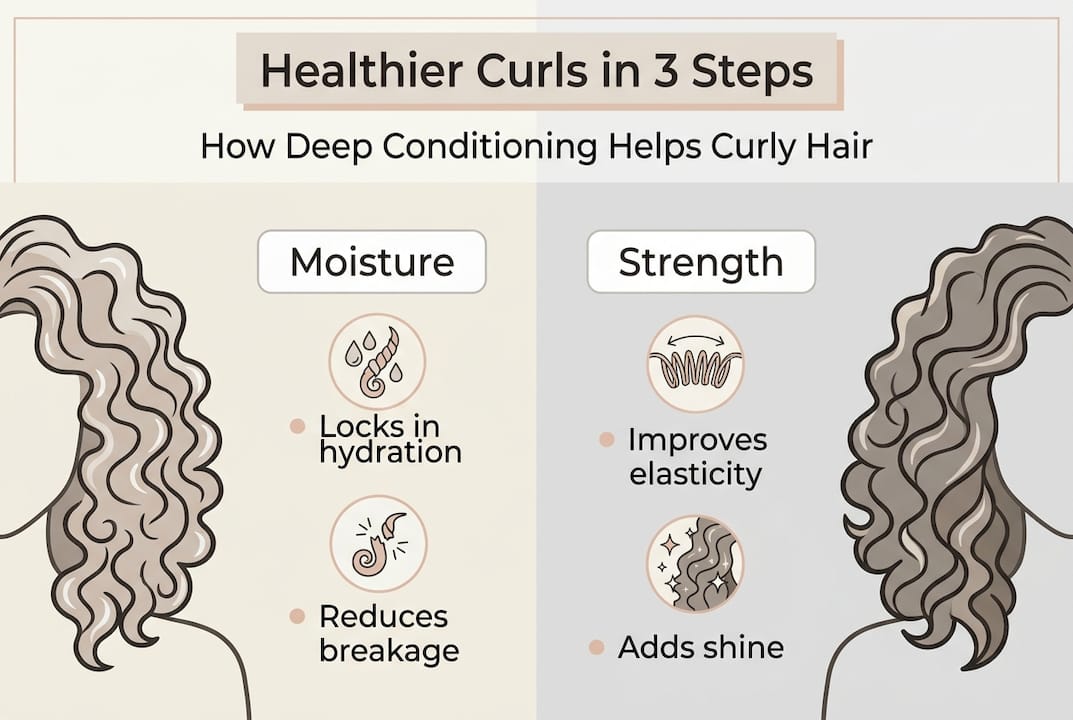
Deep conditioning addresses these challenges by delivering concentrated moisture and nutrients directly into the hair shaft. Unlike surface treatments that wash away quickly, deep conditioners create lasting structural improvements. They fill gaps in damaged cuticles, restore elasticity to weakened protein bonds, and establish a protective barrier against future damage. Integrating this practice into your ultimate curly hair routine transforms hair health from the inside out.
How deep conditioners work differently from regular conditioners
The distinction between regular and deep conditioners lies in molecular structure and ingredient concentration. Deep conditioners penetrate deeper than regular conditioners via humectants, emollients, proteins, and cationic agents, restoring hydration and strength at the cortex level. Regular conditioners primarily contain cationic surfactants that coat the hair surface, smoothing cuticles temporarily without internal repair.
Deep conditioning formulas pack higher concentrations of these key ingredient categories:
- Humectants like glycerin, panthenol, and honey draw moisture from the environment into hair strands
- Emollients including shea butter, coconut oil, and argan oil seal moisture inside while adding slip for detangling
- Proteins such as hydrolyzed wheat, silk, and keratin fill structural gaps in damaged hair cortex
- Cationic conditioning agents create positive charges that bind to negatively charged damaged areas
- Penetrating oils like avocado and olive oil have small molecular structures that slip between cuticle layers
These ingredients work synergistically to create lasting improvements. Humectants establish hydration pathways that keep hair moisturized between wash days. Emollients create flexible protective films that prevent moisture escape. Proteins rebuild the internal structure where chemical treatments or heat styling caused breakdown. Understanding deep conditioner ingredient mechanisms helps you select formulas matched to your specific damage patterns.
Pro Tip: Apply heat strategically during deep conditioning to amplify results. Warmth temporarily lifts cuticle layers, creating wider pathways for ingredient absorption. Use a heated cap, steamer, or warm towel wrap for 20 to 30 minutes, but skip heat if you have high porosity hair that already absorbs products easily.
The penetration difference matters significantly for long term curl health. Most conditioners coat only the hair surface while true penetration requires certain ingredients and sometimes heat. Surface coating provides immediate smoothness but washes away completely, leaving hair in the same damaged state. Deep conditioning creates cumulative improvements where each treatment builds on previous sessions. Ingredients like ethylhexylglycerin enhance penetration by modifying how other ingredients interact with hair proteins, making formulas more effective at lower concentrations.
Tailoring deep conditioning to hair porosity and curl type
Hair porosity describes how readily your cuticle layer opens to accept moisture and products. This characteristic dramatically affects which deep conditioning approaches work best for your specific hair. Porosity exists on a spectrum from tightly sealed cuticles that resist moisture entry to damaged, porous structures that absorb everything rapidly but can’t retain it.
Low porosity hair benefits from heat assisted, lightweight, humectant rich formulas while high porosity hair requires protein moisture balanced products to seal cuticles. Understanding your porosity level prevents common mistakes like using heavy butters on low porosity hair, which sit on the surface causing buildup, or applying only moisture to high porosity hair, which creates weak, overstretched strands.
| Porosity level | Characteristics | Deep conditioning approach | Product focus |
|---|---|---|---|
| Low porosity | Cuticles lay flat and resist opening; products sit on surface; takes long to wet and dry | Use heat to lift cuticles; choose liquid or cream consistency; apply to damp hair; focus on humectants | Lightweight formulas with glycerin, aloe vera, panthenol; avoid heavy oils and butters |
| High porosity | Cuticles are raised or damaged; absorbs moisture quickly but loses it fast; prone to frizz and tangles | Balance protein and moisture; seal with oils after conditioning; use cool water final rinse | Protein treatments alternating with moisturizing masks; heavier oils like castor or avocado |
Identify your hair porosity and curl pattern using these practical indicators:
- Perform the water glass test by placing a clean shed hair in room temperature water; low porosity floats, high porosity sinks quickly
- Notice how long hair takes to dry naturally; low porosity stays wet for hours, high porosity dries rapidly
- Observe product absorption; if serums and creams sit on your hair looking greasy, you likely have low porosity
- Check for raised cuticles by running fingers up a strand from tip to root; roughness indicates high porosity damage
- Assess your curl pattern when fully hydrated; tighter coils need more frequent treatments regardless of porosity
Adjust your routine based on these observations. Low porosity hair thrives with clarifying shampoo tips to remove buildup before conditioning, allowing better product penetration. High porosity hair needs gentle cleansing to avoid stripping remaining moisture. Both porosity types benefit from following comprehensive curly hair routine guidelines that address cleansing, conditioning, and styling as interconnected steps.
Curl type interacts with porosity to determine your ideal deep conditioning frequency. A 4C curl pattern with low porosity needs weekly heat assisted treatments with liquid conditioners. A 3B curl pattern with high porosity might need twice weekly protein moisture alternating treatments. Pay attention to how your hair responds rather than following rigid schedules, adjusting frequency when you notice increased dryness, breakage, or limpness.
Best deep conditioning practices for healthy, vibrant curls
Executing deep conditioning correctly amplifies results while poor technique wastes time and products. Follow this systematic approach to maximize every treatment session and build cumulative improvements in your curl health.
-
Start with clarified, clean hair by shampooing to remove product buildup, oils, and environmental residue that block conditioner absorption. Skip this step only if you cleansed within the past two days.
-
Remove excess water by gently squeezing with a microfiber towel until hair stops dripping but remains thoroughly damp. Soaking wet hair dilutes conditioner effectiveness.
-
Section hair into four to eight parts depending on thickness and length, securing each with clips to ensure even product distribution without missing areas.
-
Apply deep conditioner generously from mid shaft to ends, using more product than you would for regular conditioning. Focus on the driest sections while avoiding the scalp unless treating dandruff.
-
Detangle gently with fingers or a wide tooth comb while conditioner provides slip, working from ends upward to minimize breakage.
-
Apply heat using your preferred method for 20 to 30 minutes to enhance penetration. Heat temporarily lifts cuticles for better penetration with longer heat up to 30 plus minutes increasing benefits without damage for most hair types.
-
Rinse thoroughly with cool water to seal cuticles closed, locking in the moisture and nutrients you just deposited. Incomplete rinsing causes buildup over time.
-
Apply leave in products immediately on damp hair to seal in the deep conditioning benefits before hair dries.
Pro Tip: Create DIY heat by wrapping your conditioner coated hair in a plastic cap, then covering with a warm damp towel heated in the microwave for 30 seconds. Replace the towel when it cools to maintain consistent warmth throughout your treatment.
Consistency matters more than intensity when building healthy curls. Weekly 30 minute sessions produce better results than monthly marathon treatments. Your hair accumulates damage continuously from styling, environmental exposure, and daily manipulation. Regular deep conditioning counteracts this damage before it becomes visible breakage. Think of it as preventive maintenance rather than emergency repair.
Balance frequency with your hair’s feedback signals. If curls start feeling mushy, limp, or overly soft, you may be over moisturizing and need to reduce frequency or add protein treatments. If hair feels rough, tangles easily, or breaks during styling, increase deep conditioning frequency. Using clarifying conditioner recommendations between deep treatments helps reset your hair when product buildup interferes with moisture absorption.
Enhance your curly hair care with products tailored for you
Finding the right deep conditioning products transforms your routine from frustrating to effective. Cocomera curates specialized formulas designed specifically for curly, coily, and afro textured hair that addresses the unique moisture and protein needs these patterns require. Our selection eliminates guesswork by focusing exclusively on products that deliver results for textured hair.
Explore targeted solutions like the Aunt Jackie’s kids hair care bundle which combines gentle cleansing with intensive moisture for delicate curls. The raw shea butter deep moisturizing masque provides concentrated hydration for severely dry or damaged hair. Complete your regimen with the dry itchy scalp care shampoo that prepares hair for maximum deep conditioner absorption. Each product works synergistically within a comprehensive curl care system, making it easier to maintain healthy, vibrant curls without trial and error.
Frequently asked questions about deep conditioning curly hair
How often should I deep condition my curly hair?
Tight curl patterns from 4A to 4C benefit most from weekly deep conditioning sessions due to maximum sebum distribution challenges. Looser curl patterns from 2C to 3C typically thrive with treatments every 10 to 14 days. Adjust frequency based on your hair’s dryness level, damage severity, and how quickly it loses moisture between wash days. If you use heat styling tools regularly or have chemically treated hair, increase frequency regardless of curl pattern.
Does applying heat during deep conditioning really make a difference?
Heat application significantly improves deep conditioning results, especially for low porosity hair with tightly closed cuticles. Warmth temporarily lifts cuticle layers, creating wider pathways for humectants, proteins, and emollients to penetrate the cortex. Extended heat sessions up to 30 minutes maximize ingredient absorption without causing damage for most hair types. High porosity hair may not need heat since cuticles already remain open, but gentle warmth still enhances product performance.
How do I know if my hair is low or high porosity?
Perform the water float test by placing a clean shed hair in a glass of room temperature water. Low porosity hair floats on the surface while high porosity hair sinks quickly. Notice how products behave on your hair; if conditioners and oils sit on the surface looking greasy, you likely have low porosity. Check styling patterns too. Low porosity hair takes hours to dry naturally and resists absorbing products. High porosity hair dries rapidly, tangles easily, and feels rough when running fingers up the strand from tip to root. Use clarifying shampoos regularly if you have low porosity to remove buildup that worsens absorption issues.
Can over conditioning damage my curls?
Excessive moisture treatments without protein balance can cause hygral fatigue where hair becomes overly elastic, limp, and prone to breakage. This happens when you deep condition too frequently with moisture only formulas, causing strands to overstretch. Conversely, too much protein makes hair brittle and stiff, particularly problematic for low porosity hair that doesn’t need much protein reinforcement. Balance treatments by alternating moisture focused and protein focused deep conditioners based on how your hair feels. If curls look stringy and won’t hold their shape, reduce moisture and add protein. If hair feels stiff and snaps easily, increase moisture and decrease protein treatments.