You buy the creams, you apply the oils, and your curls still feel dry by the end of the day. Sound familiar? The frustrating truth is that moisturizing more is rarely the answer. Curly and coily hair has a unique biological structure that makes it naturally prone to dryness, and when you add European climate conditions into the mix, things get even more complicated. This guide breaks down the real science behind curl dryness, explains why where you live in Europe matters, and gives you practical strategies to finally keep your curls hydrated.
Table of Contents
- The science behind why curls dry out
- Environmental factors: Why Europe’s climate dries out curls
- Common mistakes that make curls drier
- How to prevent dryness and boost moisture retention
- A fresh perspective: What most curl guides miss about European hair
- Support your curl journey with the right products
- Frequently asked questions
Key Takeaways
| Point | Details |
|---|---|
| Curl structure matters | Curly and coily hair dries out because its shape keeps oils from reaching the ends. |
| Environment impacts dryness | European winters, indoor heating, and hard water all steal moisture from curls. |
| Avoid common mistakes | Skipping hydration, overwashing, and the wrong products cause even more dryness. |
| Use targeted routines | Methods like LOC and LCO lock in moisture when personalized for your hair. |
The science behind why curls dry out
Most people think dry hair is a product problem. Reach for a richer cream, add more oil, and problem solved. But the real issue starts at the structural level, long before any product touches your hair.
Curly hair types 2, 3, and 4 are shaped like spirals, zigzags, or tight coils. That shape is beautiful, but it creates a real challenge: natural oils produced by your scalp (called sebum) have a hard time traveling down a twisted strand. On straight hair, sebum glides from root to tip easily. On a coily type 4 strand, that oil barely makes it past the first few inches. This is why sebum distribution is harder in textured hair compared to straight hair, and it explains a lot about why your ends always feel the driest.
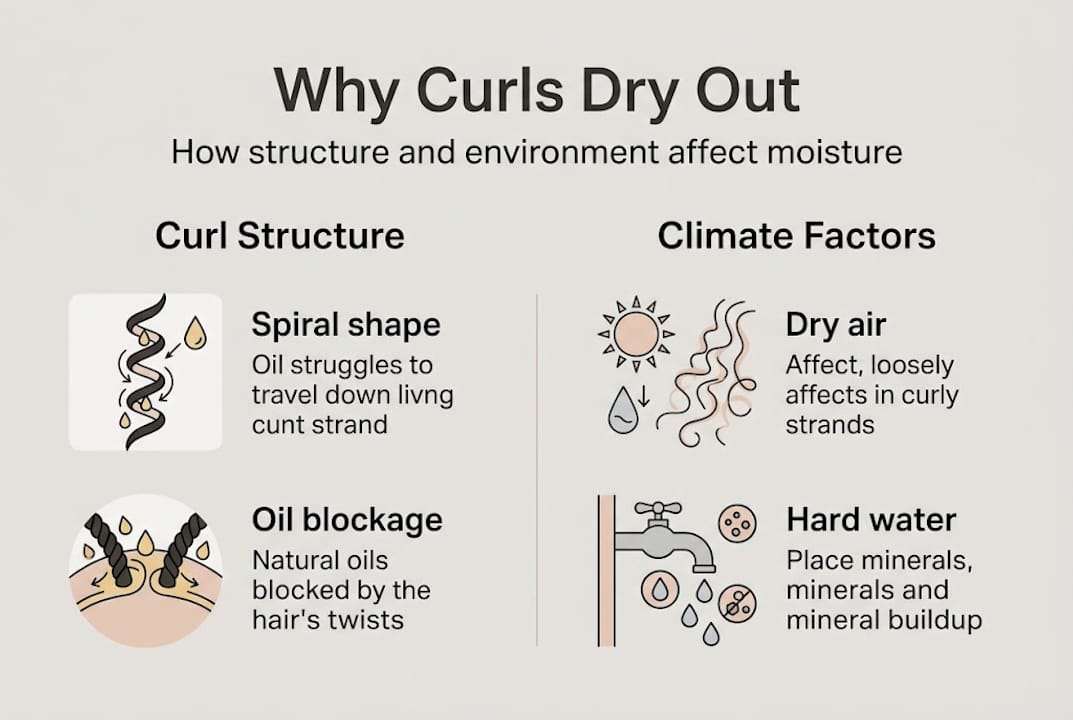
The tighter your curl pattern, the more pronounced this problem becomes. A type 4c strand may have dozens of bends per inch, creating dozens of points where oil flow slows or stops. This is not a flaw in your hair. It is simply how it is built.
Beyond shape, your hair’s porosity plays a major role. Porosity refers to how easily your hair absorbs and holds onto water. Hair is covered in a cuticle layer, which is like tiny overlapping tiles on a roof. When those tiles lie flat (low porosity), water has trouble getting in. When they are lifted or damaged (high porosity), water gets in fast but escapes just as fast.
| Porosity type | Cuticle state | Moisture absorption | Moisture retention |
|---|---|---|---|
| Low | Tightly closed | Slow | Good |
| Normal | Slightly raised | Balanced | Balanced |
| High | Open or damaged | Fast | Poor |
Research confirms that lipids regulate water permeation in hair, and when damage strips those lipids away, porosity increases and elasticity drops. Healthy hair should stretch 30 to 50% when wet before breaking. Damaged, high-porosity hair often snaps much sooner.
Coloring, bleaching, and heat styling all raise the cuticle and increase porosity. If you have color-treated curls, your hair is working against two challenges at once: the structural difficulty of distributing oils, and the physical inability to hold onto moisture once it gets in. Understanding why moisture matters for curls is the first step toward building a routine that actually works.
- Type 2 (wavy): Mild oil distribution challenge, moderate porosity risk
- Type 3 (curly): Moderate oil distribution challenge, higher dryness at ends
- Type 4 (coily): Significant oil distribution challenge, highest dryness risk overall
Environmental factors: Why Europe’s climate dries out curls
Structure is not the only culprit. Where you live can dramatically change how your curls behave, and Europe presents some specific challenges that most online curl guides simply do not address.

Winter in Northern Europe is especially harsh on textured hair. Outdoor air is cold and dry, which pulls moisture out of your strands. Then you step indoors and the central heating kicks in, dropping indoor humidity even further. Your curls are essentially sitting in a dehydrating environment for months. Low winter humidity and indoor heating accelerate dryness by increasing evaporation and blocking product absorption.
Hard water is another issue that is rarely talked about in mainstream curl communities. Much of Europe, especially the UK, Germany, and Scandinavia, has very hard water. Hard water contains high levels of calcium and magnesium minerals. These minerals coat the hair shaft and create a barrier that prevents conditioners and moisturizers from actually penetrating the strand. You could use the most expensive deep conditioner on the market and barely feel the benefit if hard water is blocking absorption.
“Hard water buildup on the hair shaft is one of the most overlooked causes of persistent dryness in European curl communities.”
| Region | Climate challenge | Main curl impact |
|---|---|---|
| Northern Europe (Sweden, Norway, Finland) | Very low winter humidity, hard water | Extreme dryness, product buildup |
| Central Europe (Germany, France, Netherlands) | Moderate humidity, very hard water | Poor product absorption |
| Southern Europe (Spain, Italy, Greece) | Hot dry summers, moderate water | Summer heat damage, frizz |
| UK and Ireland | Damp but cold, hard water | Frizz plus mineral buildup |
Seasonal shifts also mean your routine cannot stay the same year-round. What works for your curls in July will likely not work in January. Knowing how to adapt is part of choosing the right curly hair products for Europe.
- Use a chelating shampoo (one designed to remove mineral buildup) monthly if you have hard water
- Add a humectant-rich leave-in during winter to draw moisture from the air
- Switch to heavier butters and creams in cold months, lighter gels in summer
- Pay attention to seasonal dryness in curls and adjust your routine accordingly
Common mistakes that make curls drier
Even with the best intentions, daily habits can quietly sabotage your moisture levels. These are the mistakes we see most often.
- Sealing before hydrating. Oil seals the hair shaft. If you apply oil first, you are locking dryness in, not moisture. Always hydrate with a water-based product before sealing with an oil or butter.
- Washing with sulfate shampoos too often. Sulfates are powerful cleansers that strip natural oils along with dirt. For curly hair that already struggles to distribute oils, overwashing with sulfates is one of the fastest ways to create chronic dryness.
- Ignoring your porosity. Using heavy butters on low-porosity hair or lightweight products on high-porosity hair will not give you results. Your porosity determines which products can actually enter and stay in your strand.
- Protein overload. Protein treatments strengthen hair, but too much protein makes curls feel stiff, crunchy, and brittle. This is often mistaken for dryness when it is actually protein imbalance.
- Cotton towels and pillowcases. Cotton creates friction against the hair cuticle, roughing it up and allowing moisture to escape. This small habit causes more damage than most people realize.
Pro Tip: If your hair feels dry AND crunchy after deep conditioning, protein overload is likely the issue, not lack of moisture. Take a break from protein-heavy products for two to four weeks and focus on pure hydration.
“The most common curl mistake is not a product choice, it is the order in which products are applied.”
Fixing these mistakes that dry out hair does not require buying new products. It requires changing how you use the ones you already have.
How to prevent dryness and boost moisture retention
Now for the part you have been waiting for. Here are the strategies that actually work, adjusted for different curl types and porosity levels.
The LOC and LCO methods are the gold standard for layering moisture. LOC stands for Liquid, Oil, Cream. LCO stands for Liquid, Cream, Oil. The LOC and LCO methods work by layering hydration first, then sealing it in. High-porosity hair benefits more from LOC because the oil seals quickly. Low-porosity hair often does better with LCO because cream helps open the cuticle slightly before the oil seals.
- Liquid: Water or a water-based leave-in conditioner
- Oil: A lightweight oil like argan or jojoba for low porosity; a heavier oil like castor or avocado for high porosity
- Cream: A moisturizing styler or curl cream to lock everything in
Choosing the right oils for your hair porosity makes a real difference in how long moisture lasts.
Deep conditioning weekly is non-negotiable for type 3 and 4 hair. Apply your deep conditioner with heat (a hooded dryer or a warm towel works) to help it penetrate the shaft. Look for best moisturizers for curls that contain ingredients like aloe vera, glycerin, shea butter, and panthenol.
Pro Tip: Check your product labels for curl-friendly ingredients like humectants (glycerin, aloe) and emollients (shea, mango butter). These are the workhorses of moisture retention.
- Protect curls at night with a silk or satin bonnet or pillowcase
- Aim for 80% hydration-focused products and 20% protein in your routine
- Refresh curls mid-week with a water and leave-in spray rather than restyling from scratch
- Browse deep conditioning treatments designed specifically for textured hair
A fresh perspective: What most curl guides miss about European hair
Here is something worth saying out loud: most of the curl care advice circulating online was created in the United States, for American water, American climate, and American product availability. Following those routines without adjustment is like using a weather app set to the wrong city.
European curls face challenges that simply do not appear in most YouTube tutorials. Hard water alone can make a perfectly good routine fail completely. We have seen it happen. Someone follows every step of a popular method and still ends up with dry, lifeless curls, because their water is coating every strand with mineral buildup.
The fix is not to abandon those methods. It is to localize them. Use a chelating shampoo before your deep conditioning sessions. Layer your products more heavily in winter. Choose products built for European curls rather than defaulting to whatever is trending in another market. Real moisture success comes from treating your hair’s actual environment, not the one described in a video filmed somewhere with soft water and year-round humidity.
Support your curl journey with the right products
Knowing the science is powerful. Having the right tools makes it real.
At Cocomera, we have curated a selection of products specifically chosen for textured hair types 2, 3, and 4, with European conditions in mind. Whether you need hair treatments for curly hair to restore deep moisture, styling products that hold without drying out your curls, or hair brushes and combs that work with your curl pattern instead of against it, you will find options that match your specific needs. Browse by curl type, porosity, or concern and build a routine that actually fits your hair and your life.
Frequently asked questions
What is the main reason curls get dry even after moisturizing?
The spiral or coily shape of curly hair makes it hard for natural oils to travel from scalp to ends, so moisture escapes faster than products can replace it. The sebum distribution challenge is structural, not a product issue.
How does European climate affect curly hair moisture?
Cold winters, dry indoor air, and hard water in Europe strip moisture from curls and create mineral buildup that blocks conditioners from absorbing properly.
What are common mistakes that worsen curl dryness?
Overwashing with sulfates, applying oil before water-based products, ignoring porosity, and using cotton against your curls all quietly drain moisture from your hair.
How can I keep my curls hydrated longer?
Use the LOC or LCO layering method, deep condition weekly with heat, and match your oils and creams to your hair’s porosity for the best moisture retention.