If you’ve ever dropped a strand of hair into a glass of water to figure out your porosity, you’re not alone. The float test is everywhere, but it’s also one of the most misleading pieces of hair advice circulating in the curly community. High porosity hair is a real and important concept, but the way it’s explained online often leaves women with textured hair more confused than helped. This guide breaks down what high porosity hair actually means, why it happens more often in curly, coily, and afro textures, and exactly what you can do to build a routine that keeps your curls moisturized and strong.
Table of Contents
- What is high porosity hair?
- Common causes of high porosity in curly and coily hair
- Testing for high porosity: Facts vs. myths
- Caring for high porosity textured hair: Practical strategies
- A fresh perspective on high porosity hair care
- Shop products designed for high porosity curls
- Frequently asked questions
Key Takeaways
| Point | Details |
|---|---|
| High porosity defined | High porosity hair absorbs and loses moisture quickly due to raised or damaged cuticles. |
| Most common causes | Genetics and chemical, thermal, or environmental damage often increase porosity, especially in curly types. |
| Testing accuracy | Popular at-home tests like the float test are unreliable; focus on your hair’s moisture and absorption behaviors instead. |
| Care strategies | Seal in moisture with rich creams, oils, and gentle routines to support strong, defined curls. |
What is high porosity hair?
Porosity sounds like a science class term, but the idea is simple. It describes how easily your hair absorbs water and products, and just as importantly, how well it holds onto them. Think of your hair strand like a roof with shingles. When those shingles lie flat and smooth, water slides off slowly and stays inside longer. When the shingles are lifted, cracked, or missing, water rushes in fast and escapes just as quickly.
The outer layer of each hair strand is called the cuticle. It’s made up of overlapping, scale-like cells. In low porosity hair, these scales sit tightly together, making it harder for moisture to enter. In high porosity hair, the cuticle layers are raised, damaged, or have gaps, which means water and products absorb rapidly but also evaporate fast.
According to hair porosity science, all hair absorbs roughly 30% of its weight in water under normal conditions. High porosity typically means that number goes up because cuticle damage has increased the hair’s permeability. This is why why moisture matters for curls is such a critical topic for textured hair specifically.
Key fact: Scientifically, hair porosity refers to void spaces that allow fluid absorption. All undamaged hair absorbs about 30% of its weight in water. High porosity usually signals increased absorption due to cuticle damage or structural differences.
Here’s a quick comparison to make it concrete:
| Feature | Normal porosity | High porosity |
|---|---|---|
| Water absorption | Moderate, gradual | Fast, immediate |
| Moisture retention | Good | Poor, evaporates quickly |
| Product absorption | Even, controlled | Rapid, can feel greasy then dry |
| Typical texture feel | Balanced, defined | Often frizzy, rough, or brittle |
| Drying time | Average | Faster than expected |
For women with wavy, curly, coily, and afro hair, this matters a lot. Textured hair already has a naturally more complex structure than straight hair, which makes it more vulnerable to the kind of cuticle disruption that leads to high porosity.
Common causes of high porosity in curly and coily hair
Not every case of high porosity comes from damage. Some women are simply born with it. Genetics play a real role, and certain hair textures, particularly tightly coiled and afro hair types, have structural characteristics that make them naturally more porous from the start. That’s not a flaw. It’s just how the hair grows.
But damage is also a major driver, and it’s worth knowing exactly what causes it. High porosity causes include chemical treatments like bleaching, coloring, and relaxers, all of which break down the cuticle layer to alter the hair’s structure. Heat styling, especially without protection, lifts and cracks the cuticle over time. Even sun exposure contributes, as UV rays degrade the proteins that hold the cuticle in place.
For textured hair, the risk is compounded. Physical and chemical changes in textured hair show that curly and coily strands are more prone to porosity increases from both chemical and physical damage. The natural twists and bends in curly hair create points of weakness where the cuticle is already under more stress. Add heat or chemicals, and those weak points become gaps.
Main contributors to increased porosity:
- Bleaching and lightening treatments
- Permanent hair color and chemical relaxers
- Frequent heat styling without a heat protectant
- Sun exposure and UV damage
- Rough handling, aggressive detangling, or tight styles
- Hard water mineral buildup
- Environmental pollution and humidity fluctuations
Statistic to note: Studies suggest that chemical and physical damage can significantly increase porosity in curly hair, sometimes doubling the rate of water absorption compared to undamaged strands.
Knowing your triggers helps you make smarter choices. Learning about ingredients for textured hair that protect and restore the cuticle is a great starting point. And if you’re building a new routine from scratch, curly hair care tips can help you avoid common mistakes that worsen porosity over time.
Testing for high porosity: Facts vs. myths
Here’s the uncomfortable truth about the float test. You drop a clean strand of hair into a glass of water, wait a few minutes, and check whether it sinks or floats. Sinking supposedly means high porosity. But this test is not scientifically reliable. Surface tension, product residue, strand thickness, and even how you handle the hair all affect the result. Two strands from the same head can give opposite readings.
So what actually works? Observation. Your hair tells you its porosity through how it behaves, not how it floats.
| Test method | Reliability | Why it works or doesn’t |
|---|---|---|
| Float test | Low | Affected by surface tension, residue, thickness |
| Drying speed | High | Reflects actual water retention ability |
| Frizz level | High | Raised cuticles absorb humidity quickly |
| Product absorption | High | Shows how fast moisture enters and exits |
| Elasticity stretch | Moderate | Indicates protein and moisture balance |
3 practical steps to assess your porosity at home:
- Wash your hair with a clarifying shampoo to remove all buildup, then let it air dry without products.
- Time the drying process. High porosity hair often dries faster than you’d expect because moisture escapes quickly.
- Apply a small amount of water to a dry section and watch. If it absorbs almost instantly and the hair still looks dry or frizzy within minutes, that’s a strong signal of high porosity.
Pro Tip: Keep a simple note on your phone after each wash day. Log how fast your hair dried, how much frizz you had, and how long your style lasted. After three or four wash days, patterns become very clear. This is especially useful if you’re managing a coily hair wash day or dealing with multi-textured hair where porosity can vary across different sections.
Caring for high porosity textured hair: Practical strategies
Once you know your hair is high porosity, the goal shifts. You’re not just trying to add moisture. You’re trying to keep it in. That’s a different challenge, and it requires a slightly different approach to products and layering.
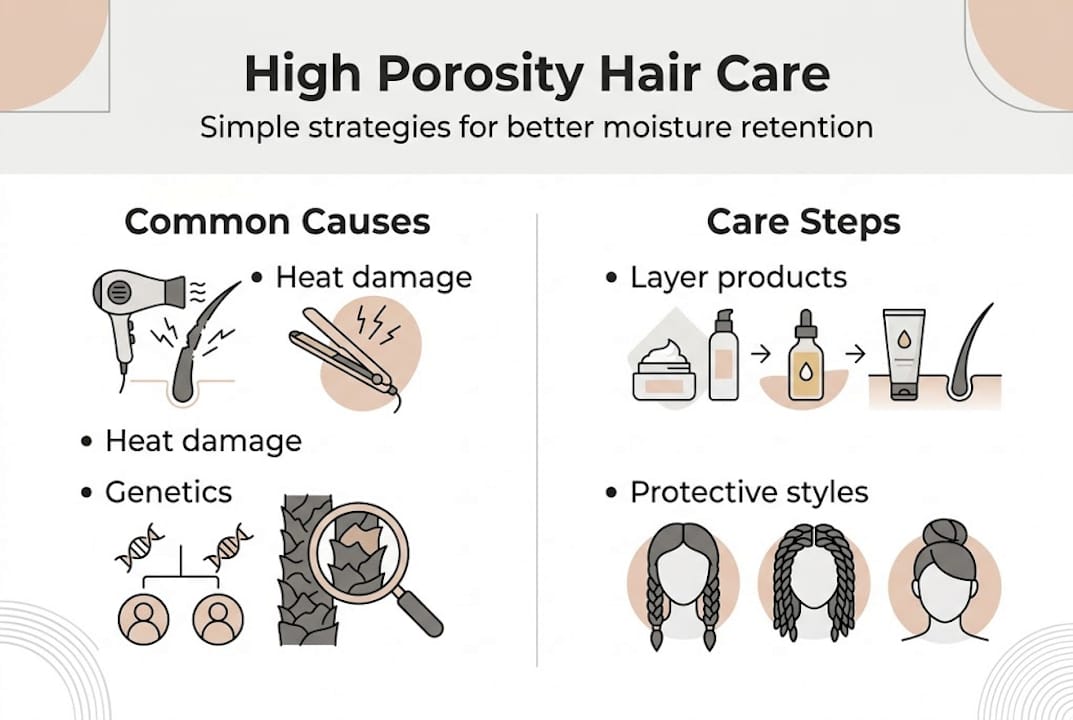
Lipids are crucial for moisture retention in curly hair types, and this is backed by research. Oils and butters work as sealants, slowing down the rate at which water evaporates from the strand. Rich creams and leave-ins provide the moisture base, while heavier products like shea butter or castor oil lock that moisture in place.
Ingredients to prioritize:
- Shea butter, mango butter, and cocoa butter for sealing
- Oils like avocado, castor, and jojoba to coat the cuticle
- Hydrolyzed proteins (keratin, silk, wheat) to temporarily fill cuticle gaps
- Aloe vera and glycerin for water-based moisture
- Panthenol (vitamin B5) to improve flexibility and reduce breakage
Ingredients to avoid or limit:
- High-alcohol ingredients that dry out the cuticle further
- Harsh sulfates in shampoos that strip natural oils
- Silicones that build up and block moisture from entering
Layering products in the right order makes a big difference. Apply your water-based leave-in first, then a cream, and finish with an oil or butter to seal. This method, often called the LOC or LCO method, is especially effective for high porosity curls.
Pro Tip: After applying your leave-in, add a few drops of a lightweight oil like argan or sweet almond before your styling cream. This creates a barrier that slows moisture loss without weighing curls down. Explore best oils for porosity to find the right match for your texture.
Consistency matters more than perfection here. Regular deep conditioning, protein treatments every few weeks, and protective styling all help reduce breakage and improve curl definition over time. Check out best moisturizers for curly hair and moisture for textured curls for more specific product guidance.
A fresh perspective on high porosity hair care
Here’s something the porosity conversation rarely admits: most women with high porosity hair don’t need a more complicated routine. They need a more honest one.
We’ve seen it repeatedly. Someone reads about high porosity, loads up on every recommended product, layers five things on wash day, and still ends up with dry, frizzy hair by day two. The issue isn’t the porosity. It’s that the routine was built for someone else’s hair.
Science gives us a framework, but your hair is the real experiment. What works for a 4C coil won’t necessarily work for a 2B wave, even if both are technically high porosity. Paying attention to how your hair responds after each wash, each product swap, and each styling choice teaches you more than any chart or test.
We also believe in the power of simplicity. Sometimes a single well-formulated product does more than a seven-step routine. Single ingredient haircare is worth exploring if you feel overwhelmed. Less can genuinely be more when your hair finally gets what it actually needs.
Trust the process, and trust your observations.
Shop products designed for high porosity curls
If you’ve made it this far, you now know more about your hair than most people ever will. The next step is putting that knowledge to work with products that actually match your needs.
At Cocomera, we curate products specifically for wavy, curly, coily, and afro hair types, including options built for high porosity needs. From restorative treatments for curly hair that reinforce the cuticle, to rich curl styling products that lock in moisture all day, to strengthening shampoo for curls that cleanse without stripping, everything is chosen with textured hair in mind. Browse by hair type and find your next staple product today.
Frequently asked questions
How can I quickly tell if my hair is high porosity?
Look for fast water absorption, unusually quick drying, and persistent frizz even after moisturizing. The float test is inaccurate and should not be used as a reliable method.
Can high porosity hair return to normal?
With consistent care, you can significantly improve how your hair retains moisture and reduce symptoms like frizz and breakage. However, if the cuticle is permanently damaged, full reversal is unlikely since the structural change is physical.
What ingredients should I use for high porosity curly hair?
Focus on rich butters and oils that seal moisture into the strand, and add protein treatments for strength every few weeks to temporarily fill cuticle gaps and reduce breakage.
Is high porosity hair genetic or caused by damage?
It can be both. Some people are born with naturally higher porosity, while others develop it through chemical treatments and heat that damage the cuticle layer over time.