TL;DR:
- Coily hair has tight coils that struggle with moisture, fragility, and significant shrinkage.
- Understanding your subtype (4A, 4B, or 4C) guides product choices and styling routines.
- Consistent moisture, gentle handling, and protective nighttime practices are key to healthy coily hair.
Coily hair is one of the most misunderstood hair types in the world, and if you’ve ever stared at your strands wondering why your routine isn’t working, you’re not alone. Many women with type 4 hair spend years using products and techniques designed for looser curl patterns, only to end up frustrated by persistent dryness, unexpected shrinkage, and fragile strands that seem to break at the slightest touch. The truth is, coily hair operates by its own rules. Once you understand those rules, everything changes. This guide covers what coily hair actually is, how to identify your specific subtype, the core challenges you’ll face every day, and how to build a routine that genuinely works.
Table of Contents
- What is coily hair? The science and unique features
- The main coily hair subtypes: 4A, 4B, and 4C
- Core challenges: Moisture, breakage, and shrinkage in daily life
- How to build an effective coily hair care routine
- Why most people misunderstand coily hair—and what really works
- Care for your coils: Unique products and support for every curl
- Frequently asked questions
Key Takeaways
| Point | Details |
|---|---|
| Coily hair traits | Coily hair is tight, fragile, and dries out easily due to its unique structure. |
| Subtype differences | 4A, 4B, and 4C coily hair each have distinct patterns and care needs. |
| Daily challenges | Managing dryness, breakage, and shrinkage is key for healthy coily hair. |
| Routine essentials | A layering approach with gentle products and regular care keeps coils at their best. |
What is coily hair? The science and unique features
Coily hair is not simply “very curly” hair. It’s a distinct hair type with its own structure, behavior, and needs. Each strand grows in a tight, spring-like coil or zigzag pattern from the root, which creates a shape that is fundamentally different from wavy or loosely curly hair. That tight structure is beautiful, but it also creates real challenges.
One of the biggest issues is moisture. Your scalp produces a natural oil called sebum, which is meant to travel down the hair shaft to keep strands conditioned. On straight or wavy hair, this happens relatively easily. On coily hair, sebum struggles to travel down the tight bends and twists of each strand. The result? Chronically dry hair, even when you feel like you’re moisturizing constantly. This is not a personal failure. It’s physics.
The tight coil structure also makes each strand inherently more fragile. Every bend in the coil is a potential weak point. When hair is manipulated, combed, or styled without care, those weak points can snap. Breakage risk is significantly higher in coily hair than in other types, which is why protective styling and gentle handling are non-negotiable.
Then there’s shrinkage. This is one of the most surprising features of coily hair for those who are new to understanding it. Coily strands can shrink 60 to 75% of their actual length when dry. Hair that reaches your shoulders when stretched might sit at your ears when fully coiled. This is completely normal and actually a sign of healthy elasticity.
Here’s a quick overview of what sets coily hair apart:
- Curl pattern: Tight S-shaped or Z-shaped coils from root to tip
- Porosity: Often high porosity, meaning it absorbs and loses moisture quickly
- Shrinkage: Between 60 and 75% of actual hair length
- Sebum distribution: Poor, leading to chronic dryness
- Fragility: High, due to structural bends in each strand
- Density: Usually high, creating significant volume
Understanding moisture and coily hair is the foundation of every good routine. For more general guidance on textured strands, the curly hair care tips resource at Cocomera is a solid starting point. You can also use a hair type reference to get a broader picture of where coily hair fits in the overall spectrum.
| Feature | Straight hair | Wavy hair | Coily hair |
|---|---|---|---|
| Sebum distribution | Easy | Moderate | Difficult |
| Shrinkage | Minimal | Low | 60 to 75% |
| Fragility | Low | Moderate | High |
| Moisture retention | High | Moderate | Low |
The main coily hair subtypes: 4A, 4B, and 4C
Coily hair falls under the type 4 category in the widely used hair typing system, but type 4 is not one single texture. It includes three distinct subtypes, and knowing which one describes your hair will completely change how you shop for products and build your routine.
4A hair is the most defined of the three subtypes. The coils form a clear S-shape and are roughly the size of a crochet needle. This subtype tends to retain moisture better than 4B or 4C, and products like curl creams and light gels often work well. The coils are springy and visible, which makes it easier to achieve defined styles.

4B hair takes a sharper turn, literally. Instead of an S-shape, 4B strands form a Z or zigzag pattern. The bends are tighter and more angular, which means the hair appears fluffier and less defined without product. Volume is a key characteristic here. 4B hair also loses moisture faster than 4A and responds well to heavier creams and butters.
4C hair is the tightest of all. The 4C subtype has the least visible curl definition without styling, the highest shrinkage (up to 75%), and is the most prone to dryness and breakage. It can also be the most versatile for protective styles like twists, braids, and locs.
Here’s how the subtypes compare:
| Subtype | Curl pattern | Shrinkage | Moisture retention | Best for |
|---|---|---|---|---|
| 4A | S-shaped, defined coils | Moderate | Better than 4B/4C | Wash-and-go, twist-outs |
| 4B | Z-zigzag, angular | High | Moderate | Braid-outs, twist-outs |
| 4C | Tight, least defined | Up to 75% | Lowest | Protective styles, stretched styles |
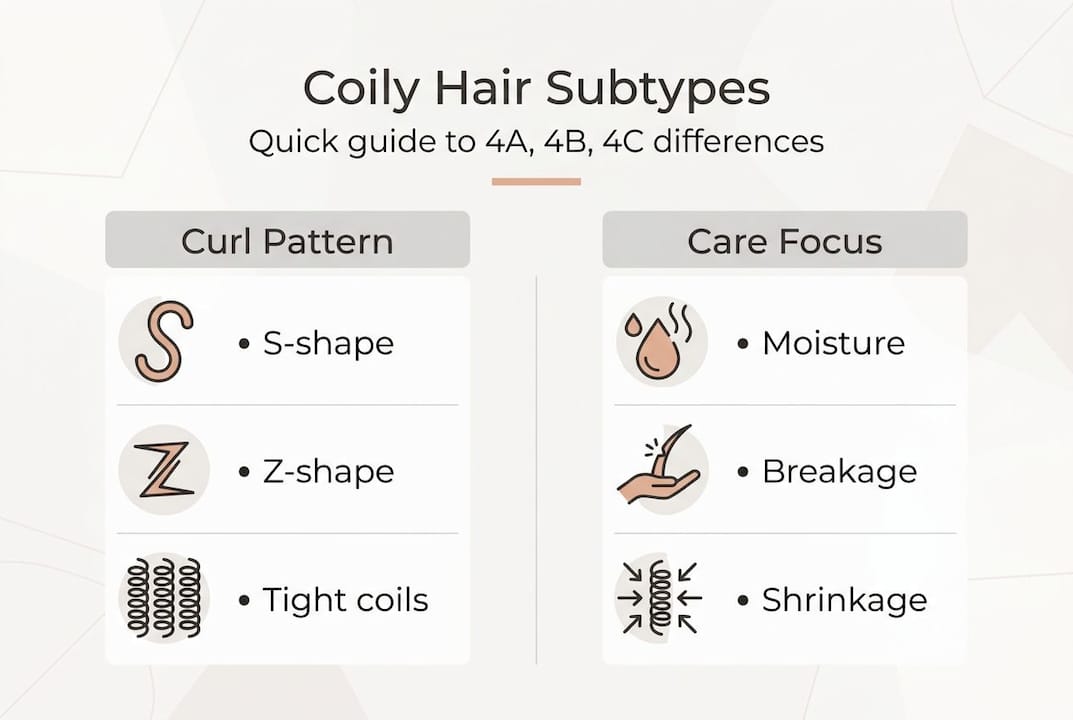
Many women have more than one subtype across different sections of their head. Your crown might be 4C while your edges are 4A. That’s normal.
Pro Tip: To identify your subtype at home, try the stretch test. Take a single strand and gently stretch it out. If it bounces back into a clear S-shape, you’re likely 4A. A zigzag or no visible pattern points to 4B or 4C. Do this on dry hair for the most accurate result.
For more detailed guidance on working with each subtype, explore styling 4A, 4B, and 4C hair to see techniques tailored to each pattern.
Core challenges: Moisture, breakage, and shrinkage in daily life
Knowing your subtype is empowering, but it doesn’t automatically solve the daily realities of managing coily hair. Three challenges come up again and again: dryness, breakage, and shrinkage. Let’s look at each one honestly.
Dryness is the constant companion of coily hair. Because sebum can’t travel down the tight coil structure, your ends are almost always thirsty. You might moisturize on wash day and find your hair feels dry again within 24 hours. Cold European climates and indoor heating in winter make this even worse, pulling moisture from your strands faster than in warmer, more humid environments.
Breakage often sneaks up on you. It doesn’t always look like chunks falling out. More often, it’s the fine, short strands you see on your comb or the single-strand knots (also called fairy knots) that form when coily strands tangle around themselves. Rough towel drying, skipping conditioner, and using fine-tooth combs on dry hair are among the fastest ways to cause breakage.
“Coily hair is fragile due to its twists and prone to breakage, with shrinkage reaching 60 to 75% of actual length.”
Shrinkage is not a problem to fix. It’s a feature of healthy, elastic coily hair. But it does affect styling expectations. If you’re planning a style based on stretched length, you need to account for how much your hair will coil back up. Banding, African threading, and twist-outs are popular techniques for managing shrinkage without heat.
Here are five strategies to manage all three challenges daily:
- Moisturize in layers. Apply water first, then a water-based leave-in, then seal with an oil or butter.
- Detangle gently. Always detangle on wet, conditioned hair using your fingers or a wide-tooth comb.
- Protect at night. Use a satin or silk bonnet or pillowcase to reduce friction and moisture loss.
- Trim regularly. Remove single-strand knots and split ends every 8 to 12 weeks to prevent breakage from traveling up the strand.
- Avoid manipulation. The less you touch and style daily, the less breakage you’ll experience.
For product recommendations, the guide to best hair moisturizers for coily hair is worth bookmarking. You’ll also want to understand best ingredients for textured hair so you can read labels with confidence.
Pro Tip: If your hair feels dry within a day of wash day, your sealing step is likely missing or too light. Try a heavier butter like shea or mango butter as your final layer, especially on your ends.
How to build an effective coily hair care routine
A good coily hair routine isn’t complicated, but it does need to be consistent. The goal is to deliver moisture, protect the strand, and minimize manipulation. Here’s how to build yours from the ground up.
Wash day is the foundation. Use a sulfate-free shampoo or a co-wash (conditioner-only wash) to cleanse without stripping the little natural oil your hair does produce. Follow immediately with a deep conditioner. Leave it on for at least 20 to 30 minutes, ideally under a heat cap or shower cap to help it penetrate.
After rinsing, apply your products while hair is soaking wet. This is where the LOC or LCO method comes in:
- L = Leave-in conditioner (water-based, applied first)
- O = Oil (seals in moisture, like jojoba, castor, or argan oil)
- C = Cream (a styling cream or butter to define and protect)
The order you use (LOC vs. LCO) depends on your hair’s porosity. High porosity hair often benefits from LOC because the oil helps slow moisture loss before the cream goes on. Experiment to find what works for your specific strands.
Weekly care should include a scalp massage to stimulate circulation and a light refresh of moisture between wash days. A water and leave-in conditioner spray is a simple, effective refresh tool.
Protective styles like braids, twists, and buns reduce daily manipulation and give your ends a break. The key is not leaving them in too long (more than 6 to 8 weeks) and moisturizing your scalp and edges while the style is in.
Night care is non-negotiable. Sleeping on cotton pulls moisture from coily hair fast. A satin bonnet or silk pillowcase is one of the highest-return investments you can make for your hair health.
For a detailed breakdown of wash day steps, the wash day workflow guide walks you through each stage. You can also explore the ultimate curly hair routine for a broader routine framework that adapts well to coily hair.
Pro Tip: If you’re new to the LOC method, start with lightweight products and build up. Heavy butters on fine coily hair can cause buildup and weigh curls down. Always start light and adjust.
Why most people misunderstand coily hair—and what really works
Here’s something most hair content won’t tell you: a huge portion of the advice circulating online about coily hair was developed in the United States, for American climates, American water systems, and American product availability. When you’re living in Stockholm, Amsterdam, or Paris, that advice doesn’t always translate.
European tap water is often harder, meaning higher mineral content. That mineral buildup sits on your strands and blocks moisture from getting in, no matter how good your products are. A clarifying wash every few weeks matters more here than most American routines suggest.
The cold, dry air of European winters is also brutal on coily hair in a way that summer-focused American tutorials don’t address. Layering moisture protection before going outside in winter is not optional. It’s essential.
The most important lesson from working with coily hair in a European context is this: observation beats imitation. Watch how your hair responds to products, seasons, and water. Adapt. What works in July may not work in January. Your hair is not broken when it behaves differently. It’s responding to its environment, and your job is to respond back.
For practical tips adapted to real life, the European coily hair care tips resource is a good ongoing reference.
Care for your coils: Unique products and support for every curl
Building a coily hair routine is easier when you have access to products that are actually formulated for your texture. At Cocomera, every product in the range is curated specifically for textured hair, from type 2 waves to type 4C coils.
Whether you’re looking for styling products for curly hair to define your wash-and-go, treatments for curly hair to restore moisture and strength, or the right brushes and combs for coily hair that won’t cause breakage, Cocomera brings it all together in one place. You don’t have to hunt across dozens of websites or guess which products suit your subtype. The curation is done with your specific curl pattern in mind, so you can focus on what matters: your hair thriving.
Frequently asked questions
How do I know if my hair is coily or just curly?
Coily hair has much tighter S- or Z-shaped patterns, higher shrinkage, and feels denser or more fragile than standard curls. If your hair shrinks significantly when dry and has little visible curl definition without product, it’s likely coily.
What’s the difference between 4A, 4B, and 4C coily hair?
4A coils are springy and defined, 4B is zigzagged and voluminous, while 4C is the tightest with the highest shrinkage and the least visible curl definition without styling.
What’s the most important step for keeping coily hair healthy?
Consistent deep hydration is the top priority. Because coily hair is drier by nature, regular deep conditioning and moisture layering are the most impactful habits you can build.
Is it true coily hair can shrink by 75%?
Yes. Subtype 4C in particular can shrink up to 75% of its actual length when dry, which is why stretched styles often look dramatically longer than wash-and-go results.