- Transition hair features natural growth alongside chemically treated ends, requiring targeted moisture and gentle handling. The process spans 6 months to 2 years, with protective styles and patience essential for healthy curls. Proper care around the fragile line of demarcation prevents breakage and ensures successful transitioning.
Managing two completely different hair textures at once is one of the most misunderstood experiences in the natural hair community. If you’ve recently stopped relaxing your hair or walked away from another chemical treatment, you’re dealing with what is transition hair: the period where your natural curl pattern grows in alongside chemically processed ends. This isn’t just a cosmetic challenge. It’s a structural one that demands a new approach to care, styling, and patience. This guide breaks down everything you need to know to come out the other side with healthy, thriving curls.
Table of Contents
-
What transition hair actually is and why it behaves differently
-
Building a care routine that actually works for transition hair
-
What I’ve learned from watching so many transitioners get it right and wrong
Key takeaways
| Point | Details |
|---|---|
| Transition hair has two textures | Your new growth and chemically treated ends behave differently and need targeted care at each zone. |
| The line of demarcation is fragile | The junction between natural and processed hair breaks easily without consistent moisture and gentle handling. |
| Timeline varies widely | Most people transition for 6 months to 2 years depending on hair growth rate and how much length they retain. |
| Protective styles are your best friend | Low-manipulation styles reduce breakage and help you manage texture differences while your natural hair grows. |
| Patience and product choices matter | Weekly deep conditioning and avoiding heat are the two habits that protect your progress most. |
What transition hair actually is and why it behaves differently
Transition hair occurs when natural growth coexists with chemically treated hair on the same strand, usually after stopping relaxers, texturizers, or keratin treatments. It results in a strand with two different structures.
The key concept is the line of demarcation, where natural curl meets chemically altered hair. This point is fragile and needs targeted moisturization with leave-in conditioner and light oils. Without it, breakage occurs most often at this junction.
Here’s what makes transition hair challenging:
-
Curl pattern mismatch. Your new growth may be tightly coiled while your ends remain straight or wavy from the chemical treatment. These two textures shrink and respond to moisture completely differently.
-
Scab hair confusion. Many people panic when their new growth feels coarser or rougher than expected. Scab hair is a temporary coarse hair type that emerges immediately after stopping chemical treatments and does not reflect your final natural texture. Give it time.
-
Heat sensitivity. Your natural new growth has never been exposed to the chemicals that weakened your processed ends. That means the two sections respond very differently to heat and tension.
-
Multi-texture care needs. Each zone of your hair needs something slightly different, which is why a one-size approach to products and styling typically fails during this period.
Pro Tip: Apply leave-in conditioner and oil directly to the line of demarcation first during your wash day routine before working the product through the rest of your hair. That targeted application prevents the most common type of breakage transitioners experience.
What you’re managing is essentially a multi-textured hair situation on every single strand. Understanding that from the start reframes how you approach products, styling decisions, and what you expect from your reflection in the mirror.
The stages of transitioning hair and how long it takes
Transitioning is not a single event. It unfolds in distinct phases, and knowing which phase you’re in changes what you should prioritize.
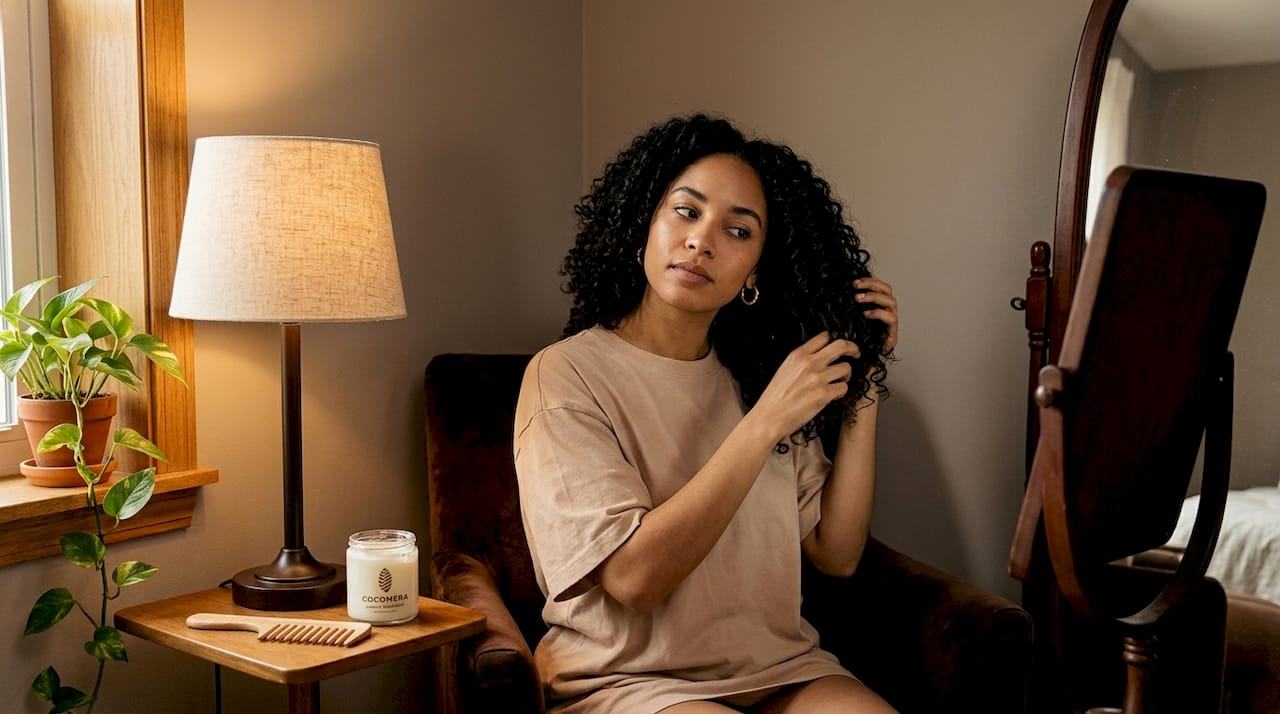
Stage 1: Early transition (months 1 to 4). This is the hardest stage emotionally and physically. You have minimal natural growth, a very visible line of demarcation, and two textures that seem impossible to blend. Your biggest job right now is not to style your way out of this stage. It’s to protect the line of demarcation and let growth happen.
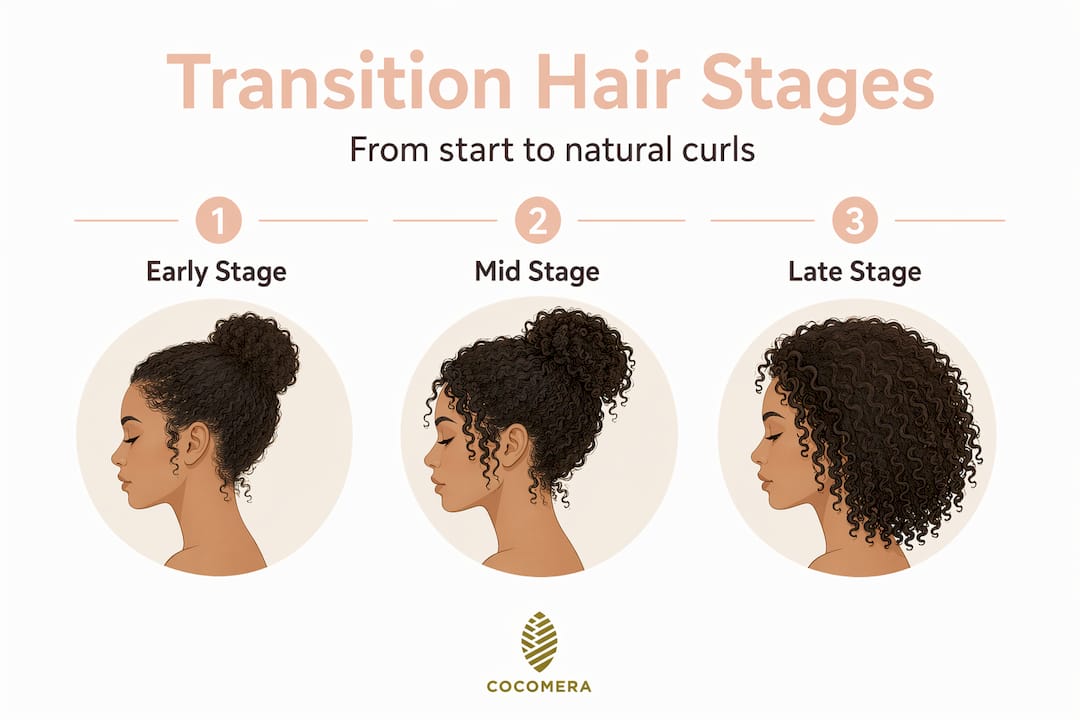
Stage 2: Mid-transition (months 4 to 12). You now have enough natural growth to work with. Protective styles become your primary tool. You can begin gradually trimming relaxed ends during this phase if your goal is a slow, length-retaining transition. Many transitioners lean heavily on styles like box braids or twists during this period to manage the texture difference and reduce daily manipulation.
Stage 3: Late transition (month 12 onward). At this point, the majority of your visible hair may already be natural. You’re approaching the finish line, though the exact endpoint depends on your hair growth rate. The typical transition timeline ranges between 6 months and 2 years depending on hair growth rate and desired length.
It’s worth knowing that professional stylists often recommend at least 8 to 10 weeks of natural regrowth before certain transition techniques can be applied effectively. Rushing before that threshold can make the process harder, not easier.
Your individual timeline also depends on:
-
How fast your hair naturally grows (average is about half an inch per month)
-
How much length you want to retain before cutting the relaxed ends
-
Whether you choose a big chop at some point or a gradual trim approach
-
How well you retain length through protective styling and gentle handling
There is no race here. Someone with slower growth or longer relaxed ends may need closer to two years. That’s completely normal.
Building a care routine that actually works for transition hair
This is where transitioning hair care becomes specific and non-negotiable. Your routine needs to address two textures, one fragile junction, and a hair strand that is working harder than it ever has to hold itself together.
Deep conditioning weekly strengthens the fragile line of demarcation, while protein treatments should be limited to once every 2 to 4 weeks to avoid brittleness. Too much protein makes hair feel stiff and prone to snapping. Think of it this way: moisture is your daily foundation, protein is your monthly reinforcement.
Here’s a practical breakdown of your transitioning hair care priorities:
| Step | What to do | Why it matters |
|---|---|---|
| Pre-poo | Apply coconut or avocado oil before washing | Pre-poo softens hair and reduces tangles before shampooing |
| Cleanse | Use a sulfate-free or gentle strengthening shampoo | Removes buildup without stripping the moisture your transition hair desperately needs |
| Deep condition | Apply a rich mask from roots to ends, focusing on the demarcation zone | Weekly treatment rebuilds strength and maintains elasticity across both textures |
| Leave-in | Apply to damp hair, especially at the line of demarcation | Seals moisture and acts as a buffer against friction and tension |
| Seal | Follow with a lightweight oil or butter | Locks in the leave-in and protects against environmental moisture loss |
Pro Tip: Try finger detangling on wash day instead of reaching for a comb. Start from the ends and work upward, separating tangles with your fingers before using any tool. Your line of demarcation will thank you.
For deep conditioning, the Trepadora Quinoa Repair Deep Conditioner works particularly well for transitioners because it rebuilds protein bonds while delivering intense moisture, addressing both sides of the tension that transition hair faces. You can explore more hair treatments for curly hair to find options that match your specific needs.
When it comes to leave-ins, look for products rich in humectants like glycerin or aloe vera alongside emollient oils. Your leave-in conditioner is not optional during this process. It’s the single product category most likely to determine how much breakage you experience.
Styling your way through the two-texture challenge
Styling transition hair is about working with what you have, not fighting against it. The goal is low manipulation, high moisture, and as little heat as possible.
Heat damage can permanently alter your curl pattern and hinder the transition. That means flat irons and blow dryers should be reserved for rare occasions if used at all. Your natural growth is new, delicate, and forming its curl memory right now. Heat disrupts that process.
These styling approaches work well for most stages of transition:
-
Bantu knots and twist-outs. These styles stretch both textures in a similar direction and create a blended look without heat. They also reduce friction at the line of demarcation.
-
Flexi rods. Ideal for adding curl definition to both textures simultaneously. The result is a cohesive style that makes the two-texture situation less obvious.
-
Protective styles with extensions. Protective styles like box braids, sew-ins, and crochet styles can protect fragile hair and conceal texture differences during transition. Using braiding hair extensions also gives your natural growth time to flourish without daily manipulation.
-
Satin or silk nighttime protection. Wrapping your hair or sleeping on a satin pillowcase at night dramatically reduces friction-related breakage. Reapply a small amount of leave-in to your ends before wrapping to lock in moisture overnight.
Pro Tip: Avoid brushing through your hair when it’s dry. If you want to define or smooth a style, always dampen the hair first with a water spray and a small amount of curl cream before touching it with any tool.
Styling transition hairstyles for beginners does not need to feel complicated. Simpler is genuinely better. The fewer times you manipulate your hair each week, the more length you retain and the healthier your line of demarcation stays.
Common mistakes that set transitioners back
Most people who struggle during transition are making a handful of very predictable mistakes. Knowing them in advance puts you ahead.
-
Trying to force the two textures to behave the same way. They won’t. Accepting that both zones need different attention is what separates successful transitioners from frustrated ones.
-
Skipping protein balance. Both too much and too little protein causes breakage. Test your hair’s elasticity regularly: if it stretches without snapping, your moisture-protein balance is good.
-
Seeking outside validation too early. Your hair will look unfamiliar during early stages. Relying on others’ opinions during this phase often leads to unnecessary decisions, like heat styling or reverting to chemicals.
-
Ignoring the emotional side. Transition hair is as much a mindset process as a physical one. Social support and personal confidence are key to successfully managing the transition, especially during the uncomfortable early phases.
“The best thing you can do for your transition hair is decide, early on, that temporary awkwardness is not a reason to quit. Every stage is temporary. The results are permanent.”
On the big chop question: there is no right answer. If you want to retain as much length as possible, a gradual trim approach takes longer but gets you there. If the two-texture management feels overwhelming, cutting the relaxed ends earlier can be genuinely liberating. Both paths lead to the same destination.
What I’ve learned from watching so many transitioners get it right and wrong
I’ve seen transitioners succeed and I’ve seen them give up three months in, not because the process was too hard, but because they went in expecting fast results and got frustrated when those results didn’t show up on schedule.
My honest take: the line of demarcation does not get the respect it deserves. Most people treat it like just another part of the hair shaft. It’s not. It’s a structural fault line, and how you handle it every single week is the difference between retaining length and starting over constantly. The people who do best during this process are obsessively gentle around that point.
I also think the conversation about scab hair gets skipped too often. When someone’s new growth comes in coarser than they expected, they sometimes assume that IS their natural texture and they panic. That temporary coarseness fades. Your actual curl pattern reveals itself gradually, and it’s almost always softer and more defined than that initial growth suggests.
The contrarian truth about transition hairstyles for beginners is that the fanciest styles are often the worst choice early on. A simple, moisturized protective style that you barely touch for two weeks does more for your transition progress than a beautifully sculpted twist-out that required 45 minutes of manipulation. Simple wins.
Be patient with yourself. This process is unique to your hair, your history, and your timeline. What worked for someone else in six months may take you twelve. That’s not failure. That’s just your hair doing things on its own schedule.
— Cocomera
Find the right products for your transition at Cocomera
Your transition hair needs products that actually understand the challenge of two textures living on the same strand.

At Cocomera, we’ve curated a selection of hair care specifically for textured hair types, including transitioners managing fragile, multi-textured strands. From styling products for curly hair that blend both textures without heat, to detangling conditioners that protect the line of demarcation on wash day, every product in our store is chosen with your curl type in mind. If you’re in the early or mid-transition stage, start with a solid deep conditioner and a leave-in that works for both textures. We’ll help you find your routine without the guesswork.
FAQ
What is transition hair exactly?
Transition hair describes the period when natural, unprocessed hair grows alongside chemically treated hair on the same strand. This creates two distinct textures that require separate care approaches.
How long does the transition to natural hair take?
The transition timeline typically ranges from 6 months to 2 years, depending on your hair’s growth rate and how much length you choose to retain before removing chemically treated ends.
What is the line of demarcation in transition hair?
The line of demarcation is the fragile junction on each strand where your natural curl pattern meets the chemically processed section. It’s the most breakage-prone point on transition hair and needs targeted moisture and gentle handling.
What are the best transition hair tips for beginners?
Focus on weekly deep conditioning, finger detangling, avoiding heat, and wearing low-manipulation protective styles. These habits protect the line of demarcation and help you retain length throughout the process.
What is scab hair and will my texture change?
Scab hair is a temporary coarser texture that appears immediately after stopping chemical treatments. It does not represent your true natural curl pattern. As new growth continues, your actual texture becomes clearer and typically softer.